
How to Layer Products for Acne-Prone Skin Correctly
Learn how to layer products for acne-prone skin with the right order, timing, and active ingredient use to avoid irritation and maximize results.
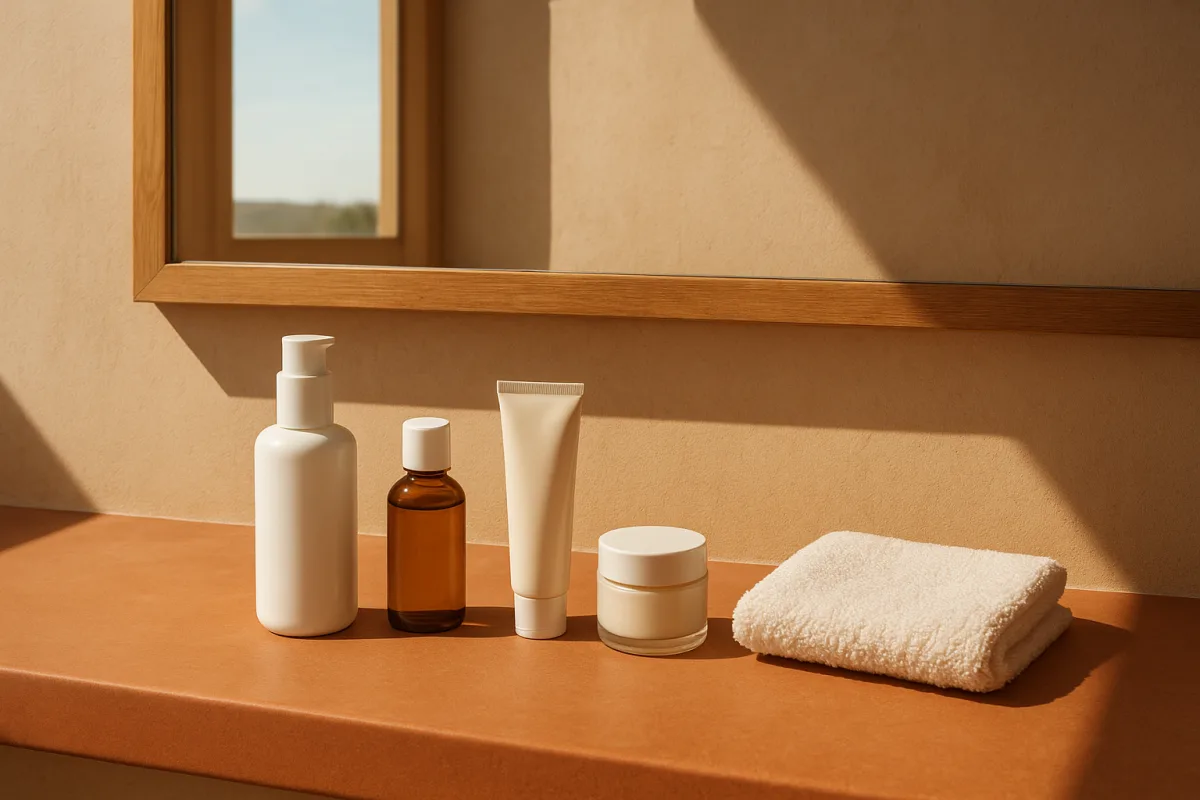
First problem: deciding what actually belongs in the routine
Acne-prone skin does not need a crowded shelf. It needs a routine in which every product has a job, and in which the treatment step does not get buried under several competing acids, scrubs and serums.
The workable basic order is cleanser, optional toner, treatment, moisturiser and sunscreen in the morning. At night, cleanse, optionally tone, use a treatment, then moisturise. If you double cleanse, the oil-based cleanser comes first in the evening. [3][21]
The general rule is thinnest to thickest. Watery toners and treatment serums go on before lotion-like moisturisers, while sunscreen is the final daytime layer. Applying a heavy cream before a thin treatment can make the routine less even and needlessly complicated. [2]
That does not mean every thin product deserves a place. A toner is optional, not a required “prep” step. If your cleanser, active, moisturiser and sunscreen are already working without persistent irritation, adding a toner mainly adds another formula to assess.
This is where ingredient-list reading beats marketing language. Look for the active ingredient and its percentage, then decide whether it fills a gap. A serum labelled “clarifying” may contain a useful acid, or it may mostly contain humectants and fragrance.
The available sources are primarily dermatologist-informed routine guidance, beauty reporting and brand educational material, rather than direct head-to-head trials of elaborate product stacks. The PMC article, Dermatologists’ Perspectives on Skincare Routine Trends, is useful context, but it does not make a seven-step routine medically necessary. [1]
The morning problem: fitting treatment under sunscreen
Morning is usually the easier routine. Start with a cleanser, using roughly a nickel-sized amount, then rinse thoroughly. Follow with an optional thin toner, if you use one, without inserting a long drying period between cleansing and toning. [3][4]
If salicylic acid is your chosen treatment, apply it before moisturiser. Salicylic acid is an exfoliating acid, and the commonly recommended leave-on range is 0.5% to 2%. A product at the top of that range is not necessarily the sensible starting point. [3][8]
Use only a small amount of a leave-on active, about pea-sized for the face. More product does not create a faster result, but it can make irritation harder to identify. The same goes for moisturiser, where a nickel-sized amount is the cited rough guide. [7]
After the treatment layer, wait about one minute before moisturiser. This is not a magic absorption threshold. Paula’s Choice and Allure both frame wait times as practical advice, with Allure noting that ideal timing varies by formulation and skin type. [4][5]
Finish with sunscreen, using about a nickel-sized amount for the face. Let it set for a few minutes before makeup, and reapply every two hours during ongoing exposure, as TIME advises. Sunscreen belongs last because it needs to form the outer protective film. [5][16]
A useful morning routine might therefore be: cleanse, 0.5% to 2% salicylic acid treatment, moisturiser, sunscreen. That is enough layering to follow the order without turning the routine into an irritation experiment. [3][21]
The active-conflict problem: do not stack everything at once
The mistake most likely to derail an acne-prone routine is treating every blemish as a reason to add another active. Benzoyl peroxide, salicylic acid and retinoids are not interchangeable, and they are not automatically compatible in one application session. [7][10]
Benzoyl peroxide is an antibacterial acne active, commonly sold from 2.5% to 5% in the guidance reviewed here. Start at the lower end, particularly if you are new to it, because irritation can make it difficult to tell whether the routine is tolerable. [3][6]
Retinoid guidance in the brief centres on adapalene at 0.025% to 0.1%. Do not layer benzoyl peroxide and a retinoid in the same routine. The Derma Co guidance specifically warns that benzoyl peroxide degrades retinoids, reducing their effectiveness. [3][6]
A more practical split is benzoyl peroxide in the morning and a retinoid at night, or to reserve one active for selected days. Dermatology Sense notes that salicylic acid can be paired with retinoids or benzoyl peroxide, but separating them by time of day is preferable for minimising irritation. [7]
This is not an argument for cramming in a morning acid, benzoyl peroxide and an evening retinoid immediately. It is a framework for choosing one primary treatment first, then deciding whether the skin comfortably tolerates another separate treatment session.
The routine should be boring enough that you can tell what caused a problem. If redness or stinging appears after introducing three products in one week, the ingredient list will not solve the mystery. You have created a confounded experiment.
The night problem: cleansing without over-cleansing
At night, begin with cleansing. If you double cleanse, use an oil-based cleanser first, followed by a water-based cleanser. The cited acne routine guidance places double cleansing in the PM sequence, before toner and treatment products. [3]
Do not confuse double cleansing with scrubbing. The point is product removal and a clean surface for subsequent layers, not leaving the face tight or squeaky. The research brief does not establish an ideal climate-specific or seasonal version of this routine for acne-prone skin.
After cleansing, use an optional toner, then apply the selected active. For a retinoid routine, that means cleanser, optional toner, a pea-sized retinoid treatment, approximately one minute of pause, then moisturiser. [3][4]
If you are using benzoyl peroxide at night instead, do not add a retinoid on top. Use the benzoyl peroxide layer, allow about a minute before the next product, then moisturise. The aim is consistent use of a tolerable routine, not maximum intensity. [4][6]
Moisturiser is not a consolation prize for people with dry skin. In an active-heavy routine, it is the step that prevents the treatment layer from being followed by nothing. Choose texture according to preference and tolerability, but keep the application order consistent.
The impatience problem: waiting for products without waiting forever
There is no evidence-based requirement to stand in front of the mirror for ten minutes between every layer. There is no required pause between cleanser and toner, while about one minute after an active or serum is the practical recommendation cited by Paula’s Choice. [4]
That minute is useful because it gives a thin treatment a chance to spread and settle before a cream goes over it. It is not a guarantee of better performance, and it does not rescue an incompatible combination of active ingredients. [4][5]
Sunscreen is the exception with a slightly longer practical pause. Apply it last, then allow a few minutes before makeup so the film has time to set. If makeup pills, the answer may be fewer layers or less product, not more waiting. [5]
Expect modest, gradual cosmetic changes rather than overnight transformation. The sources supplied here provide concentration and ordering guidance, but they do not support a precise universal timetable for visible results from a particular routine.
That limitation matters. Product labels and online routines can make acne care sound mechanical, as if correct layering delivers a fixed outcome. It does not. Layering can improve product placement and reduce avoidable irritation, but it cannot determine the cause of persistent breakouts.
The over-exfoliation problem: when a routine starts making skin angrier
Exfoliation is the step most likely to be mistaken for productivity. Salicylic acid already counts as an exfoliating active, so adding frequent scrubs, peeling pads and acid masks on top can create an unnecessarily aggressive routine. [8][10]
The cited layering-mistake guidance flags exfoliating more than once or twice weekly as a common way to overdo it. That warning is especially relevant when the rest of the routine already includes salicylic acid, benzoyl peroxide or a retinoid. [10][11][14]
Watch the total routine, not just the label on one product. A “gentle” cleanser, exfoliating toner, acid serum, spot gel and retinoid may each sound reasonable individually. Together, they can be far more active exposure than intended.
Incorrect order can also make the routine feel worse. Applying a thick oil or cream before a watery treatment disrupts the basic thin-to-thick sequence. Applying multiple potent products back to back can be equally unhelpful, even if the order is technically correct. [2][10]
If you want to introduce an exfoliant, do not introduce it on the same week as a benzoyl peroxide or retinoid product. Keep the rest of the routine stable, use the exfoliant no more often than the cited one-to-two-times-weekly caution, and reassess tolerability. [10][11]
The “Korean versus Western” problem: routine philosophy is not proof
Korean skincare guidance often emphasises gentle, hydrating, multi-step routines aimed at supporting the skin barrier and reducing the look of inflammation. Western routines are more often framed around a smaller number of potent actives. [17][20]
That distinction can be useful when choosing a routine style. Someone who is already irritated may prefer a stripped-back routine with moisturising layers, while someone with a stable routine may prefer one clearly identified active rather than several soothing serums.
But the brief does not identify rigorous comparative evidence showing that one regional routine philosophy produces superior outcomes for acne-prone skin. Hydration-focused layering and active-focused layering are approaches, not rival medical protocols. [17][18][20]
The sensible takeaway is not to copy a ten-step routine or reject one on principle. Read the ingredient list, identify the active concentration, place it correctly in the order, and avoid duplicating the same kind of irritation across several products.
When layering should stop and a dermatologist should start
A skincare routine is not a diagnosis. If breakouts are painful, widespread, leaving marks, accompanied by significant swelling, or persist despite a simple and tolerable routine, book an appointment with a dermatologist rather than escalating to stronger over-the-counter layers.
Take the product list with you, including active ingredients and concentrations. That is more useful than saying a product was “for acne.” A dermatologist can assess what is happening, while a routine can only organise the products you already chose.
Frequently Asked Questions
What is the correct order to layer skincare products for acne-prone skin?
The recommended order is to start with cleansing, followed by an optional toner, then one treatment step with actives, moisturiser, and finally sunscreen in the morning. Products should be applied from thinnest to thickest consistency to ensure even layering. At night, the order is cleanse, optional toner, treatment, then moisturise.
Can I use benzoyl peroxide and retinoids together in my acne routine?
No, benzoyl peroxide and retinoids should not be used in the same routine because benzoyl peroxide can degrade retinoids and reduce their effectiveness. It is better to use them in separate routines, such as benzoyl peroxide in the morning and retinoids at night.
How long should I wait between applying acne treatments and moisturizer?
It is advisable to wait about one minute after applying an active treatment before applying moisturizer. This wait time is a practical guideline to allow the product to absorb but is not a strict rule, as ideal timing can vary by formulation and skin type.
What active ingredient strengths are safe to start with for acne-prone skin?
Safe starting strengths for acne-prone skin include 0.5% to 2% salicylic acid, 2.5% to 5% benzoyl peroxide, and 0.025% to 0.1% adapalene (a retinoid). Starting with lower strengths helps minimize irritation while still providing effective treatment.
How do I layer sunscreen with acne treatment products in the morning?
After applying your acne treatment and moisturizer, finish with sunscreen as the last step in your morning routine. Use about a nickel-sized amount of sunscreen and let it set for a few minutes before applying makeup. Reapply sunscreen every two hours during prolonged sun exposure.
How we researched this
This article was assembled from 21 cited references.
Nothing here is based on hands-on testing. Where a figure or finding appears, it belongs to the source cited beside it, and the writing says so rather than implying otherwise. Every source is listed below so you can check it.
Sources
- Dermatologists’ Perspectives on Skincare Routine Trends - PMC
- I've Had Countless Experts Confirm It: This Is the Correct Order to Apply Your Skincare Products
- Best Skincare Routine for Acne — Morning & Night Steps | AcnePath
- How Long To Wait Between Applying Skin Care Products | Paula's Choice
- How Long to Wait Between Applying Skin-Care Products | Allure
- How Benzoyl Peroxide Clears Bacterial Acne | The Derma Co
- Can You Combine Acne Treatments?
- Best Exfoliants for Acne-Prone Skin | Dermatology
- Best Skincare Routine for Acne-Prone Skin (AM + PM) — Skin Stacker
- How to Layer Skincare Products Without Irritating Your Skin – elementrē dermo cosmetics
- Skincare Layering Mistakes Guide How to Apply Products Correctly for Healthy Skin – Quetee Cosmetics
- How to Layer Products Correctly for Acne Prone Oily Skin - acneadvocate.com
- Is Layering Skincare Products Actually Helping Or Causing More Breakouts | ToolGuideDaily
- 10 Common Skincare Mistakes That Cause Breakouts | Pimpl Blog
- Best Skincare Routine for Acne — Morning & Night Steps | AcnePath
- What's the Best Skin-Care Routine?
- Korean Skincare for Acne: What Actually Works in 2026 | Glowarua
- K-Beauty vs Western Skincare — SYNC Skin Encyclopedia
- Korean Teen Gen Z Acne Routine 2026 Skincare Guide | AskGangnam
- Korean vs Western Skincare: What's Actually Different?
- The Skincare Order That Dermatologists Actually Recommend-Here's Exactly Where Every Product Goes
Related Articles
How to Layer Serums: Correct Order and Application Tips
Learn how to layer serums properly with tips on order, wait times, and amounts for effective skincare routines.
How to Layer Skincare Products for Best Results
Learn how to layer skincare products effectively for maximum absorption and efficacy with this comprehensive guide.

How to Apply Face Oil: Best Practices and Tips
Learn how to apply face oil correctly, including layering order, amount, and timing for glowing, hydrated skin in your skincare routine.

Affordable Skincare Gems: Dr Dray's Reviews & Recommendations
Dr Dray reviews affordable gems like Olay's Complete Rich Moisturizing Cream and Tree Hut's Pre-Shave Foaming Polish, alongside pricier options like Josie Moran's body butters. She also shares insights on cleansing oils and a mineral sunscreen lip balm for a comprehensive skincare roundup.