
How to Layer Serums: Correct Order and Application Tips
Learn how to layer serums properly with tips on order, wait times, and amounts for effective skincare routines.
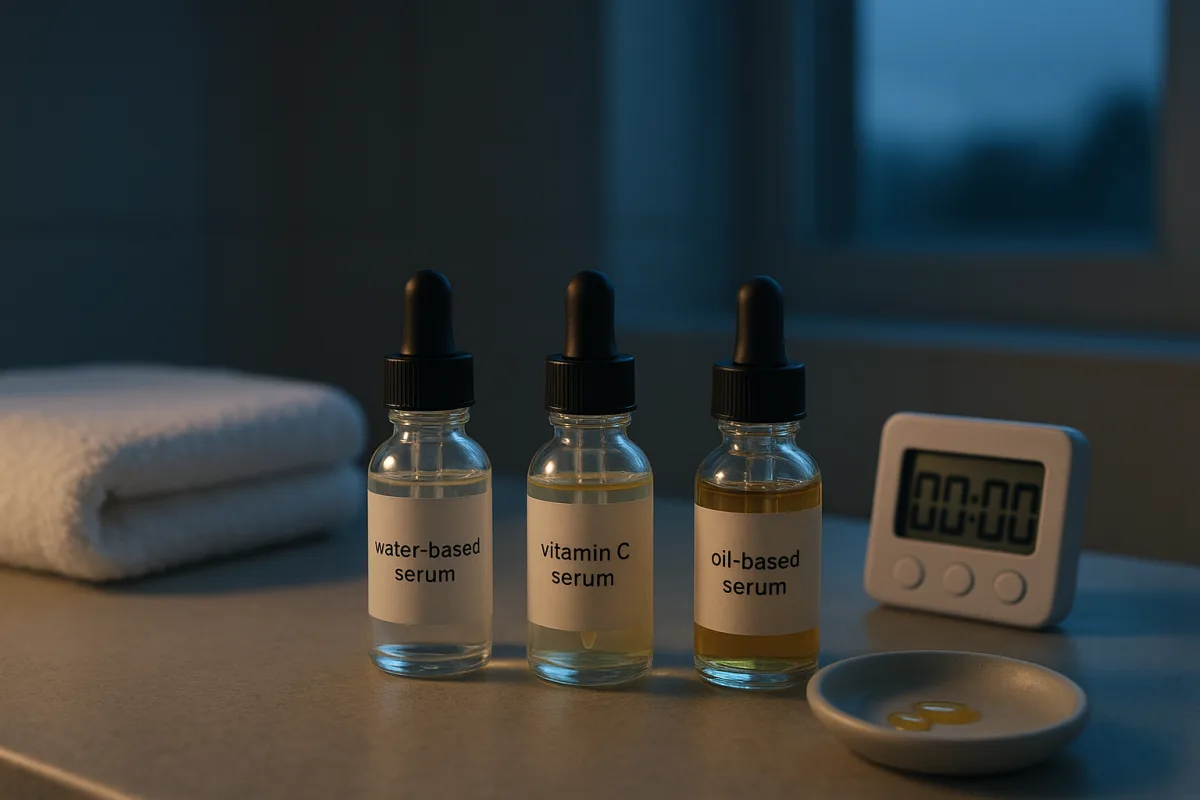
First problem: you have several serums and no obvious order
The useful rule is texture, not the order products appeared in a social-media routine. Apply clean, water-light formulas before heavier emulsions, then oils last. Skin Inc. notes that oils can create an occlusive layer that makes it harder for lighter, water-based products to reach the skin when applied afterward. [4]
Start on clean skin. A serum placed over sunscreen, makeup, surface oil or yesterday’s product residue is not getting a fair chance to spread evenly, and Dermathub specifically lists unclean skin as a layering mistake. [10]
A practical morning order might look like this: cleanse, L-ascorbic acid vitamin C serum, hydrating serum, niacinamide serum if you are using one, moisturiser, then sunscreen. That order follows the supplied guidance on vitamin C’s acidity, hyaluronic acid’s preference for damp skin, and oil-last layering. [1][2][4]
At night, the sequence changes depending on the active you chose. Cleanse, use either an exfoliating acid or a retinoid if it suits your routine, add a simple hydrating serum if desired, then moisturiser. An oil serum, if you use one, belongs after water-based layers and usually after moisturiser. [4][18]
There is no supplied clinical evidence identifying a molecular-weight cutoff that dictates serum order, nor conclusive data showing exact absorption rates for each layer. “Thinnest to thickest” is a sensible application convention, not a precision delivery system that turns every serum into a high-performance treatment.
The second problem: where vitamin C actually goes
If your vitamin C is pure L-ascorbic acid, put it first after cleansing. It is typically formulated at an acidic pH, with the guidance here placing optimal absorption at pH 3.5 or below. [2] This is why it gets priority over a more neutral hydrating or niacinamide serum.
Do not confuse “vitamin C” on a front label with a single ingredient category. This ordering advice is specifically about L-ascorbic acid, not necessarily every vitamin C derivative. Read the INCI list and product directions, because the brief does not provide evidence that all derivatives need the same pH or wait time.
The sources advise waiting anywhere from one to two minutes to three to five minutes after vitamin C. [3][8] Given that discrepancy, three minutes is a reasonable practical compromise for an acidic L-ascorbic acid serum, especially if you are following it with multiple layers.
That pause is not proven to make a dramatic cosmetic difference. It is simply intended to let a pH-dependent formula settle before another product is spread over it. If your routine becomes so elaborate that you stop doing it, shorter and consistent is more useful than a perfect five-minute ritual abandoned after four days.
The third problem: you are applying hydrating serums to dry skin
After vitamin C, apply a hyaluronic acid serum while skin is slightly damp, not dripping wet. Hyaluronic acid is a humectant, meaning it binds water, and Who What Wear’s layering guidance places it after vitamin C for hydration. [1]
“Slightly damp” means you have patted off most cleanser water, or lightly misted your face, not left rivulets running down your cheeks. Too much water can make a serum slide, dilute the layer and encourage you to use more than you need.
Follow with niacinamide if you are using it. The supplied guidance describes niacinamide as generally compatible with most actives and places it after hyaluronic acid. [3] That compatibility does not make it compulsory, and it does not mean every skin type enjoys every concentration.
This is where ingredient lists matter more than category labels. A “niacinamide serum” may also contain exfoliating acids, fragrance, oils or a high alcohol content. Layer according to the full formula’s texture and active ingredients, not the one ingredient printed in oversized type on the bottle.
The brief provides no evidence-based universal concentration for hyaluronic acid or niacinamide, so do not assume that a bigger percentage is automatically a better serum. Concentration is only one part of a formula, alongside vehicle, pH, stability and how much your skin tolerates.
The fourth problem: how much serum is enough
For most dropper serums, use two to three drops for the face. Pump formulas generally need one to two pumps. [5][6] Spread the product between fingertips or place small drops around the face, then press or glide it over the skin without aggressive rubbing.
A dime-sized amount is also cited as sufficient for face, neck and chest, but that is a broad estimate rather than a mandate. [6] A watery serum may need fewer drops than a thick gel, and a pump may dispense far more product than a dropper.
The common mistake is treating serum like moisturiser. An overloaded face feels tacky, pills when you add sunscreen or makeup, and can leave you unable to tell which product is causing discomfort. Excess does not translate neatly into extra benefit. [5][6]
If your serum leaves a persistently slick film after a minute, use less next time. If three layers make your face feel coated before moisturiser, the problem is usually not that you need a better waiting technique. You probably need fewer layers.
The fifth problem: deciding when to wait, and when to move on
For uncomplicated hydrating or niacinamide serums, wait 30 to 60 seconds before the next layer. Nordic Formula gives that range to reduce pilling and allow the product to settle. [7] You do not need to wait until the skin feels completely dry or tight.
Hydrating serums and toners may benefit from one to two minutes according to Skincare Bible. [8] In real terms, apply the serum, brush your teeth or put away the bottle, then continue. Waiting should support a usable routine, not become an endurance event.
Acid exfoliants require more restraint than a hydration serum. The supplied guidance suggests five to 10 minutes after an AHA or BHA, allowing the formula time at its acidic pH before you cover it with another layer. [8]
Retinoids have the longest suggested pause, 10 to 20 minutes. [8] But the more important point is that retinoids can be irritating, particularly when they are introduced alongside several other potent products. A bare-bones evening routine is easier to tolerate and easier to troubleshoot. [18]
The supplied sources disagree somewhat, with some recommending only 30 to 60 seconds even for actives. [9] Longer waits are therefore a cautious convention for pH-sensitive or potent formulas, not a clinically quantified requirement. Do not mistake a timer for a substitute for choosing compatible products.
The sixth problem: your serums technically layer, but your skin does not like the combination
Avoid combining pure L-ascorbic acid vitamin C and retinol in the same routine. The cited guidance points to different pH requirements and reduced effectiveness, recommending vitamin C in the morning and retinol at night instead. [10][17]
Also keep retinoids separate from AHAs and BHAs. Today reports that this combination can increase dryness and irritation, and recommends separating them by at least an hour. [11] For most people, alternating nights is the simpler approach because it removes both timing complexity and cumulative irritation.
Do not pair retinol with benzoyl peroxide in the same routine. The supplied guidance says benzoyl peroxide can deactivate retinol and increase irritation risk. [11] If you are using a clinician-directed regimen, follow that clinician’s instructions rather than a generic layering guide.
Vitamin C plus AHAs or BHAs is another combination to approach cautiously. Both are acidic, and the concern in the supplied guidance is irritation rather than a guaranteed chemical disaster. [9] Put them in separate routines or on alternate days if your aim is a calmer, more legible routine.
Niacinamide and pure L-ascorbic acid are presented inconsistently in the supplied material. One source says their pH differences may reduce efficacy, while another describes niacinamide as broadly compatible. [3][12] The conservative answer is to separate them if your L-ascorbic acid formula is acidic or your skin is reactive.
The seventh problem: pilling, stickiness and seasonal changes
Pilling usually starts with too much product, too little pause, or a heavy layer applied too early. Use smaller amounts, allow each layer to settle for 30 to 60 seconds, and keep oils and rich creams until the end. [4][7][18]
In hot, humid weather, lighter serum textures may be more comfortable. The brief notes that humidity can increase sebum and interfere with water-soluble serum absorption, while summer heat can increase dehydration and sensitivity. [14][20] That does not mean you need more serums, only a less crowded routine.
Cold, dry conditions can make skin feel tight and can thicken some formulas. [15][20] Apply hydrating serum to slightly damp skin and follow it with moisturiser, rather than repeatedly adding humectant layers and hoping they will replace an occlusive final step.
Store sensitive formulas sensibly. High temperatures can degrade vitamin C, while low temperatures can thicken or crystallise some serums. [14][15] A cool, stable cupboard away from a sunny windowsill is more useful than treating every serum as refrigerator-only skincare.
Finally, give any simplified routine time. Cosmetic changes in surface hydration or smoothness can be relatively quick, but results from active ingredients are usually slower and modest, and the supplied brief does not provide reliable study-based timelines for individual serum combinations. If you have persistent acne, pigment changes, painful lesions or an unexplained rash, that is dermatologist territory, not a layering puzzle.
Frequently Asked Questions
What is the correct order to layer serums in skincare?
Apply serums from thinnest to thickest consistency, starting with water-based formulas and ending with oil-based serums. For example, in the morning, cleanse first, then apply L-ascorbic acid vitamin C serum, followed by hydrating and niacinamide serums if used, then moisturizer and sunscreen. Oil-based serums should be applied last as they can block absorption if layered earlier.
How long should I wait between applying different serums?
For ordinary serums, wait about 30 to 60 seconds between layers to allow absorption and prevent pilling. However, for pH-dependent actives like L-ascorbic acid vitamin C, a longer wait of around three to five minutes is recommended to ensure optimal absorption.
Can I layer vitamin C serum with other serums?
Yes, but pure L-ascorbic acid vitamin C serum should be applied first on clean skin due to its acidic pH requirement. It is best followed by hydrating serums like hyaluronic acid and then niacinamide. Avoid layering vitamin C with retinoids or exfoliating acids in the same routine.
How many serums should I use in one skincare routine?
It is advisable to use no more than two or three serums in a single routine. Using more can increase stickiness, pilling, and reduce the effectiveness of the layers.
Should I apply serums on damp or dry skin?
Hydrating serums such as those containing hyaluronic acid are best applied to damp skin to maximize hydration. Other serums, including vitamin C, should be applied on clean, dry skin for optimal absorption.
How we researched this
This article was assembled from 20 cited references.
Nothing here is based on hands-on testing. Where a figure or finding appears, it belongs to the source cited beside it, and the writing says so rather than implying otherwise. Every source is listed below so you can check it.
Sources
- I've Had Countless Experts Confirm It: This Is the Correct Order to Apply Your Skincare Products
- How to Layer Skincare Products in Your Morning Routine (2026) | GiftedPicks
- AB Skincare Guide 2026: Steps That Actually Work
- Serum Strategies for Layering and Customizing | Skin Inc.
- How Much Vitamin C Serum Should You Use? A Simple Skincare Guide – Phyto-C Skin Care
- The Correct Amount of Each Skincare Product To Use | Skincare.com
- How long should I wait between products when applying skincare? - Nordic Formula - Norwegian Skin Technology
- How to Layer Skincare Products in the Right Order
- Skincare Wait Times: The Definitive Reference | Layered Skincare
- Best Anti-Aging Ingredients to Layer Together | Dermatology
- Skin care ingredients you should and shouldn't mix
- Which Two Serums Cannot Be Used Together? RYSUN Guide
- How to Layer Active Ingredients Without Irritation | OcuraLife
- Summer & High Humidity Skincare Guide | Nuon Medical
- Temperature vs. Humidity: Skincare Stability Guide | Journal
- Banned Cosmetic Ingredients: Korea vs US vs EU — What's Actually Different (2026) · Seoul Window
- How to Layer Face Serums & The Order to Apply Serums | SkinCeuticals
- How to Layer Skincare Products Without Irritating Your Skin – elementrē dermo cosmetics
- How to Layer Face Serums & The Order to Apply Serums | SkinCeuticals AU
- How Seasonal Changes Affect Your Skin | RATIONALE Skincare Journal
Related Articles

How to Apply Face Oil: Best Practices and Tips
Learn how to apply face oil correctly, including layering order, amount, and timing for glowing, hydrated skin in your skincare routine.
How to Layer Products for Acne-Prone Skin Correctly
Learn how to layer products for acne-prone skin with the right order, timing, and active ingredient use to avoid irritation and maximize results.
How to Layer Skincare Products for Best Results
Learn how to layer skincare products effectively for maximum absorption and efficacy with this comprehensive guide.
How to Choose a Face Serum for Your Skin Type and Needs
Learn how to choose a face serum based on your skin type, key ingredients, and usage tips for effective skincare results.