
How Often Should You Exfoliate? Expert Frequency Guide
Learn how often you should exfoliate based on skin type, exfoliant type, and signs of over-exfoliation to build a safe skincare routine.
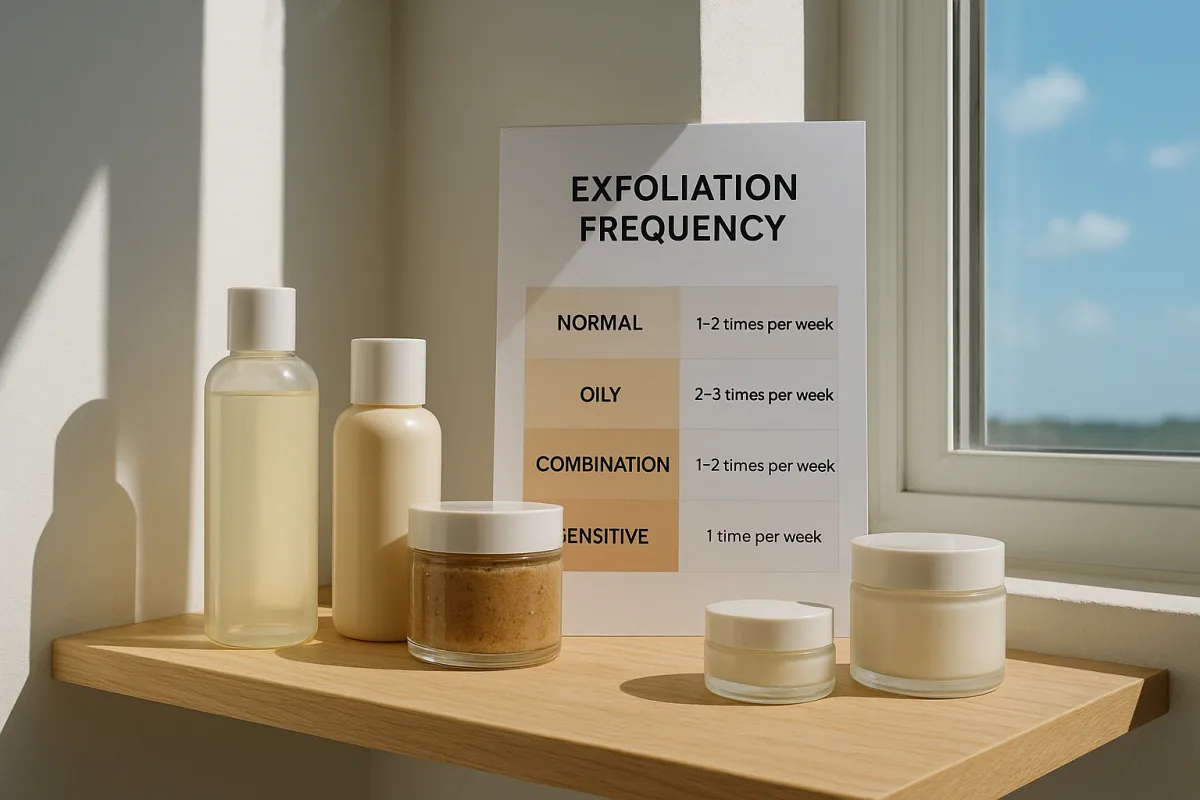
The number that matters is total exfoliation exposure
“How often should I exfoliate?” sounds like a question with one clean answer. It is not. The useful number is not simply how many times you use a scrub or acid serum each week.
It is your total exfoliation exposure: the number of times you deliberately remove or loosen surface skin cells, plus the strength and format of the product doing it. This is where most routines go wrong.
Someone might use a facial scrub every Sunday and call that weekly exfoliation. But if they also use glycolic-acid toner three nights a week, salicylic-acid pads after workouts and an enzyme mask on Friday, they are not exfoliating once weekly.
They are giving their skin six separate exfoliating exposures. The labels may call those products “clarifying,” “glow,” “resurfacing” or “pore refining,” but the skin does not care about the marketing category.
That cumulative load helps explain why the broad advice from dermatology sources tends to land around two to three sessions weekly for normal skin. [2] It is a guardrail designed to leave time between exposures, rather than a productivity target.
The goal is not to remove as much surface material as possible. Exfoliation can make the skin’s surface feel smoother and can temporarily improve the look of dullness or rough texture, but more frequent use does not reliably mean more visible improvement.
Why too much exfoliation can make skin look worse
The practical cost of exfoliating too often is irritation. Sources on over-exfoliation consistently flag persistent redness, inflammation and increased sensitivity as warning signs. [5][6] These are not signs that the product is “working.”
Dryness and flaking are also common clues, particularly when someone continues using exfoliants despite discomfort. [3][6] Skin may also develop an unusually shiny or wax-like finish, which can look superficially polished but is not the healthy glow skincare advertising tends to imply. [6]
Breakouts can complicate the picture. A person may see spots and assume they need to exfoliate more aggressively, when the irritation created by repeated exfoliation may be contributing to the problem. [2][5]
This is why frequency has to be judged by what happens between uses. If skin feels calm, looks normal and tolerates a bland moisturizer and sunscreen without stinging, the current schedule may be workable. If it increasingly reacts, the schedule is too ambitious.
That does not mean every breakout, red patch or sting is necessarily caused by exfoliation. Skin symptoms have many possible causes. Persistent irritation, painful acne, rashes or anything that seems like a medical skin issue belongs with a dermatologist, not a new acid routine.
Start with a conservative weekly schedule
For normal skin, two to three exfoliation sessions per week is the commonly cited working range. [2] That is a range, not an instruction to begin at three sessions immediately.
A better approach is to start at one session weekly for two or three weeks. If there is no lingering redness, tenderness, flaking or stinging, add a second weekly session. Keep it there unless there is a clear reason to change it.
Dry, sensitive and mature skin usually merits a slower schedule of one to two times weekly. [3][4] The important word is usually. “Sensitive” is not a diagnosis or a fixed skin type, and a person who reacts to many products should consider professional advice.
Oily skin may tolerate two to three weekly sessions, and Prevention notes that some oily skin can use a gentle beta hydroxy acid up to four times weekly. [4] That does not mean oiliness makes skin immune to irritation.
Combination skin is where a single whole-face schedule can become clumsy. Prevention recommends one to two sessions weekly overall, with more attention to oily areas where needed. [4] In plain terms, your nose may not need the same treatment as your cheeks.
The sensible version is not necessarily exfoliating the T-zone on four nights and the rest of the face on none. It is reducing unnecessary exposure on areas that are dry, tight or prone to irritation.
Chemical versus physical exfoliation changes the calculation
Physical exfoliation uses friction. Think facial scrubs, textured cloths, brushes or particles that manually polish the surface. The frequency question is therefore not just how often you use it, but how much pressure and rubbing you apply.
Dermatology guidance collected by Dermathub places physical exfoliation at two to three uses weekly in general, while sensitive skin should keep it to one or two times weekly. [2] If you find yourself scrubbing harder for a “clean” feeling, that is a reason to stop.
Chemical exfoliants use ingredients such as alpha hydroxy acids, or AHAs, and beta hydroxy acids, or BHAs. They are often easier to use consistently because there is no scrubbing motion, but that can make them deceptively easy to overuse.
The fact that an acid is in a toner pad or a daily serum does not make it automatically gentle. A leave-on product can add another exposure every time it is applied, even if it feels lightweight and never tingles.
The frequency advice for chemical exfoliants is still generally two to three times weekly, with sensitive skin beginning once weekly. The brief’s practical guidance also identifies lactic acid and polyhydroxy acids, or PHAs, as gentler chemical options often considered for dry or dehydrated skin.
“Gentler” does not mean unlimited. Dry or dehydrated skin can still become more uncomfortable if it is exfoliated too frequently. The first useful adjustment is normally fewer uses, not a longer list of barrier-support products piled on top.
Concentration matters, but it does not replace restraint
Concentration affects the calculation, although it cannot tell you exactly how your individual skin will respond. The FDA states that cosmetic AHAs are generally formulated at concentrations of 10 percent or less and at a pH of 3.5 or higher. [1]
Those numbers are safety parameters, not a recommendation to seek out the maximum. A 10 percent AHA product is not automatically better than a lower-strength option, particularly for someone who is new to acids or already using other potentially irritating products.
BHAs are commonly sold in the 0.5 to 2 percent range. [5] Again, that tells you the broad marketplace range, not how many nights each week your skin will comfortably tolerate one.
A useful rule is that stronger concentration and more frequent use are not separate decisions. If you increase one, keep the other conservative. Moving from a once-weekly 5 percent AHA to a nightly 10 percent AHA is two changes at once.
That makes it difficult to identify why skin becomes irritated. It also makes it too easy to confuse a damaged skin surface with a need for even more exfoliation.
The FDA also warns that AHAs can increase sensitivity to the sun. [1] That is not an argument for avoiding them entirely, but it is an argument for daily broad-spectrum sunscreen and for not treating exfoliation as a shortcut around basic sun protection.
Build a routine that leaves recovery days
The easiest way to avoid over-exfoliation is to assign exfoliation a place in the week. For example, a beginner might choose Tuesday and Saturday nights, rather than deciding based on whether their face looks dull in the bathroom mirror.
On non-exfoliation nights, keep the routine deliberately dull: gentle cleanser if needed, moisturizer, and nothing else intended to resurface or polish. This makes it easier to see whether the exfoliant itself is agreeing with your skin.
Do not stack a scrub and an acid product in the same routine simply because each product is mild when used alone. Your skin experiences the combined exposure, not the individual product claims.
The same applies to products marketed as “daily.” Daily is a label instruction or a brand position, not proof that daily use suits every face. The dermatologist-style recommendations in the available sources are notably more cautious than that.
Give any frequency change time. Cosmetic changes from exfoliation are usually gradual and modest, not overnight transformations. If a product seems dramatic after one use, that may be temporary surface smoothness, not a durable change in the skin.
What to do when you have gone too far
If you notice ongoing redness, stinging, flaking, inflammation, breakouts or that shiny-waxy look, stop exfoliating. [5][6] Do not switch immediately to another acid, another scrub or a “purging” explanation.
The School of Dermatology advises avoiding exfoliants for roughly two to four weeks while focusing on barrier recovery. [6] In practical terms, that means simplifying: avoid exfoliating products and use a basic, non-irritating moisturizing routine.
There is no need to punish your skin with a complicated reset. More active products are not automatically more restorative. The immediate job is to remove the repeated irritation trigger and give the skin time to become comfortable again.
If symptoms persist, worsen, involve swelling, significant pain, crusting or a widespread rash, see a dermatologist. Those features are beyond a routine-adjustment question and should not be self-managed through trial and error.
When you restart, begin lower than you think you need to. Once weekly is not failure. It is a useful test of whether your skin can tolerate an exfoliant without starting the same irritation cycle again.
Do not invent a seasonal rule
You will often hear that exfoliation should automatically increase in humid summer weather or decrease in dry winter weather. It sounds logical, but the available brief found no specific evidence-based guidance from major dermatology organizations supporting a seasonal or climate-based schedule.
That does not mean the weather never affects your skin. It means there is no established formula that turns humidity, temperature or location into a reliable exfoliation frequency.
Use the observable signals instead: tightness, flaking, redness, stinging and sensitivity mean reduce frequency. Comfortable skin that is not becoming irritated may tolerate the schedule you already have.
The blunt answer is that most people do not need to exfoliate every day, and many do not need three sessions weekly. Pick one method, start once a week, count every other exfoliating product, and only increase when your skin gives you a boringly calm reason to do so.
Frequently Asked Questions
How often should you exfoliate normal skin?
For most normal skin types, two to three exfoliation sessions per week is the commonly recommended maximum. It is best to start with one session per week and increase only if the skin remains comfortable without irritation.
How often can dry or sensitive skin exfoliate?
Dry, sensitive, or mature skin usually benefits from a slower exfoliation schedule of one to two times weekly. Starting with once weekly and only increasing if there is no irritation is advised to avoid over-exfoliation.
What are signs of over-exfoliation?
Signs of over-exfoliation include persistent redness, stinging, flaking, dryness, unexpected breakouts, and an unusually shiny or waxy skin surface. These symptoms indicate irritation and are reasons to reduce or stop exfoliation rather than increase product strength.
How to count exfoliation frequency with multiple products?
You should count every exfoliating product in your routine, including scrubs, acid toners, pads, and masks. The total number of exfoliating exposures matters because over-exfoliation is usually due to cumulative frequency rather than a single product’s use.
Should exfoliation frequency change by skin type?
Yes, exfoliation frequency should be adjusted based on skin type. Normal skin can typically exfoliate two to three times weekly, while dry and sensitive skin should exfoliate less often, usually one to two times per week, to avoid irritation.
How we researched this
This article was assembled from 6 cited references.
Nothing here is based on hands-on testing. Where a figure or finding appears, it belongs to the source cited beside it, and the writing says so rather than implying otherwise. Every source is listed below so you can check it.
Sources
- Alpha Hydroxy Acids | FDA
- How Often to Use Physical Exfoliants | Dermatology
- How Often Should You Exfoliate Your Face? 11 Qs on Skin Type, More
- How Often Should You Exfoliate Your Face? Dermatologists Explain
- How to Avoid Over-Exfoliated Skin | Paula's Choice
- Over-Exfoliation: Signs & How to Recover
Related Articles
Best Time to Exfoliate Skin: Morning or Night Explained
Discover the best time to exfoliate skin, why night is preferred, and how to protect your skin after exfoliation with sunscreen.
How to Choose a Facial Sunscreen: SPF, Ingredients & Tips
Learn how to choose a facial sunscreen with the right SPF, broad-spectrum protection, and ingredients suited for your skin type and daily needs.
How to Choose a Face Serum for Your Skin Type and Needs
Learn how to choose a face serum based on your skin type, key ingredients, and usage tips for effective skincare results.

Signs of Over-Exfoliation: How to Recognize Skin Damage
Learn the signs of over-exfoliation and how to recognize when your skin barrier is compromised for healthier skincare choices.