
How to Read Skincare Labels: A Clear Ingredient Guide
Learn how to read skincare labels to understand ingredients, claims, and ingredient order for better product choices.
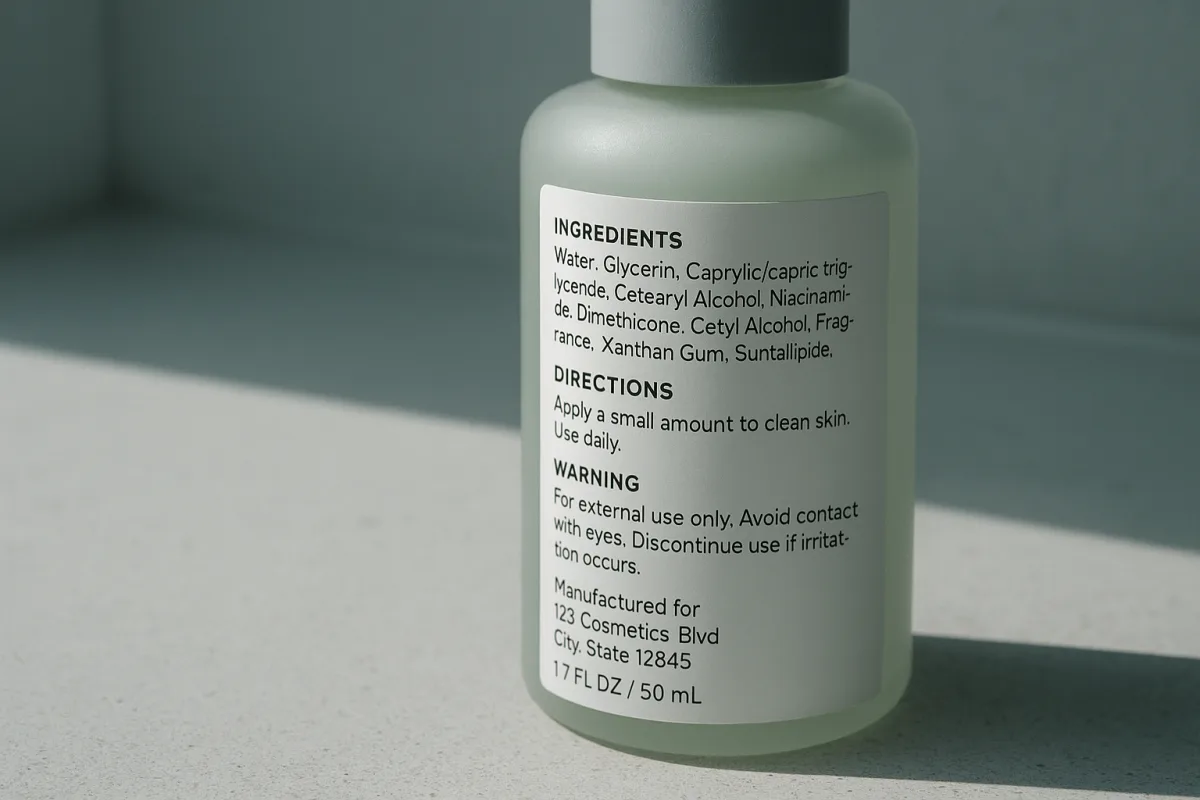
Start with the front label, then downgrade its importance
The front of a skincare package is designed to make a quick argument: brightening, barrier support, clean, natural, dermatologist tested, non-comedogenic. Some of those words may describe a product’s intended cosmetic effect. They do not, on their own, tell you what is in the bottle, how much of it is there, or whether the formula is likely to suit your skin.
The useful information is usually elsewhere: the ingredient list, the directions, the warnings, the quantity, the company details and, sometimes, a batch code or durability symbol.
A practical rule is to treat the front label as a list of claims to verify, not proof. “Hypoallergenic,” “non-comedogenic” and “dermatologist tested” do not have standardised legal definitions or universally required test protocols in major markets, including the US. “Dermatologist tested” can mean a dermatologist was involved somewhere in testing, but it does not tell you the study design, number of participants, skin types included or result. It is not a guarantee that a product will not irritate you or contribute to breakouts.
The same caution applies to “clean” and “non-toxic.” These terms do not have a consistent regulatory meaning in cosmetics. They are positioning language, not an ingredient standard. [5][7]
“Natural” is similarly slippery. In the US, “natural” is not a regulated cosmetic claim. An ingredient can be described as natural without that word telling you much about its concentration, processing, fragrance content or irritation potential. The ingredient list is still required, whether the product is marketed as conventional, natural or organic. [2][5]
Organic is more specific, but only when a relevant certification standard is actually involved. In the US, the USDA National Organic Program governs organic claims, with “organic” generally requiring at least 95% organic ingredients, excluding water and salt. European organic claims similarly depend on recognised certification standards. That may matter if organic agricultural sourcing is your priority. It does not automatically tell you whether the formula is better moisturising, gentler or more effective cosmetically.
Find the ingredient list, and read it as a formula, not a shopping list
Cosmetic ingredients are generally declared using INCI names, the shared naming system used across many markets. This is why a label may say Aqua instead of water, Tocopherol instead of vitamin E, or Butyrospermum Parkii Butter instead of shea butter.
In the US, required cosmetic label information includes the product identity, net quantity, ingredient declaration, manufacturer name and address, plus relevant warnings. Canada requires an INCI ingredient list, product identity, metric net quantity or count, dealer information, warnings and safe-use directions in English and French. [2] EU rules also require the responsible person’s name and address, nominal content, durability information, batch number, function, ingredients and warnings. [6]
Once you have found the ingredients, read from the top down. Ingredients are listed in descending order of predominance, so the early portion of the list tells you most about the formula’s structure. The first five to seven ingredients typically make up the bulk of the product. In many water-based serums and lotions, water is the first ingredient, often followed by humectants such as glycerin, solvents, emollients, thickeners or silicones. [4][5]
That does not mean the first ingredient is definitely 60% of the formula, or that the second ingredient is definitely 20%. Labels do not disclose exact percentages, and the actual share of the leading ingredient varies by product type. A cleansing oil, balm and watery essence will have very different structures.
What you can reasonably conclude is simpler: if a product is sold as a ceramide cream but ceramides appear far down an otherwise basic moisturiser formula, the primary experience may come from the humectants, oils, occlusives and emulsifiers above them. That is not necessarily bad. A modest amount of a secondary ingredient can still be appropriate in a stable, pleasant formula. It is just not evidence that the product is built around that ingredient.
Do not make the classic ingredient-order mistake: the 1% line
Ingredient order is useful, but it has a major limit. Once ingredients are present at 1% or less, they can be listed in any order. [3][5]
This means that a cluster of ingredients at the end of a label is not a ranking. A vitamin C derivative listed just before a botanical extract may be present at a lower, equal or higher amount than that extract, as long as both are at or below 1%.
It also means a headline active near the end of the list may be present at a modest level. Sometimes that is enough. Sometimes it is mostly there to support a front-label story. The label cannot settle that question without a disclosed percentage, and brands are not generally required to disclose cosmetic ingredient percentages.
Do not overcorrect by treating every low-listed ingredient as useless. Preservatives, fragrance components, chelators and some potent ingredients are intentionally used below 1%. The sensible conclusion is narrower: ingredient presence is not evidence of a meaningful dose.
This is particularly important with formulas that advertise a long roster of extracts, peptides, antioxidants and vitamins. A label can contain all of them without containing each one at a level supported by relevant research. Think of the list as evidence of inclusion, not a clinical recipe.
When the label gives you a percentage, ask better questions than “is it high?”
Percentages can be helpful when they are clearly stated, especially for familiar actives. But a bigger number is not automatically a better formula.
Niacinamide is a good example. Evidence summaries identify 2% as a studied concentration for reducing the appearance of excess oil and 5% as a studied concentration for improving aspects of skin ageing appearance. [3] That does not mean everyone needs a 10% serum, or that 10% will produce twice the cosmetic benefit of 5%. Higher concentrations can be harder for some people to tolerate, while the rest of the formula and the frequency of use still matter.
For pure vitamin C, listed as ascorbic acid, effective leave-on formulations are commonly in the 10% to 20% range. [3] But the number alone is particularly incomplete here. Ascorbic acid performance depends heavily on pH, packaging, stability and delivery system. A 20% formula that has oxidised in a clear bottle by a sunny window is not made better by the original number on its label. [3][8]
The supplied evidence brief does not identify individual clinical trial titles for those concentration figures, so it would be false precision to name studies that were not provided. What it does support is the practical point: 2% and 5% niacinamide, and 10% to 20% ascorbic acid, are more informative benchmarks than vague “infused with” language. [3]
For any active, ask four questions before treating a percentage as meaningful:
- Is the ingredient form named clearly? “Vitamin C” may mean ascorbic acid or one of several derivatives, which do not behave identically.
- Is the percentage disclosed?
- Does the packaging protect a light- and air-sensitive formula where that matters?
- Are the directions realistic enough for regular use?
Skincare results from cosmetic products are usually gradual and limited. A moisturiser may make skin feel less tight soon after application because humectants and occlusive ingredients alter water content at the surface. Changes in visible brightness, oiliness or the look of fine lines, where they occur, typically require regular use over weeks rather than a few applications. A label cannot promise the timeline for your skin.
If you are trying to interpret persistent inflammation, sudden pigment changes, painful lesions, itching, swelling or an apparent reaction, that is no longer a label-reading exercise. Stop using the suspected product if needed and seek advice from a dermatologist or other appropriate clinician.
Check the directions and warnings before checkout
The directions are not filler. They tell you whether a product is intended to be rinsed off, left on, used only at night, kept away from the eye area or introduced gradually. A high-profile ingredient in a wash-off cleanser has less contact time than the same ingredient in a leave-on serum. That does not make cleanser actives pointless, but it makes direct percentage comparisons unreliable.
Warnings can also expose a mismatch between the product and your routine. If a formula advises avoiding damaged skin, limiting use around the eyes or stopping use if irritation occurs, take that seriously rather than assuming a “gentle” front-label claim overrides it. Canadian cosmetic requirements specifically include warnings and directions for safe use where needed. [2]
For fragrance-sensitive shoppers, scan for Parfum or Fragrance and the separately listed fragrance allergens required in some markets. Whether you choose fragranced skincare is a personal tolerance issue, not a moral category. “Natural fragrance” is still fragrance, and botanical extracts can also contribute scent or sensitisation potential. A natural claim does not make that risk predictable.
Look for a date, but understand what it does and does not mean
US cosmetics are not required by the FDA to carry an expiration date. [1] If there is no date on a US product, that absence is normal, not proof that it lasts forever.
In the EU, products with a shelf life longer than 30 months generally display a Period After Opening, or PAO, symbol, shown as an open jar with a number such as 6M or 12M. That is the suggested period of use after opening, assuming normal storage. Products with a shorter durability period require a minimum durability date instead. [6]
A PAO symbol is useful, but it cannot account for how the product has actually been stored. Heat, direct light and repeated exposure to air can degrade vulnerable actives and weaken preservative systems. Keep products sealed, cool and out of direct sun, particularly vitamin C formulas and products in clear packaging. [1][8]
When there is no clear expiry guidance, use the manufacturer’s instructions, record when you opened the product if you are likely to forget, and pay attention to obvious changes in smell, colour or texture. Do not try to rescue a visibly altered product by shaking it harder.
Make the buying decision from the whole label
A useful label-reading decision is rarely, “Does this contain ingredient X?” It is, “Is the whole formula and its use case worth the price?”
For a basic moisturiser, the first part of the list should tell you whether you are buying a humectant-heavy lotion, a richer emollient cream, an occlusive balm or some combination. For a vitamin C serum, look for the ingredient form, disclosed percentage if available and packaging that supports stability. For a niacinamide product, a 2% to 5% disclosed range has a clearer evidence basis than an unexplained high percentage. [3]
Finally, resist the urge to buy a product because it claims to be natural, clean, non-toxic, dermatologist tested, hypoallergenic or non-comedogenic. Those terms can be part of the brand’s message, but they are not substitutes for formula transparency or a standardised assurance of compatibility. [5][7]
The ingredient list will not tell you everything. It cannot reveal exact percentages below 1%, manufacturing quality, finished-product stability or how your own skin will respond. But it can help you separate a formula’s backbone from its decorative extras, recognise when a percentage is meaningful, and spend with more scepticism than the front label would prefer.
Frequently Asked Questions
What do the order of ingredients on skincare labels mean?
Ingredients are listed in descending order of predominance, so those at the top make up the bulk of the product. The first five to seven ingredients typically represent most of the formula. Ingredients present at 1% or less can be listed in any order, so their placement near the end does not indicate lower or higher concentration.
How can I tell if a skincare product contains effective ingredients?
The presence of an ingredient alone does not guarantee effectiveness. The concentration, ingredient form, pH, stability, delivery system, and usage frequency all influence efficacy. Ingredients listed near the end of the label are often at low concentrations (≤1%), which may or may not be enough to have a meaningful effect.
What do marketing claims on skincare packaging really mean?
Claims like “hypoallergenic,” “non-comedogenic,” and “dermatologist tested” have no standardized legal definitions or required testing protocols in major markets, including the US. Terms such as “clean,” “natural,” and “non-toxic” are marketing language without consistent regulatory meaning. “Organic” claims are more regulated but only when backed by recognized certification standards.
How to interpret percentages on skincare ingredient labels?
Exact percentages are generally not disclosed on labels. Ingredient order shows relative predominance above 1%, but below that threshold, ingredients can be listed in any order. Some active ingredients have known effective concentration ranges (e.g., niacinamide at 2–5%, vitamin C at 10–20%), but you usually cannot confirm these percentages from the label alone.
Why are some ingredients listed at the end of skincare labels?
Ingredients at or below 1% concentration can be listed in any order at the end of the ingredient list. This means an active ingredient near the end may be present at a low or modest level, sometimes enough to contribute, sometimes mainly to support marketing claims. Some important components like preservatives and fragrances are intentionally used at low concentrations.
Sources
- Do I need to label my cosmetics products with expiration dates? | FDA
- Cosmetic advertising, labelling and ingredients - Canada.ca
- Skincare Ingredient Concentrations: Evidence Guide – GlowBareSkin
- How to Read a Skincare Ingredient List — 5 Things the First 5 Ingredients Tell You | Meria
- How to Read Skincare Ingredient Labels: A Complete Guide | NicerSkin
- EU rules for cosmetics and skincare sellers (2026) | EUReady
- Reading Skincare Labels: What the Ingredient List Really Tells You - Your Great Skin
- Skincare Ingredient Concentration: 7 Truths for Better Results
Related Articles
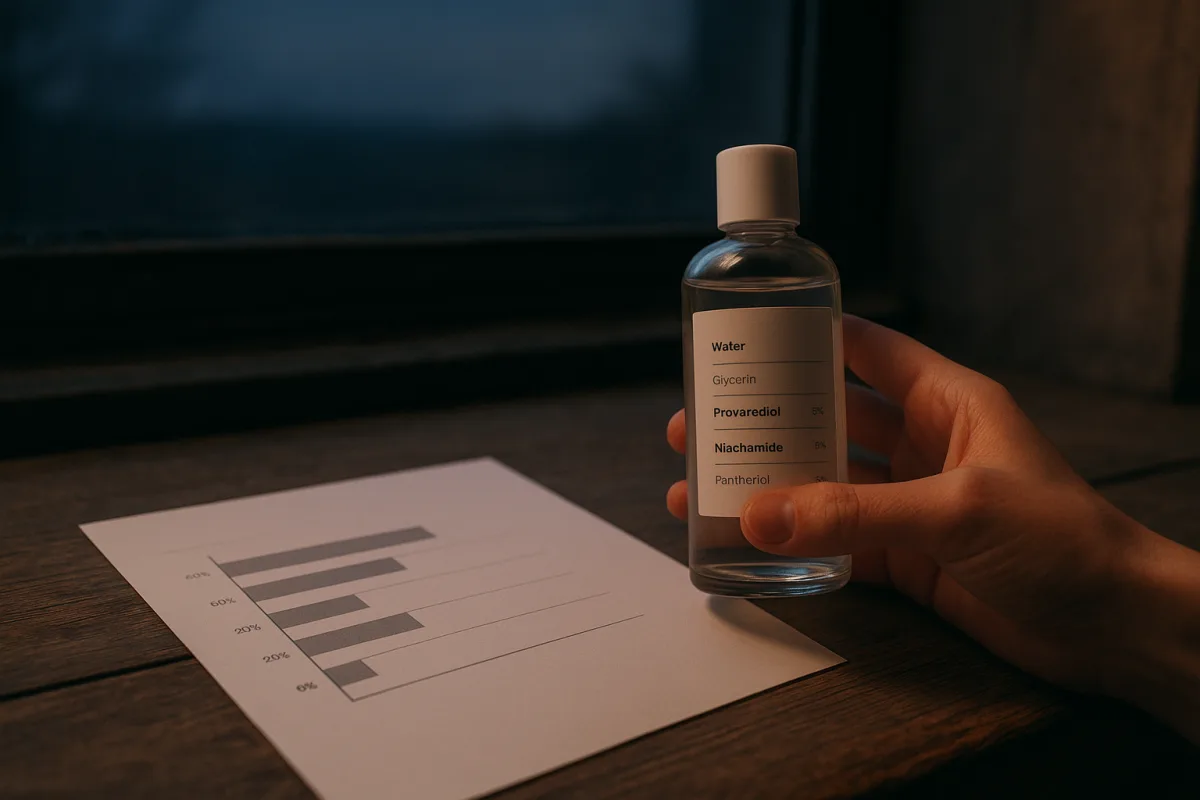
Understanding Skincare Ingredient Order and Concentrations
Learn how to interpret skincare ingredient order and concentrations to better evaluate product formulas and active ingredient levels.
How to Layer Products for Acne-Prone Skin Correctly
Learn how to layer products for acne-prone skin with the right order, timing, and active ingredient use to avoid irritation and maximize results.
Angie's Actives: Simplifying Skincare with Effective Ingredients
Angie's Actives skincare line simplifies routines with clinically effective ingredients in two products: Activate Lotion and All-In Serum. Cruelty-free, vegan, and travel-friendly for easy, transparent skincare.

City Beauty Ultra Firming Dry Oil: Transform Your Skin in 8 Weeks!
City Beauty's ultra firming dry oil combats aging with potent ingredients like spalanths extract and ubiquinone. In a 12-week study, users reported smoother, firmer skin. Try it for visible results in just 8 weeks!