
Difference Between Serums and Oils: What You Need to Know
Learn the difference between serums and oils, how they work, and which suits your skincare routine best.
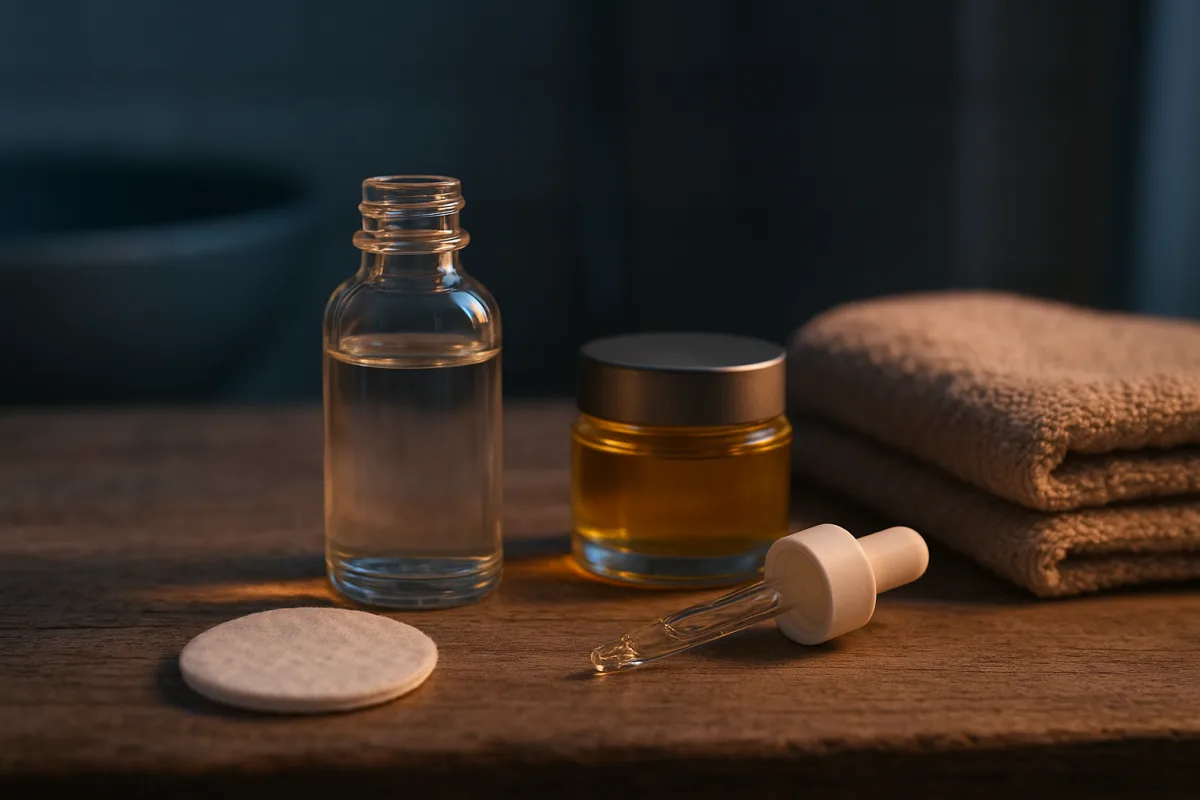
The useful distinction is not “serum versus oil.” It is the vehicle.
“Serum” and “facial oil” sound like opposing skincare categories, but they are really shorthand for two different ways of carrying ingredients onto skin.
A serum is usually built around water. A facial oil is built around lipids, meaning oils, esters and oil-soluble ingredients. That base determines the product’s texture, which ingredients it can hold, how it fits with moisturiser, and what sort of result is realistic to expect.
It does not determine whether a product is automatically “better,” more active, cleaner, or more effective. Nor does a serum necessarily contain impressive active ingredients just because the bottle calls it a serum. Plenty of products use the word as marketing shorthand for a thin, expensive liquid. The ingredient list is more revealing.
The practical question is: does your routine need a water-based treatment step, an oil-based emollient step, or both?
What the base does
Most conventional serums are mostly water, often with humectants, solvents, thickeners, preservatives and a small amount of a featured active ingredient. Water gives a serum its light slip and lets formulators include water-soluble ingredients such as niacinamide, glycerin, certain forms of vitamin C, and hyaluronic acid. Industry formulation guidance commonly places vitamin C in the 10% to 20% range, niacinamide at 2% to 5%, and hyaluronic acid at roughly 0.5% to 2%, although the label rarely tells you enough to verify every formula’s concentration. [1][5]
That structure matters because water and humectants can temporarily increase water content in the uppermost layer of skin, the stratum corneum. Glycerin and hyaluronic acid do not “inject” water into the skin or rebuild it from below. They bind water in the surface layers, which can make skin feel less tight and look a little plumper for a while. That is a cosmetic hydration effect, not a medical treatment.
A facial oil, meanwhile, is primarily a lipid mixture. It may contain plant oils, squalane, triglycerides, esters and oil-soluble antioxidants. Sources describing the category place the oil content at roughly 90% to 100%. [2] These materials can soften the feel of rough surface skin and reduce transepidermal water loss by forming part of a more occlusive surface film. In plain English, oils are better at helping the water already in skin stay put than they are at supplying water themselves.
This is why dry skin can sometimes feel better after an oil even if the formula contains no headline active at all. The immediate change is often about surface smoothness, reduced friction and a more flexible-feeling barrier. It can be noticeable within minutes. It is also modest and temporary, and it will not establish why someone has persistent flaking, burning, cracking or inflammation. Those symptoms warrant a dermatologist’s assessment rather than a more elaborate oil routine.
Why “active serum” is not a rule
The neat version of the category story is that serums deliver actives while oils nourish the barrier. It is directionally useful, but not reliably true.
Some products sold as oils contain active ingredients normally associated with serums, including retinol, niacinamide and peptides. [3] Retinol and some antioxidant forms are oil-soluble, so an oil can be an entirely reasonable delivery vehicle. Conversely, a water-based serum may be mostly humectant and botanical extract, with no ingredient at a concentration likely to produce much beyond transient hydration.
The label category tells you little. The INCI ingredient list and, where available, the disclosed concentration tell you more.
Consider retinol. A retinol oil could contain 0.2%, 0.5% or 1% retinol, ranges cited in formulation discussions of oil-based active products. [3] Whether it is called an “oil,” “treatment oil” or “serum oil” does not change the fact that it is a retinol product. The sensible approach is still gradual introduction, using it less often at first and avoiding a stack of other irritating actives in the same routine. [6] Results from retinoids, if they occur, are not an overnight gloss. Texture or tone changes are generally evaluated over weeks to months, and irritation can arrive sooner than visible benefits.
Niacinamide creates a different formulation issue. It is typically water-soluble, commonly used around 2% to 5% in serums. [1][5] A product described as an oil that claims a substantial niacinamide dose may therefore be an emulsion, a two-phase product, or a more technically complex formula than a simple bottle of plant oil. Again, the front label does not settle the question.
There is no direct comparative clinical evidence in the supplied research showing that a serum-first routine consistently outperforms a facial-oil routine over the long term. There is also no useful evidence that serums universally “penetrate deeper” simply because they are watery. Penetration depends on the individual ingredient, its concentration, stability, pH, molecular properties, vehicle, and the condition of the skin barrier. A thin texture is not proof of better delivery.
Hydration, moisturising and oil are related, not identical
This is where product language gets deliberately slippery.
Hydration refers to water content in the outer skin layer. Humectants such as glycerin and hyaluronic acid support that. Moisturising is broader. It can involve humectants, emollients that make skin feel softer, and occlusives that slow water loss. Oils mostly sit in the emollient and somewhat occlusive part of that equation.
So if a person says, “My skin is dehydrated,” a facial oil may improve comfort but may not be the whole answer. A basic water-based humectant serum followed by a moisturiser may be more logical. If skin is already comfortable but feels rough, tight in cold weather, or looks less smooth under makeup, a few drops of an oil can be useful as the final lipid-rich step.
This is also why moisturiser is not interchangeable with either category. A conventional cream or lotion is often an emulsion containing water, humectants, emollients and occlusives together. It does several jobs at once. A serum tends to be a targeted, lighter treatment step. An oil tends to be a concentrated emollient step.
People with oily or combination skin often prefer serums because they are lighter and less likely to leave a shiny film. [15] That does not mean oil is forbidden. Squalane, for example, is often suggested as a lighter option for oilier or acne-prone skin, though the suitability of any oil depends on the full formula and individual tolerance. [10] Anyone trying to manage acne, painful bumps, rash, persistent redness or peeling is better served by a dermatologist than by broad claims that a particular oil is “non-comedogenic” or “healing.”
Layering is less exact than skincare charts suggest
The usual logic is simple: apply the water-based product first, then the oil-based one. A serum goes on clean, slightly damp skin, then moisturiser, then a small amount of oil if wanted. Oil can reduce the slip and spread of a water-based product applied over it, so serum-first is the least fussy method.
The complication is that published advice is not entirely consistent. Heyday places facial oil after serum and before moisturiser, while Pestle & Mortar advises oil after moisturiser. [4][7] Neither sequence has convincing long-term comparative evidence behind it.
The practical answer is to decide what role the oil is playing.
If it is mainly an emollient layer for dry skin, use it after a water-based serum and either mix a drop into moisturiser or press it over moisturiser. If it makes your moisturiser feel too heavy, serum followed by oil can be acceptable, particularly in dry weather. If you use sunscreen in the morning, keep it as the final skincare layer. Do not mix facial oil into sunscreen, since dilution and uneven application can compromise the sunscreen film.
Amounts should be smaller than marketing imagery suggests. Guidance commonly suggests two to three drops of serum and one to two drops of facial oil. [4][6] More product does not mean more effect. With oil especially, excess usually means shine, pilling, makeup movement, or simply product transferred onto a pillowcase.
Price mostly reflects formula positioning, not a guaranteed outcome
The price difference between serums and oils can look irrational because it often is not tied neatly to results.
The 2026 market ranges in the research brief put drugstore serums around $9 to $22 per ounce, luxury serums around $120 to $220 per ounce, and medically positioned serums at roughly $80 to $250 per ounce. [8] Facial oils range from about $15 to $30 per ounce at the basic end, while luxury oils can reach $250 to $800 per ounce. [9]
Those prices do not prove that a luxury oil will support the barrier eight times better than a basic squalane or that a high-priced serum contains eight times more active ingredient. Cost can reflect packaging, brand positioning, a patented ingredient, sourcing claims, fragrance, texture work, retailer margins and, occasionally, expensive stability testing. It can also reflect a tiny bottle.
The better buying question is narrower: what is this formula providing that my moisturiser does not?
For a serum, look for a clearly named active with a disclosed concentration where that matters, a suitable packaging format, and a formula you can use consistently without irritation. For an oil, look at the first several ingredients. Are you buying mostly squalane, a fragrant essential-oil blend, a mixture of plant oils, or an oil carrying a known active such as retinol?
Choosing between them
Choose a serum when you want lightweight hydration or a specific active ingredient that works best in a water-based formula. This is often the simpler starting point for oily, combination or humid-climate routines. [1][15]
Choose an oil when your main aim is softness, a more cushioned skin feel, and help limiting surface water loss, particularly in dry or cold conditions. [2][14] Oils can be useful for dry skin, but they are optional, not a compulsory marker of a “proper” routine.
Use both when you have a clear reason for each: for example, a humectant serum under moisturiser, with a small amount of oil at night when skin feels dry. In winter, layering a serum beneath an oil is commonly recommended because low humidity can make surface dryness more noticeable. [14]
The blunt version is this: a serum is not automatically treatment, and an oil is not automatically nourishment. They are delivery formats. Read the ingredient list, identify the product’s base, and buy the format that solves the practical problem in front of you.
Frequently Asked Questions
What is the difference between serums and oils in skincare?
Serums are typically water-based products designed to deliver water-soluble ingredients like niacinamide, vitamin C, and hyaluronic acid. Facial oils, on the other hand, are primarily lipid-based, containing oils, esters, and oil-soluble ingredients that help nourish and protect the skin barrier by reducing water loss.
How do serums and facial oils differ in ingredients and function?
Serums usually contain a high percentage of water and humectants that temporarily increase water content in the skin’s surface layer, providing hydration and targeted active ingredients. Facial oils are mostly composed of lipids that soften skin and form an occlusive layer to help retain moisture, but they do not supply water themselves.
Can facial oils contain active ingredients like serums?
Yes, some facial oils include active ingredients commonly found in serums, such as retinol, niacinamide, and peptides. These actives are oil-soluble and can be effectively delivered in an oil base, blurring the traditional distinction between serums and oils.
Should I use a serum or an oil for dry skin?
Dry skin may benefit from both: serums can provide hydration through water-soluble humectants, while facial oils help lock in moisture by forming a protective barrier. Oils can improve skin feel quickly by smoothing and reducing water loss, but persistent dryness or irritation should be evaluated by a dermatologist.
How do I layer serums and oils in my skincare routine?
Typically, serums are applied first due to their water-based formulation, followed by facial oils which act as emollients to seal in moisture. Some sources suggest applying oils after serums but before moisturizers, though layering can vary depending on product formulation and skin needs.
Sources
- Facial Serums vs Oils: What’s The Difference? - Kiehl's
- Facial Oils vs. Serums: What’s the Difference? – Vivant Skin Care®
- Face Oils vs. Serums: Why So Many ‘Serums’ Are Actually Oils – KYOMI SKIN
- Serums vs Facial Oils: Key Differences & How to Choose | Heyday
- How to Choose Cosmetic Raw Materials for Skincare Formulation –
- Serums Explained: What They Do and How to Choose the Right One | NicerSkin
- Serums and oils in skincare explained – Pestle & Mortar
- How Much Do Skincare Treatments Cost in 2026? Complete Pricing Guide | The Exosome Edit
- 5 Best Facial Oils - Aug. 2026 - BestReviews
- Your Face-Oil Soulmate Exists-12 Options for All Skin Types, Backed by Derms and Editors
- Serums vs. Oils: What's the Difference?
- Facial Skincare Market Size & Share Report, 2026-2033
- Skincare Industry Trends 2026: Key Trends, Growth & Forecast
- When Should I Apply a Facial Oil In My Skincare Routine?
- Serums vs Oils: When And How To Use Each — Selfnamed Insights
Related Articles
Benefits of Hyaluronic Acid: Hydration and Skin Improvement
Discover the benefits of hyaluronic acid for skin hydration, molecular weight effects, and how to use it for smoother, plumper skin.
How to Layer Serums: Correct Order and Application Tips
Learn how to layer serums properly with tips on order, wait times, and amounts for effective skincare routines.
How to Treat Uneven Skin Texture: Effective Skincare Tips
Learn how to treat uneven skin texture with targeted actives, routines, and product tips for smoother, healthier skin.
How to Layer Products for Acne-Prone Skin Correctly
Learn how to layer products for acne-prone skin with the right order, timing, and active ingredient use to avoid irritation and maximize results.