
Best Time of Year for Chemical Peels: What You Need to Know
Discover the best time of year for chemical peels, how sun exposure and downtime affect results, and essential aftercare tips for any season.
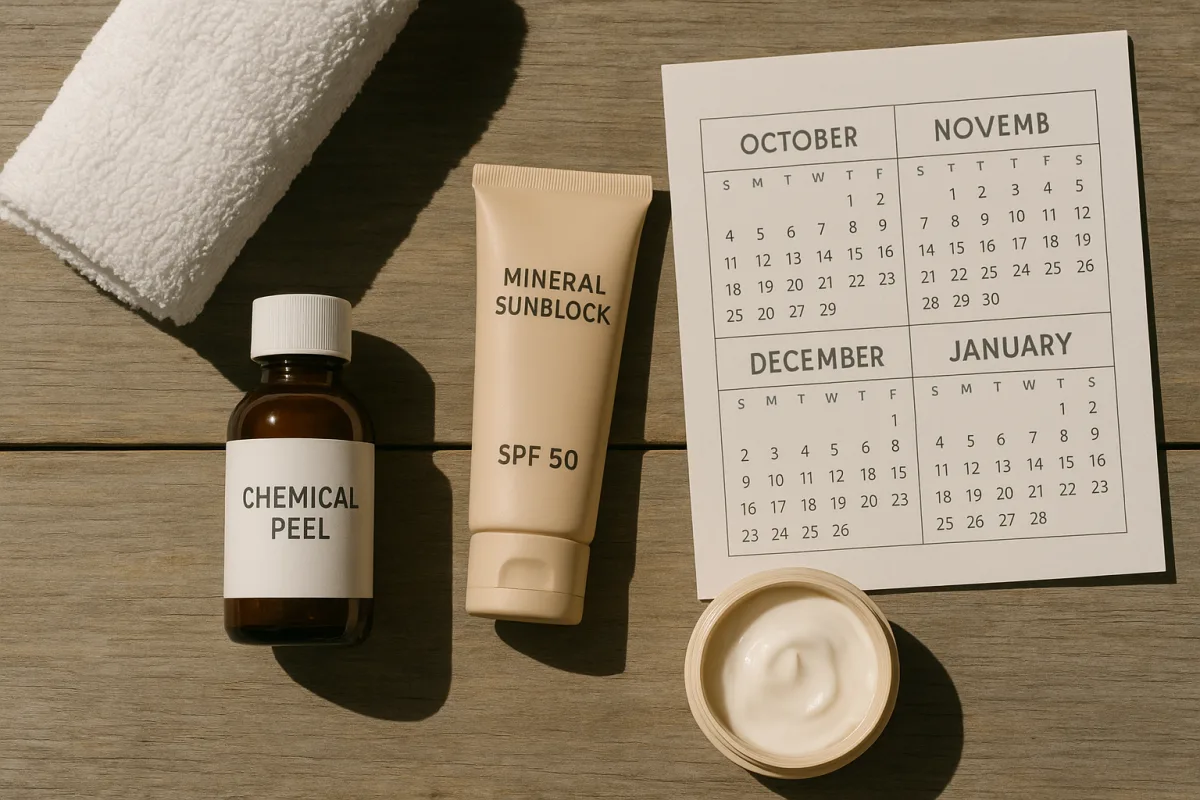
The shift is toward “peel season,” but the evidence is mostly clinical convention
Chemical peels are increasingly being framed as an autumn and winter project, rather than a treatment people book whenever they happen to have a free Friday. The practical logic is straightforward: less intense outdoor exposure can make rigorous aftercare easier.
That shift is visible across provider education. Skin Wellness Dermatology, Plastic Surgery Arts, and Healthylooks Medspa all position fall and winter as the preferred period for peels, using broadly similar reasoning about lower ultraviolet exposure and cooler weather. [1][15][16]
The repetition matters because it shows a real change in how clinics are advising patients and marketing treatment calendars. It does not, however, turn a common recommendation into proof that a peel biologically heals better in December than July.
The evidence base is thinner than the seasonal messaging suggests. No rigorous studies were identified that quantitatively connect fall or winter timing with faster healing, fewer complications, or better final cosmetic outcomes after chemical peels.
That distinction is worth making before rearranging your life around a treatment. “Best time of year” is not a fixed property of an exfoliating acid. It is shorthand for the period when your actual plans make sun avoidance and gentle recovery more realistic.
Why the timing conversation is happening now
The emphasis on season reflects a sensible collision between aftercare and real life. People spend more time outdoors in warm weather, take holidays, exercise outside, attend events, and may find it harder to avoid heat and sunlight while skin is visibly red or peeling.
U.S. Dermatology Partners specifically warns that summer heat and sun exposure can add irritation and increase pigment-related concerns after a peel. [11] That is not an argument that summer procedures are impossible. It is an argument that aftercare gets less forgiving.
A chemical peel uses a chemical solution to create controlled exfoliation at different depths. A light peel is not interchangeable with a medium or deep peel, and a treatment’s name alone does not tell you the acid, pH, concentration, application time, or expected recovery.
That is the ingredient-list version of the conversation: “chemical peel” is a category, not a formula. If a provider cannot explain the type of peel, intended depth, expected downtime, and what you need to pause beforehand, the season is not the main problem.
The growing “peel season” message also fits the cosmetic calendar. Cooler months often offer more time before summer trips, weddings, and outdoor events. Results from exfoliating procedures are not necessarily instant, and visible peeling is a poor match for an event next week.
UV exposure is the meaningful variable, not the month on the calendar
Post-peel skin is more vulnerable to sun exposure while redness or pinkness remains. SolRX and PostCare advise avoiding sun during that early period and using broad-spectrum mineral sunscreen, generally SPF 30 to 50, with outdoor reapplication every two hours. [7][9]
There is no universally established “safe UV index” that tells every patient when exposure becomes acceptable after a peel. Anyone presenting a single magic number is making the decision look more precise than the available evidence allows.
Instead, think in terms of exposure management. Can you use shade, hats, sunglasses and sunscreen consistently? Can you avoid a beach holiday, ski trip, outdoor sports event, or long driving days with sun through the window during recovery?
For someone with a sedentary indoor routine and excellent sun-protection habits, a summer light peel may be more manageable than an autumn procedure booked immediately before an outdoor holiday. The calendar is a proxy. Your exposure is the relevant planning detail.
This is also why winter is not automatically low-risk. Bright snow, high-altitude travel, and sunny climates still create meaningful ultraviolet exposure. Lower temperatures can make outdoor life feel harmless while the recovery rules remain exactly the same.
Downtime should decide your booking date before the weather does
The most useful timing tool is the recovery window your provider expects for the actual peel being proposed. Phoenix Surgical Dermatology lists 3 to 5 days of downtime for light peels, with redness or flaking potentially lasting up to two weeks. [3]
Medium peels generally demand more scheduling discipline. Pristine Med Spa describes roughly 5 to 7 days of downtime, with visible peeling and swelling during that interval. [5] “Downtime” does not necessarily mean you are housebound, but it can mean looking unmistakably treated.
Deep peels are in another category entirely. Phoenix Surgical Dermatology describes a minimum of 10 to 14 days of downtime, with full recovery taking 2 to 3 weeks and intense peeling lasting longer for some people. [3]
These are general ranges, not guarantees. The research brief found no detailed evidence linking those recovery periods to specific seasonal temperatures, humidity levels, or weather conditions. A January peel is not automatically a shorter-recovery peel.
This matters for people trying to optimize results through timing. A quiet fortnight with no travel, no major social commitments, and reliable sun protection is usually a more rational booking window than a theoretically ideal month that clashes with your life.
Winter has its own aftercare problem: dryness
The downside of cooler weather is not trivial. Cold air and indoor heating can make skin feel drier, and Skin Wellness Dermatology notes that winter recovery requires attention to hydration as well as sun protection. [1]
Dry climates may intensify dryness, while humid climates may make peeling feel more pronounced. Those are useful practical observations, but they are not standardized, evidence-backed protocols for choosing a peel month or changing treatment strength.
In other words, do not self-prescribe a stronger peel because you live somewhere humid, or assume dry weather means you need a different treatment depth. Those decisions depend on the formula, skin history, current routine, and clinician assessment.
The boring aftercare advice remains the most defensible. CareCredit recommends gentle cleansing, moisturising, avoiding picking, and pausing potentially irritating products including retinoids, AHAs, BHAs, and vitamin C for at least a week. [13]
That pause deserves attention from active-skincare enthusiasts. Retinoids and exfoliating acids can be useful ingredients in the right routine, but combining them too soon with recently peeled skin is not “extra results.” It is a higher-irritation gamble.
Ask the clinician who performs the peel exactly when to restart each active, rather than relying on a generic online timeline. The answer can vary with the peel’s depth and your recovery, which is why a one-size schedule is unreliable.
What “optimize results” should mean in practice
Optimising a peel is less about chasing the most aggressive treatment and more about reducing avoidable disruption. A well-timed light peel with consistent aftercare may be a better project than a deeper procedure scheduled when you cannot stay out of the sun.
It also means being honest about the scale and speed of cosmetic change. Peels can improve the look of surface texture or uneven tone for some people, but results are usually gradual and modest, often requiring a planned series rather than one dramatic appointment.
The sources supplied here describe treatment categories and recovery expectations, not a reliable concentration-by-concentration guide to outcomes. That is important because acid percentage alone does not establish a peel’s strength or predict what it will do on an individual face.
A 20 percent acid figure, for example, would be incomplete without the acid type, pH, vehicle, application method, number of layers, contact time, and neutralisation approach. If a clinic sells only the percentage, ask for the rest of the context.
If you are considering a peel because of persistent dark patches, scarring, inflamed breakouts, burning, or a changing skin lesion, that needs individual medical assessment rather than a seasonal skincare plan. A dermatologist can determine whether a peel is appropriate.
Do not expect an autumn discount or a winter appointment rush
There is a persistent assumption that autumn is both peak peel season and therefore either more expensive or more difficult to book. The research brief found no evidence of seasonal shifts in chemical-peel pricing, demand, or appointment availability.
That means there is no factual basis for rushing into an unsuitable date because you expect winter slots to vanish. Compare providers based on qualifications, the treatment proposed, follow-up access, and the full cost, not a presumed seasonal market pattern.
Prices were not supplied in the research brief, so it would be misleading to invent a typical figure. If you receive a quote, clarify whether it covers the consultation, the procedure itself, post-care products, follow-up visits, and treatment of complications if they occur.
For deeper procedures especially, ask what happens if healing does not follow the expected timeline. A cheaper sticker price is not a meaningful saving if it excludes clinical follow-up, aftercare requirements, or the time you need to take away from work.
A practical calendar for planning a peel
Late September through early March is a reasonable starting point if you live in a region where that period genuinely reduces your outdoor sun exposure. It is a convention supported by broad clinical advice, not a research-proven treatment advantage. [1][15][16]
Before booking, count backwards from travel, outdoor events, photos, and work obligations. For a light peel, allow at least the stated 3 to 5 days of downtime plus the possibility of lingering flaking. [3]
For a medium or deeper peel, use the longer recovery ranges as a minimum planning guide, not an optimistic forecast. If you cannot tolerate being visibly red, swollen, or peeling for that period, choose a different date or reconsider the procedure. [3][5]
Then audit your routine. Plan a bland cleanser, moisturiser, sun protection, and the temporary removal of irritating actives. Do not assume you can cover peeling skin with makeup immediately or “speed it up” by exfoliating the flakes.
Finally, choose the season that makes those steps easiest for you. Fall and winter often win because outdoor exposure is lower and schedules are calmer. But the best time is the one when you can protect healing skin consistently, not simply the month a clinic calls peel season.
Frequently Asked Questions
When is the best time of year to get a chemical peel?
The best time is generally considered late September through early March, when you can more reliably limit direct sun exposure. This timing helps make aftercare easier, though it is based on clinical convention rather than definitive evidence that healing is biologically faster or better in these months.
Why is fall or winter recommended for chemical peels?
Fall and winter are recommended because UV exposure tends to be lower, and cooler weather can make it easier to avoid sun and heat, which are irritants during recovery. These seasons also often provide more downtime before summer events, allowing visible peeling to resolve.
How does sun exposure affect chemical peel recovery?
Post-peel skin is highly photosensitive; sun exposure during the redness or pinkness phase can increase irritation and pigment-related issues. Avoiding sun and using broad-spectrum mineral sunscreen with SPF 30 to 50, reapplied every two hours outdoors, are essential to protect healing skin.
Can chemical peels be done safely in summer?
Yes, chemical peels can be done in summer, but aftercare is less forgiving due to increased sun exposure and heat. Success depends on your ability to rigorously avoid UV exposure and follow strict sun protection measures during recovery.
What aftercare is needed after a chemical peel regardless of season?
Aftercare includes avoiding sun exposure until redness resolves, using broad-spectrum mineral sunscreen (SPF 30–50) with frequent reapplication, gentle cleansing, moisturizing, and avoiding irritants like retinoids and acids for at least one week. It is also important not to pick peeling skin to prevent complications.
How we researched this
This article was assembled from 20 cited references.
Nothing here is based on hands-on testing. Where a figure or finding appears, it belongs to the source cited beside it, and the writing says so rather than implying otherwise. Every source is listed below so you can check it.
Sources
- Is Winter Really the Best Time to Get a Chemical Peel? | Skin Wellness Dermatology
- What to Avoid After a Chemical Peel: Your Complete Post-Care Guide — BAD SKIN
- Chemical Peels Explained: Types, Strengths, and Results | Phoenix Surgical Dermatology
- How Long to Heal From a Chemical Peel: By Type - ScienceInsights
- Chemical Peels in Central Florida | Light, Medium & Deep Peels | Pristine Med Spa
- What Does “Downtime” Really Mean After Lasers and Peels | Blog | APDerm
- Sunscreen After a Chemical Peel: When to Restart | SolRX
- Why Dermatologists Recommend Mineral Sunscreen After Chemical Peels
- Chemical Peel Aftercare: Your Complete Day-by-Day Recovery Guide | PostCare
- Chemical Peel Aftercare | MaxAesthetics | Philadelphia
- Chemical Peels Pre-Care and After-Care | U.S. Dermatology Partners
- Chemical Peel Aftercare Guide
- Chemical Peel Aftercare: Tips to Maximize Results
- Dermatologist's Guide to Chemical Peel Aftercare - Lumine Dermatology & Laser Clinic
- Why Fall & Winter Are the Best Times for Chemical Peels
- Seasonal Chemical Peels: Why Fall and Winter Are Prime Treatment Times - Healthylooks Medspa
- Can You Get a Chemical Peel in the Summer? - Vixen Aesthetics
- Chemical Peel Cost: 2026 Price Guide - Chemical Peel
- Chemical Peel Cost: 2026 Price Guide by Type and Provider | Rao Dermatology
- Chemical Peel Recovery & Aftercare | The Aesthetic Society
Related Articles
Best Time to Exfoliate Skin: Morning or Night Explained
Discover the best time to exfoliate skin, why night is preferred, and how to protect your skin after exfoliation with sunscreen.
Best Time to Apply Retinol: Nighttime and Dry Skin Tips
Learn the best time to apply retinol, why nighttime matters, and how waiting after cleansing reduces irritation for a better skincare routine.
Best Time to Apply Moisturizer: When and How to Do It Right
Learn the best time to apply moisturizer for optimal hydration and how to layer it properly in your skincare routine.
How Often Should You Exfoliate? Expert Frequency Guide
Learn how often you should exfoliate based on skin type, exfoliant type, and signs of over-exfoliation to build a safe skincare routine.