
How to Treat Acne Scars Naturally
Learn how to treat acne scars naturally with proven ingredients like aloe vera and vitamin C, plus essential skincare tips for best results.
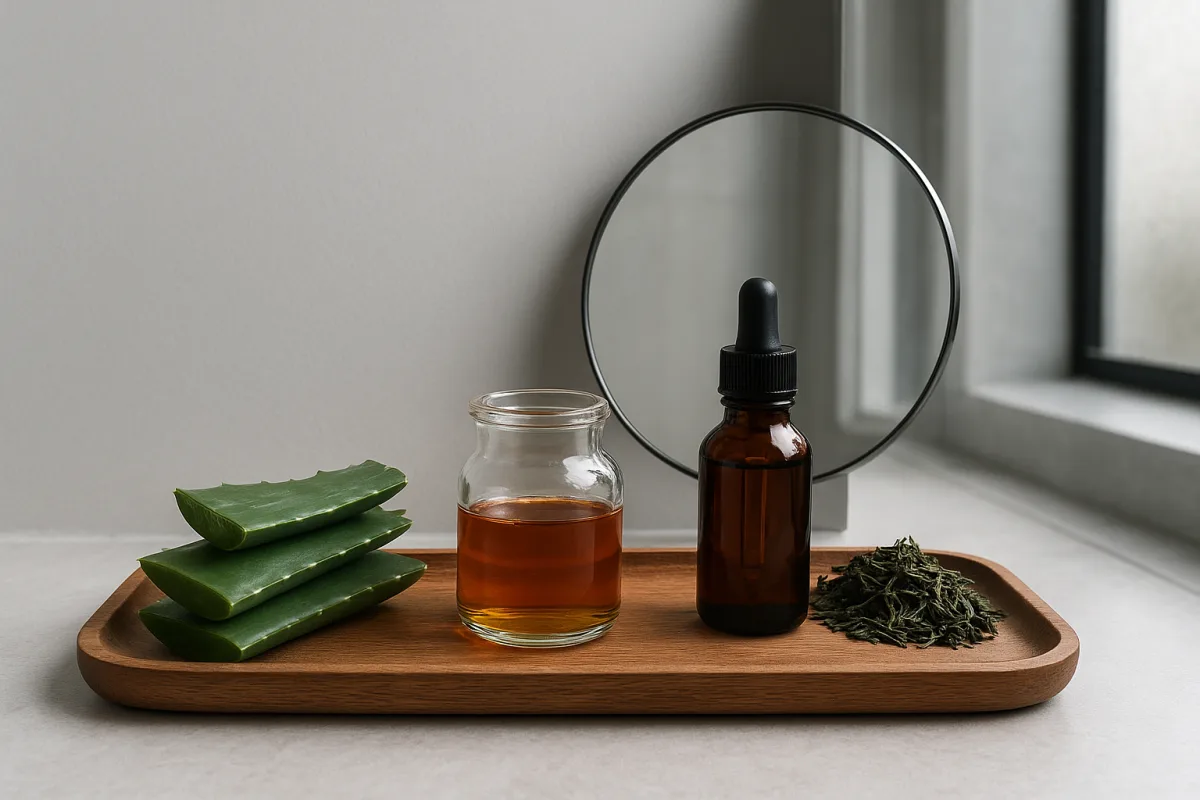
First, do not call every leftover mark a scar
The frustrating part is that “acne scars” describes several different things. A flat red, pink, brown or grey mark after a spot may be post-inflammatory colour change, while a depression, rolling texture or raised area is a structural change in skin.
That distinction matters because a botanical serum may make a flat mark look less noticeable over time, particularly by supporting hydration or reducing excess pigment. It is far less likely to change the architecture of an indented scar. [3][6]
If you cannot tell whether marks are flat or textured, or they are still changing, a dermatologist is the sensible next step. It is not something an ingredient list, a mirror or a blog can diagnose reliably.
For flat post-acne pigmentation, the earliest topical changes are generally expected around four weeks, roughly one skin-turnover cycle. The research brief places a more realistic window at four to 10 weeks, and potentially three to six months for darker skin tones. [7]
Atrophic, or indented, scars are slower and less responsive to home care. Even optimistic timelines run around three to six months, and no natural ingredient is supported as a reliable way to eliminate them. [3][7]
The non-negotiable first step: daily sunscreen
Before buying rosehip oil or mixing a kitchen mask, use sunscreen. UV exposure can darken post-inflammatory pigmentation, and it is especially counterproductive when your routine includes vitamin C, acids or anything potentially photosensitising. [6][7]
Choose a broad-spectrum sunscreen you will apply generously every morning and reapply when appropriate for your exposure. This is not glamorous, but it is more useful than rotating through five “scar-fading” oils while leaving marks unprotected in daylight.
Sunscreen is a cosmetic support step, not a way to erase textural scars. Its job here is to reduce the chance that light exposure makes residual colour more persistent, while giving slower topical ingredients a fair chance to show modest effects. [6]
Build a simple routine before trying natural remedies
Natural does not automatically mean gentle. Plant extracts, citrus, essential oils and vinegar can all sting, disrupt the skin barrier or trigger contact dermatitis, particularly when layered together in an enthusiastic DIY routine. [3][6]
Introduce one new product at a time and patch test it first. Apply a small amount to a discreet area, then wait for a reaction before using it across the face. If it burns, itches, swells or produces a rash, wash it off and stop.
Keep the rest of the routine dull on purpose: a mild cleanser, a plain moisturiser if needed, and sunscreen. This makes it much easier to identify the culprit if irritation appears, rather than blaming “purging” or assuming discomfort means an ingredient is working.
For leftover dark marks, consider vitamin C or green tea
Vitamin C is not strictly a natural kitchen remedy once formulated into a stable serum, but it is the more practical option for people drawn to plant-derived skincare. At concentrations of 10 to 20 percent, it can inhibit melanin formation and support collagen production. [6]
Apply a 10 to 20 percent vitamin C serum once daily, preferably in the morning under sunscreen. Give it at least four to six weeks before judging whether it is making a visible difference to flat, discoloured marks. [6]
That timeline is not a promise. Vitamin C can brighten the overall look of uneven tone, but evidence does not justify presenting it as a way to fill acne-scar depressions or remove scars altogether. [3][6]
Green tea extract is another reasonable option, especially for someone who wants a less aggressive-feeling botanical active. A 2017 study cited in the research brief reported up to an 89 percent reduction in certain blemishes after eight weeks, although that is not the same as proven scar revision. [3]
Look for green tea extract in a leave-on product rather than relying on cooled tea bags, which do not provide a known, stable concentration. Use it consistently for about eight weeks before deciding whether it helps the visible redness or unevenness left behind by breakouts. [3]
For dry, uneven-looking skin, rosehip oil is the more defensible oil
Rosehip seed oil contains essential fatty acids and naturally occurring retinoid-related compounds. Applied twice daily for at least eight to 12 weeks, it may improve the appearance of skin texture and pigmentation, though the evidence does not establish a dramatic change in established acne scars. [3][6]
Use two or three drops after water-based products, or mix the oil into a bland moisturiser. It is best treated as a supportive emollient that may make skin look smoother and more comfortable, not as a substitute for a dermatologist-led scar plan.
Price is not a reliable proxy for effectiveness here. Wholesale rosehip oil varies dramatically, from roughly $44 to $167 per litre depending on origin, purity, supplier and order quantity, according to European market reporting from CBI and supplier pricing from Motherland Organics. [10][13]
For an individual facial oil, check that the ingredient list actually identifies rosehip seed oil, rather than using a vague botanical blend. Fragrance, citrus oils and multiple essential oils make patch testing more important, not less.
Aloe vera can be a low-drama adjunct, not a scar eraser
Aloe vera has anti-inflammatory and wound-healing properties, and a 2019 review covering 23 trials supports its adjunctive role in scar care. “Adjunctive” is the useful word: it may support a routine, but it is not evidence that aloe alone reshapes acne scars. [3]
Choose a simple fragrance-free aloe gel or product with aloe high on the ingredient list. Apply it twice daily for several weeks to months, particularly if your skin feels irritated by a more active routine. [3][6]
Avoid assuming that every green gel is soothing. Some contain alcohol, fragrance or colourants that can be irritating. The ingredient list matters more than the familiar aloe-leaf picture on the front label.
Turmeric and honey: plausible, but do not oversell them
Turmeric masks, often mixed with honey, are commonly suggested for pigmentation. The research brief supports using a turmeric-and-honey mask up to three times weekly for a possible gradual effect on uneven colour, but notes that the pilot trial did not provide quantitative efficacy data. [3][6]
In plain English, there is not good evidence that this mixture visibly reduces scar size, depth or colour by a known amount. It may be a tolerable occasional cosmetic step for some people, but it should not become the centre of a scar routine.
Honey itself is a particularly good example of why antimicrobial properties do not automatically translate to scar improvement. A 2016 study found that topical honey did not improve scar appearance, despite honey’s wound-healing and anti-inflammatory reputation. [3]
If you use a honey-based mask, use it once or twice daily at most and stop if it irritates. Do not combine it with lemon juice in the hope that two internet remedies will become twice as effective.
Avoid lemon juice, vinegar experiments and essential-oil shortcuts
Lemon is the most persistent bad idea in natural skincare. Citrus contains furanocoumarins, compounds associated with phototoxic reactions that can cause a significant skin response after sun exposure and potentially worsen pigmentation. [3][6]
Some home-remedy guides suggest diluted lemon juice once or twice weekly at night. The safer reading of the evidence is to skip it, particularly if you have sensitive skin, deeper skin tone, ongoing breakouts or any chance of sunlight exposure. [3][12]
Apple cider vinegar is also often proposed as a daily diluted exfoliant, usually one part vinegar to three parts water. The issue is not whether it is acidic, it is that acid irritation can itself leave skin more inflamed and uneven-looking. [4][6]
If you are tempted to try diluted vinegar, do not use it alongside vitamin C, retinoid products, exfoliating acids or scrubs. Patch test first, use it sparingly, and stop at the first sign of sting, dryness or redness. There is no prize for tolerance.
Tea tree and lavender oils require equal caution. Essential oils must be diluted properly, and using them neat on a mark is unsafe because contact dermatitis can look a lot like a worsening skin problem. [3][6]
Tea tree oil is also not a bargain by default. Wholesale pricing ranges from about $81 to $186 per litre, depending on purity, supplier and volume, and a high price does not make an irritating essential oil a better scar option. [3]
Do not use vitamin E or at-home microneedling for this job
Vitamin E is often sold as the classic scar ingredient, but familiarity is not evidence. A 2016 review found insufficient evidence for scar improvement and reported that contact dermatitis may affect up to 30 percent of users. [3]
That is an unusually poor trade-off for acne-prone or reactive skin: uncertain benefit, with a meaningful chance of a new rash. Leave vitamin E oils and capsules out of a routine designed to make marks less conspicuous.
At-home microneedling is another area where “natural” has drifted into “do it yourself.” The research brief found no evidence supporting safe, effective home microneedling for acne scars, and flags irritation, hyperpigmentation and additional scarring as risks. [3][6]
Professional procedures are different because depth, sterility, skin assessment and aftercare are controlled. If indented scars are affecting you, ask a dermatologist about options rather than trying to recreate a clinical procedure with an online roller.
Know when natural care has reached its limit
Silicone gels and laser therapy have stronger clinical evidence for measurable changes in scar thickness and pigmentation than natural remedies. A controlled study published in JAMA Dermatology compared pulsed-dye laser treatment and silicone gel sheeting for hypertrophic scars, which is a different scar type from typical pitted acne scarring but still illustrates the stronger evidence base for clinical approaches. [9]
A systematic review of topical scar products similarly supports the broader point: “natural” is not a quality category, and evidence varies sharply by ingredient and scar type. [1] If marks are raised, deeply pitted, painful, spreading, or causing significant distress, book a dermatology appointment.
The realistic natural approach is therefore restrained: protect from sun, choose one evidence-informed topical such as vitamin C, green tea, aloe or rosehip oil, and use it long enough to assess it. Slow, modest cosmetic improvement is plausible. Dramatic scar removal is not.
Frequently Asked Questions
What natural ingredients help treat acne scars?
Aloe vera, rosehip oil, vitamin C, and green tea extract have the most plausible supportive evidence for improving acne scars, particularly post-inflammatory pigmentation. Turmeric masks and diluted apple cider vinegar may also help reduce pigmentation and exfoliate marks, but none of these ingredients can reliably eliminate indented scars.
How long does it take to see results from natural acne scar treatments?
Visible improvements in post-inflammatory pigmentation typically appear after 4 to 10 weeks, with up to 3 to 6 months for darker skin tones. Indented or atrophic scars are slower to respond, often requiring 3 to 6 months of consistent treatment, and natural remedies generally do not produce significant measurable changes in scar depth or size.
Can sunscreen help with fading acne scars naturally?
Yes, using a broad-spectrum sunscreen every morning is essential. Sunscreen prevents UV exposure from darkening post-inflammatory pigmentation and helps protect the skin when using photosensitizing ingredients like vitamin C. While sunscreen does not erase textural scars, it supports the fading of discoloration and protects improvements gained from topical treatments.
Are natural remedies effective for indented acne scars?
Natural remedies have not shown reliable or measurable improvement in the depth or size of indented acne scars. Structural changes in the skin usually require professional treatments, as topical natural ingredients mainly affect surface pigmentation rather than scar architecture.
Which natural products should I avoid for acne scars?
Lemon juice, undiluted essential oils, vitamin E oil, and at-home microneedling devices should be avoided. These can cause irritation, allergic reactions, or worsen pigmentation, especially in deeper skin tones. Lemon juice poses a phototoxicity risk and may increase sensitivity to sunlight.
How we researched this
This article was assembled from 13 cited references.
Nothing here is based on hands-on testing. Where a figure or finding appears, it belongs to the source cited beside it, and the writing says so rather than implying otherwise. Every source is listed below so you can check it.
Sources
- Topical Scar Treatment Products for Wounds: A Systematic Review - PubMed
- How to Get Rid of Old Scars: Top 10 Remedies
- Natural Acne Scar Remedies: What Works and What Doesn't
- Acne Scars — 8 Natural Methods to Fade Them Fast
- Treat Pimple Scars Naturally in Markham | ID Cosmetic Clinic
- How to Fade Acne Scars Naturally: What Actually Works - ScienceInsights
- How Long Does It Take for Acne Scars to Fade - acneadvocate.com
- Sensitive Skin? These Retinol Alternatives Deliver on Glow, Minus the Irritation
- Prospective, Single-blind, Randomized, Controlled Study to Assess the Efficacy of the 585-nm Flashlamp-Pumped Pulsed-Dye Laser and Silicone Gel Sheeting in Hypertrophic Scar Treatment | Dermatology | JAMA Dermatology | JAMA Network
- Wholesale Rosehip Oil – Pure Organic Cold Pressed | Motherland Organics – MotherlandOrganics
- 16 Effective Home Remedies for Acne Scars
- Does Honey and Lemon Work for Acne? - Necole Bitchie
- Entering the European market for rosehip oil | CBI
Related Articles
How to Fix Dark Circles Under Eyes: Causes and Treatments
Learn how to fix dark circles under eyes with skincare, routines, and lifestyle tips tailored to different causes and skin types.

How to Treat Hyperpigmentation: Safe and Effective Tips
Learn how to treat hyperpigmentation safely with effective ingredients, sun protection, and routines for lasting dark spot fading.
How to Choose a Moisturizer for Combination Skin
Learn how to choose the best moisturizer for combination skin with tips on ingredients, textures, and applying to oily and dry zones effectively.
How to Introduce New Skincare Products Safely
Learn how to introduce new skincare products safely with patch testing, gradual use, and tips to avoid irritation and track reactions.