
What to Avoid in Skincare If You Have Acne
Learn what to avoid in skincare if you have acne, including irritants and comedogenic ingredients, plus tips for choosing the right moisturizer.
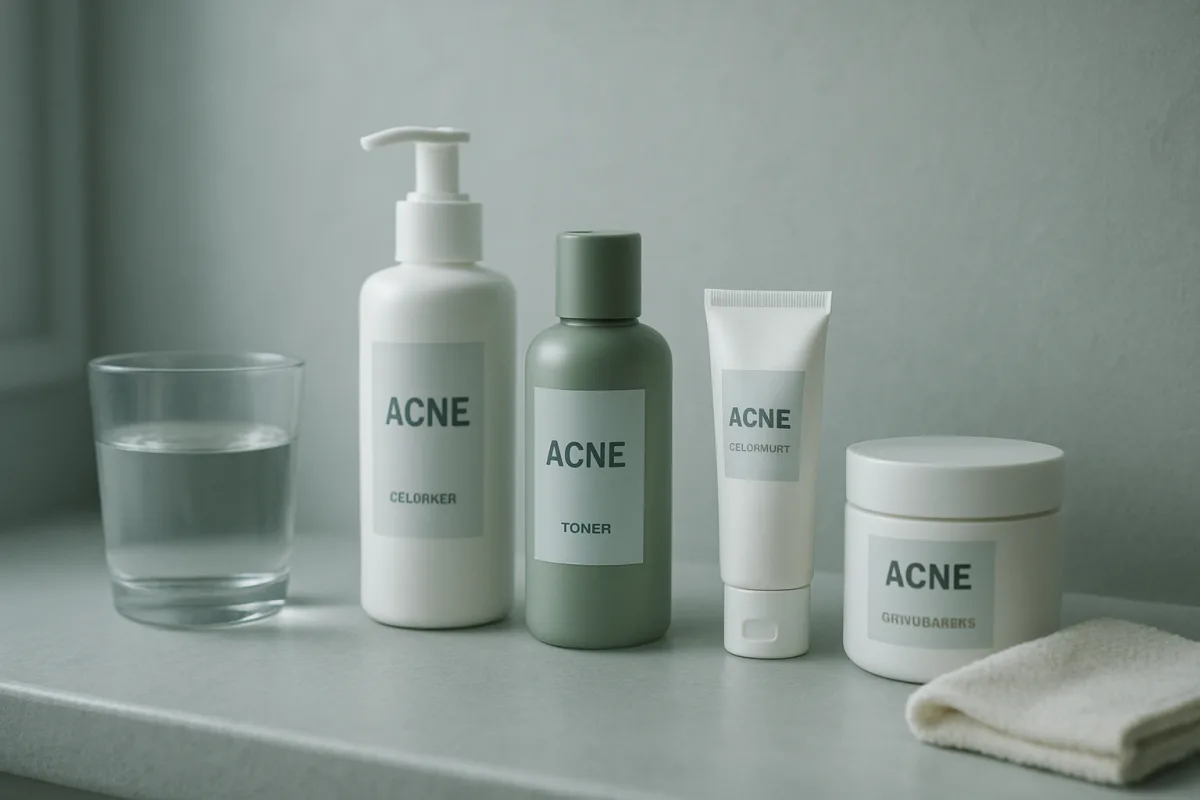
The ingredient list problem starts with a number
A jar of rich face cream can look harmless until you reach ingredients such as isopropyl myristate, wheat germ oil, or decyl oleate. These are commonly assigned a comedogenicity rating of 5, the top of the familiar scale.[2][3]
Coconut oil, cocoa butter, lanolin, palm oil, and shea butter are often rated 4. For someone whose acne tends to appear as clogged pores, these are reasonable ingredients to put on a personal avoid list first.[2][3]
But do not mistake that list for a verdict on every product or every face. The comedogenicity scale was built largely from rabbit-ear studies, and those results do not translate cleanly to human skin or to every formula.[2][3]
That limitation changes how we would use the scale. We would treat ratings of 4 and 5 as a reason to be cautious, especially in leave-on facial products, not as proof that one ingredient caused every breakout.
The outcome depends on the entire formula, how much you apply, where you apply it, and your own skin. Human clinical trials have not conclusively connected every frequently listed “comedogenic” ingredient with worsened acne across diverse populations.[2][3]
There is also no required acne-risk warning on cosmetic labels in the United States, Europe, or Asia. You are expected to infer a product’s potential from its ingredient list, despite no regulation requiring brands to flag acne-aggravating ingredients.[14]
What “non-comedogenic” can and cannot tell you
“Non-comedogenic” is useful marketing shorthand, but it has no legal definition. A product carrying that label has not passed a universal, regulated test proving it will not clog pores for you.[11][12]
That is why a label cannot replace observation. If a new moisturizer repeatedly coincides with small clogged bumps in the areas where you use it, stop it and give your skin time before adding something else.
Patch testing can help you spot immediate irritation, but it will not reliably predict whether a face product contributes to congestion over time. Acne behavior is slow, variable, and often tied to repeated use rather than one application.
We would start with a short ingredient list when possible, then avoid known personal triggers and high-rated ingredients in products left on acne-prone areas. That is a lower-risk approach than trying to decode every ingredient as universally good or bad.
Do not avoid moisturizer, avoid the wrong kind for you
The common reaction to acne is to strip everything back, including moisturizer. That can backfire when acne treatments or frequent washing leave your skin dry, tight, flaky, or burning.[1][11]
The American Academy of Dermatology says moisturizer may be needed if acne treatment dries or irritates your skin. Moisturizers support hydration and can reduce the irritation that encourages people to overcorrect with harsher products.[11]
A 2014 review in the Journal of Dermatological Treatment also supports appropriate moisturizer use alongside acne care. The point is not to coat the skin in anything rich, but to choose a formula your skin tolerates.[1]
Look for lightweight, non-comedogenic or oil-free moisturizers with humectants and barrier-supporting ingredients such as glycerin, hyaluronic acid, ceramides, or niacinamide.[1][11] These ingredients fit the job of adding water and reducing dryness without requiring a heavy-feeling finish.
This is where blanket advice about oils fails. Some oils and butters sit on common comedogenic ingredient lists, but avoiding all moisturizers can leave you with more irritation from benzoyl peroxide, retinoids, and exfoliants.[1][11]
We would skip a rich facial balm containing several high-rated ingredients if clogged pores are your pattern. We would not skip moisturizer itself, especially if your acne routine causes dryness or peeling.
Irritation is another route to worse-looking skin
Pore clogging is not the only concern. A product can be free of classic comedogenic ingredients and still be a poor fit if it repeatedly stings, causes visible redness, or leaves your skin feeling stripped.
Denatured alcohol can remove surface oils and irritate some people, potentially worsening the dryness and inflammation around breakouts.[4][5] It is different from fatty alcohols such as cetyl alcohol and stearyl alcohol, which are used as moisturizing, texture-building ingredients.[4]
Fragrance and essential oils are another category to approach cautiously. They are common irritants and allergens, so skipping them is a reasonable move if your skin is sensitive, reactive, or acne-prone.[4]
There is no established concentration at which denatured alcohol, fragrance, essential oils, or silicones become universally safe or harmful for acne-prone skin. Ingredient lists tell you what is present, not how your individual skin will respond.[4][5]
Silicones deserve less fear than they often get. They are generally considered safe, though some people find silicone-heavy products feel too occlusive on their skin, and there is no concentration cutoff that predicts that experience.[12]
If your goal is to eliminate likely trouble without building a punishing routine, fragrance and denatured alcohol are better early cuts than all silicones. Keep the rest of the routine stable enough to tell whether that change helped.
Avoid the scrub-and-strip cycle
A rough scrub can feel productive when your skin is textured. With active breakouts, aggressive friction can create irritation and micro-tears, adding redness without solving the reason pores are becoming blocked.[17]
For acne-prone skin, chemical exfoliants, particularly salicylic acid, are usually the better fit because salicylic acid can enter pores and has anti-inflammatory effects.[15][17] More is not better.
Over-exfoliation damages the skin barrier and can leave skin red, dry, and more reactive. If your cleanser, treatment, exfoliant, and spot product all tingle, you may be running too many irritating steps at once.[9][17]
If you use a physical exfoliant, choose smooth, rounded particles such as jojoba beads, limit it to one or two times weekly, and avoid scrubbing over active breakouts.[17] There is no precise particle-size threshold that makes a scrub safe.
We would favor salicylic acid over a grainy facial scrub for acne-prone skin. Then we would use it cautiously, because even a well-chosen active can become an irritant when paired with too many other exfoliating steps.
Keep the routine boring enough to work
Wash with a gentle cleanser twice daily, in the morning and at night. More frequent cleansing can damage the skin barrier and worsen the dryness and irritation that make acne care harder to tolerate.[7][16]
In the morning, benzoyl peroxide or vitamin C can fit into an acne-focused routine, beginning with lower concentrations.[8][10] Benzoyl peroxide, azelaic acid, and retinol have human clinical-trial support in acne management, unlike many trend-driven skincare ingredients.[15]
At night, topical retinoids such as adapalene are used to reduce inflammation and help prevent clogged pores.[8][9] Retinoids can increase sun sensitivity, so daily broad-spectrum SPF 50+ sunscreen belongs in the morning routine.[8][9]
Moisturizer is the buffer that often makes this schedule tolerable. Apply it daily, and reduce the frequency of irritating steps if dryness, flaking, or stinging begins to dominate your skin’s response.[11]
Results from skincare are usually slow and modest, especially when you are trying to identify what made things worse. Avoid introducing several new products together, because you lose the ability to connect a change with a reaction.
Change the texture with the weather, not the whole routine
Hot, humid weather can mean more sebum and sweat, which can promote bacterial growth on the skin. Gentle cleansing, lightweight moisturizer, and sunscreen are the baseline adjustments recommended for summer conditions.[13]
Cold, dry weather can create the opposite problem: a weakened barrier and dryness that may trigger reactive oil production. A cream-based cleanser and a richer moisturizer containing ceramides and hyaluronic acid may suit that period better.[13]
Indoor humidifiers are also suggested for dry winter conditions.[13] Give skin two to four weeks to adjust to a new climate before reacting with a complete routine overhaul, and introduce changes gradually.[13]
The ingredients to avoid are therefore not fixed forever. A moisturizer that feels excessive during a humid summer may be the one product keeping treatment-related dryness manageable in a cold, dry winter.
When to stop troubleshooting alone
If breakouts are painful, deep, widespread, leaving scars, or persist despite a gentle routine, see a dermatologist. Skincare can support acne management, but it cannot replace a medical assessment of symptoms that may need prescription care.
For everyone else, start by removing the obvious repeat offenders: a heavily fragranced product, a harsh scrub, a drying alcohol-heavy formula, or a leave-on product packed with ingredients rated 4 or 5. Then moisturize, use sunscreen, and give the simpler routine time.
Frequently Asked Questions
What ingredients should I avoid in skincare if I have acne?
Ingredients with high comedogenic ratings of 4 or 5, such as isopropyl myristate, wheat germ oil, decyl oleate, coconut oil, cocoa butter, lanolin, palm oil, and shea butter, are commonly advised to avoid. However, these ratings come from animal studies and do not always predict human skin reactions, so they should be used as a cautious guide rather than a strict rule.
Are all oils bad for acne-prone skin?
Not all oils are bad for acne-prone skin. While some oils like coconut oil and cocoa butter may clog pores for some people, others may tolerate certain oils without issue. The overall formula, amount applied, and individual skin response determine whether an oil worsens acne.
How does irritation affect acne-prone skin?
Irritation damages the skin barrier, making acne harder to manage. Ingredients such as fragrance, essential oils, and denatured alcohol can cause irritation, so avoiding these if they bother your skin can help reduce breakouts linked to barrier damage.
Can moisturizers worsen acne?
Moisturizers do not necessarily worsen acne and can be important if acne treatments or cleansing dry or irritate the skin. Using a lightweight, non-comedogenic moisturizer supports hydration and barrier repair, which may reduce irritation-related acne flares.
What does non-comedogenic really mean for acne?
“Non-comedogenic” is a marketing term without a legal or standardized definition. It does not guarantee a product will not clog pores for everyone. Observing how your skin reacts over time is the best way to determine if a product is suitable.
How we researched this
This article was assembled from 17 cited references.
Nothing here is based on hands-on testing. Where a figure or finding appears, it belongs to the source cited beside it, and the writing says so rather than implying otherwise. Every source is listed below so you can check it.
Sources
- Moisturizers for Acne: What are their Constituents?
- Is This Acne Safe? How to Spot Pore-Clogging Ingredients - ScienceInsights
- Comedogenic Ingredients: Dermatologist Guide
- Ingredients to Avoid with Sensitive Skin | Dermatology
- Skincare Ingredients That Worsen Acne
- 23 Moisturisers That Won't Clog Your Pores, According to a Skincare Expert
- Dermatologists settle it: this is how often you should wash your face for cleansed - not stripped - skin
- Best Skincare Routine for Acne, Morning & Night Steps | AcnePath
- Skincare Routine for Acne-Prone Skin | La Roche-Posay
- The Acne Skincare Routine That Actually Works (AM & PM), NeedSkincare
- Moisturizer: Why you may need it if you have acne
- Non Comedogenic Moisturizers for Acne-Prone Skin: What to Check - acneadvocate.com
- How Climate Affects Acne: Humidity, Dry Air, and Everything In Between | Teen Acne Solutions
- Omnibus Act VIII, new substances added to the list of ingredients restricted or prohibited in cosmetics from May 2026
- Cosmeceuticals in acne vulgaris: from mechanism of action to clinical application
- Acne-Prone Skin: A Simple Routine That Can Help Breakouts
- Confused by Exfoliants? Here's the Difference Between Chemical and Mechanical Options
Related Articles
How to Layer Products for Acne-Prone Skin Correctly
Learn how to layer products for acne-prone skin with the right order, timing, and active ingredient use to avoid irritation and maximize results.
Safe Skincare Ingredients During Pregnancy
Learn which skincare ingredients are safe during pregnancy and how to build a gentle, effective pregnancy skincare routine.
How to Treat Redness on Face: A Gentle Skincare Guide
Learn how to treat redness on face with gentle cleansing, moisturizing, and key ingredients to calm and restore irritated skin.
Best Ingredients for Oily Skin: Effective Skincare Solutions
Discover the best ingredients for oily skin and how to use them to reduce shine, unclog pores, and improve your skincare routine.