
Best Ingredients for Skin Hydration
Discover the best ingredients for skin hydration, how to use humectants and moisturizers for effective water retention and skin barrier support.
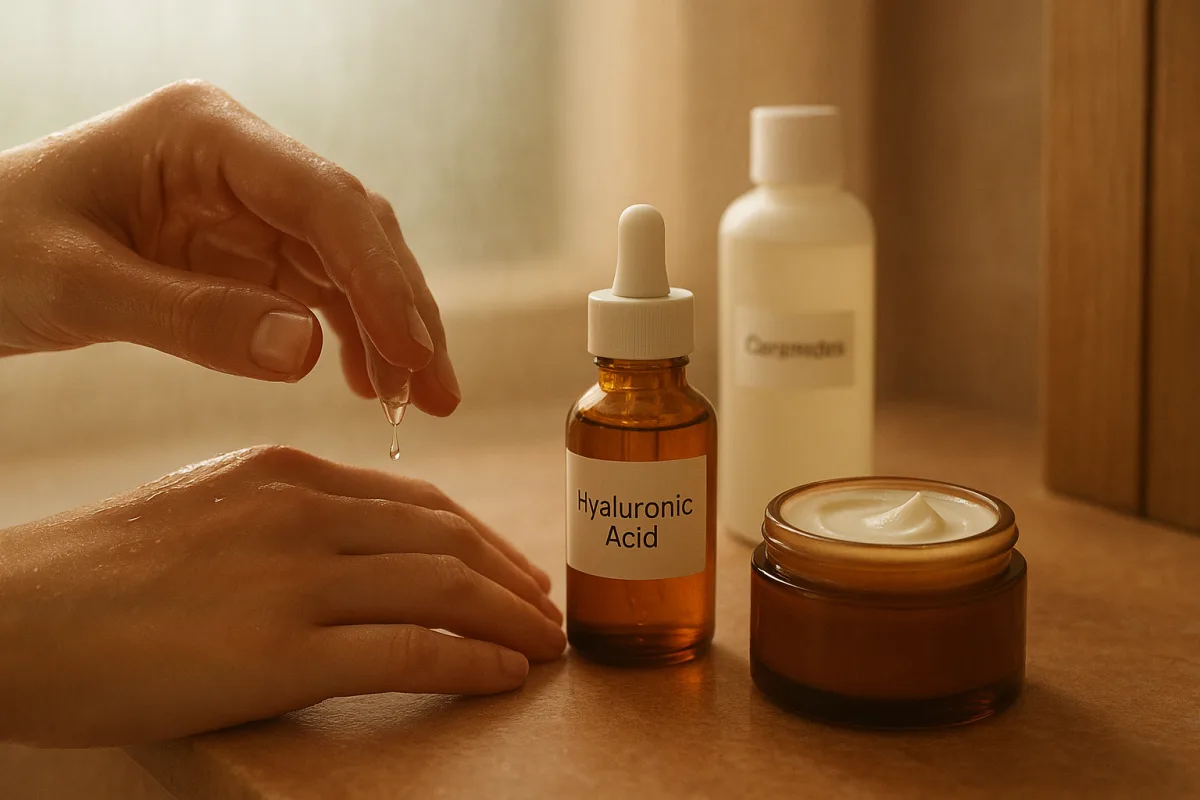
Hydration is a water-management system, not a hyaluronic-acid percentage
When people say their skin is dehydrated, they often mean it feels tight, looks dull, or makes fine surface lines more obvious. Those are cosmetic observations, not a diagnosis, and they do not automatically tell you which ingredient to buy.
The useful concept is water management. A good routine has to do two jobs at once: increase water held in the outermost skin layer, then slow the loss of that water into the environment. Humectants handle the first job. Barrier lipids and occlusive moisturiser ingredients assist with the second.
This is why a high-priced hyaluronic acid serum can underperform when used alone. It may bind water at the surface, but it does not necessarily provide enough of the film-forming or lipid support needed to keep that water there.
The most relevant measure behind this is transepidermal water loss, often shortened to TEWL. It describes water moving from skin into the surrounding air. Cold, dry conditions can raise TEWL by an estimated 10% to 25%, while winter also reduces surface sebum. [15][16]
That number matters because it explains why the same gel serum can feel perfectly adequate in humid July and oddly ineffective in a heated room in January. The problem is not always that your skin needs a stronger serum. It may need a better seal.
The three parts of a hydration routine
Think of a moisturising routine as a three-part system: water, humectant, and seal. You do not need three separate products, but a successful formula or routine usually covers these functions.
First comes water. Skin does not need to be dripping wet, and repeatedly splashing the face is not a treatment. It simply helps create a water source for ingredients designed to hold water in the surface layers.
Second comes the humectant. Glycerin and hyaluronic acid are the familiar examples. They attract and bind water, making the upper skin layer feel more flexible and look temporarily smoother.
Third comes the seal, usually a moisturiser containing emollients, barrier-supporting lipids, or occlusive ingredients. This reduces the chance that a humectant-heavy serum leaves the face feeling tight again an hour later.
CeraVe’s facial-moisturising guidance recommends moisturising on damp skin and doing so morning and night. [13] That advice is more valuable than the internet’s obsession with whether one serum contains 1% or 2% hyaluronic acid.
There is a caveat. The commonly repeated claim that hyaluronic acid on dry skin inevitably “pulls water from deeper layers” is too neat for a complicated biological process. Still, applying it to slightly damp skin and following with moisturiser is low-risk, sensible practice, especially in dry air. [18]
Humectants: useful, ordinary, and easy to overrate
Hyaluronic acid, often listed as sodium hyaluronate, is a humectant. It does not inject water into skin, rebuild lost volume, or reproduce the effect of medical injectable procedures. In a cosmetic serum, its most plausible benefit is improved surface hydration and a more cushioned feel.
The range repeatedly cited for topical hyaluronic acid is 0.1% to 2%. [6] Above 2%, formulas can become more viscous and sticky, without a convincing reason to expect proportionally better hydration. More is mostly a texture decision, not a performance guarantee.
A formula also matters more than the ingredient listing alone suggests. Hyaluronic acid can appear alongside glycerin, panthenol, beta-glucan, polymers, oils and emulsifiers. The ingredient cannot be evaluated as if it were working in a vacuum.
Glycerin is less glamorous and often more useful. It is a small, reliable humectant used throughout moisturisers and cleansers, typically at around 3% to 10% in hydrating products. Higher levels can feel tacky, which is a usability problem rather than evidence of superior hydration. [7]
For dry-feeling skin, a 4% to 5% glycerin formula is often a sensible target cited in consumer ingredient guidance. [3] This is not a magic threshold. It is simply a range where formulators can obtain humectant benefit while still making a product people can tolerate and use consistently.
Beta-glucan and ectoin are also commonly positioned as hydrating ingredients. They are reasonable supporting players, especially in formulas designed for comfort, but the brief provides no direct comparative evidence showing that either consistently beats glycerin or hyaluronic acid in real-world moisturisation. [2][20]
That distinction matters at the checkout. A product featuring ectoin or beta-glucan may be well formulated, but the presence of a newer-sounding ingredient is not proof that it will outperform a plain glycerin cream.
Ceramides answer a different question
Ceramides are not primarily there to make skin feel wet. They are lipid components associated with the skin barrier, the organised structure that helps limit water loss and shields the surface from external irritants. [8][25]
That makes ceramides especially relevant when the issue is recurring tightness despite using hydrating serums. If humectants attract water but the barrier is not holding it effectively, adding another watery layer can be less helpful than switching to a richer moisturiser.
Reported effective ceramide concentrations vary substantially. General ingredient guidance places them around 0.01% to 0.5%, while sensitive-skin guidance sometimes suggests 1% to 5%. [8][12] That is not a settled prescription for everyone.
The gap likely reflects formulation differences, differing definitions of “sensitive skin,” and a frustrating fact about skincare research: percentages alone rarely capture the entire delivery system. Ceramide type, accompanying lipids, vehicle, preservatives and individual tolerance all affect the experience.
For that reason, do not reject a moisturiser because it does not advertise a heroic ceramide percentage. Brands often do not disclose percentages, and there is no evidence-based rule that a 5% ceramide claim must hydrate five times better than a lower-dose, well-balanced cream.
Niacinamide can be useful in this wider barrier-focused approach, generally at 2% to 5% for sensitive skin and around 4% to 5% in lightweight formulas aimed at oilier skin. [10][11][12] It is not a replacement for moisturiser, however.
The routine that makes the ingredients work
After cleansing, leave a little water on the face rather than towel-drying it completely. Apply a glycerin or hyaluronic acid serum, then follow with moisturiser. In the morning, finish with a broad-spectrum sunscreen appropriate for your needs.
At night, the same serum-plus-moisturiser structure is enough for most people. Wait roughly 30 to 60 seconds between layers if that helps reduce pilling, although skincare does not need a laboratory-style pause between every product. [14]
The order matters because a moisturiser applied before a watery serum can make subsequent layers less even and more prone to rolling. More importantly, skipping moisturiser after a hydrating serum leaves the water-management system incomplete. [18]
The common mistake is not owning too little hyaluronic acid. It is trying to solve dryness by adding multiple actives, exfoliating more often, or using a harsh high-pH cleanser, all of which may make the skin feel less comfortable. [19]
Retinoids, AHAs and BHAs can have legitimate cosmetic roles, but stacking several in pursuit of “glow” can lead to irritation that undermines a hydration routine. If your face stings with plain moisturiser, simplify rather than adding another active. [19]
Twice-daily moisturising is the general recommendation in CeraVe’s guidance. [13] Some people with very dry skin may prefer another application during the day, but ongoing severe dryness, eczema-like symptoms, facial cracking or inflammation needs medical assessment rather than a more elaborate shopping list.
What the promising extras can, and cannot, add
Ergothioneine is an antioxidant ingredient with interest in skin ageing research. A 2026 paper on ergothioneine, collagen peptides and sodium hyaluronate links these ingredients with oxidative-stress and extracellular-matrix pathways, but that does not make ergothioneine a first-line topical hydrator. [1]
Its proposed role is more indirect than glycerin’s. Antioxidant support may be relevant to broader skin biology, but the evidence base for straightforward surface hydration is less established than it is for humectants and barrier lipids. [1][2]
Oral collagen peptides occupy a similar category: plausible, potentially useful, but not interchangeable with moisturiser. Suggested intake is often 5 to 10 grams daily, yet the evidence for hydration is less robust than the practical evidence behind topical glycerin, hyaluronic acid and barrier-focused creams. [4]
Supplements also involve cost, flavour, dietary restrictions and medication considerations. They are not necessary for a basic hydration routine, and no oral product should be treated as a substitute for evaluating a persistent skin problem with a clinician.
Choose format by climate and skin feel, not fashion
Serums are useful when you want to add humectants without much weight. NBC News places budget hydrating serums from brands such as The Ordinary and CeraVe around $7 to $23, while premium options from La Roche-Posay and SkinCeuticals can range from roughly $40 to $120. [21]
The lower-priced group suits someone who needs a simple humectant layer under an existing moisturiser. Premium formulas may offer a different texture, packaging or ingredient blend, but price alone does not establish better hydration.
Creams are more useful when the missing part is the seal. Budget creams from CeraVe and Neutrogena are cited around $14 to $19, while Innisfree and Tatcha sit in the $30-plus mid-premium category. [22]
A cream suits dry-feeling skin, winter weather, or anyone whose skin feels tight shortly after serum application. Gel creams may suit oilier skin or humid weather, but they still need enough moisturising support to be comfortable through the day.
Mists are the least essential format. Allure lists examples from La Roche-Posay at about $25 to Caudalie at about $49. [24] They may feel refreshing, but the brief found no direct evidence that mists outperform serums or creams for lasting hydration.
Use a mist because you enjoy it, not because it replaces moisturiser. Without a follow-up layer, repeated misting can simply leave water to evaporate. For most people, that money is better directed toward a gentle cleanser, a humectant product and a moisturiser they will actually use.
The slow, unglamorous answer is the accurate one: choose a glycerin or hyaluronic acid product you like, apply it to damp skin, cover it with moisturiser, and adjust the richness when the weather changes. That system is more important than chasing the newest hydration claim.
Frequently Asked Questions
What are the best ingredients for skin hydration?
Top scientifically validated hydrating ingredients include hyaluronic acid, glycerin, ceramides, collagen peptides (oral), beta-glucan, ectoin, and ergothioneine. Recommended concentrations for topical use are roughly 0.1% to 2% for hyaluronic acid, 3% to 10% for glycerin, and 0.01% to 0.5% for ceramides, with higher ceramide levels sometimes used for sensitive skin.
How do humectants like glycerin and hyaluronic acid work?
Humectants attract and bind water to the outermost skin layer, increasing surface hydration and making skin feel more flexible and smoother. They do not inject water into the skin but help hold water present on or near the skin surface.
Why is a moisturizer needed after applying a hydration serum?
A hydration serum with humectants alone can bind water but does not prevent it from evaporating. A moisturizer containing emollients, barrier-supporting lipids, or occlusive ingredients seals in the moisture, reducing transepidermal water loss and preventing the skin from feeling tight again.
What role do ceramides play in skin hydration?
Ceramides support the skin’s lipid barrier, which slows the rate at which water escapes from the skin. Unlike humectants that attract water, ceramides help retain existing moisture by strengthening the barrier function.
How should I layer hydrating products for best results?
Apply a humectant-containing serum such as one with glycerin or hyaluronic acid onto lightly damp skin to provide a water source for the humectants to bind. Follow this with a moisturizer to seal in the hydration and reduce water loss, especially in dry or cold environments.
How we researched this
This article was assembled from 25 cited references.
Nothing here is based on hands-on testing. Where a figure or finding appears, it belongs to the source cited beside it, and the writing says so rather than implying otherwise. Every source is listed below so you can check it.
Sources
- Ergothioneine, collagen peptides, and sodium hyaluronate ameliorate facial skin aging via modulating oxidative stress, inflammation, and extracellular matrix homeostasis.
- Best Skincare Ingredients 2026: Evidence Guide | ScanSkinAI
- Don't Sleep on Glycerin-Experts Say It's The Superior Hydrating Ingredient for Dry Skin
- Best Supplements for Skin Health (2026)
- The Six Ingredients Defining Skincare in 2026 — What the Evidence Actually Says — Skin Stacker
- Hyaluronic Acid and Moisture Retention: Hydrating Sensitive Skin at the Molecular Level | June Adaptive Our Community Blog blog
- Humectants — Skincare Products — DermApproved
- Ceramides vs Glycerin — Ingredient Comparison | Skincare Database
- The Complete Skincare & Beauty Guide 2026 — Routines, Ingredients & Top Picks | GiftedPicks | GiftedPicks
- Skincare Ingredients Glossary: 15 Key Actives Explained
- Best Skincare for Sensitive Skin Guide | Mega We Care
- Skincare Routine for Sensitive Skin
- Facial Moisturizing 101 | How To Moisturize Your Face | CeraVe
- How Long to Wait Between Skin Care Steps: Exact Timing Guide
- PDRN Seasonal Skincare Guide — Adapt Your Routine for Every Season | PDRN Care
- Seasonal Skincare Routine: How To Transition Between Seasons – SkincareEssentials
- Your skin changes dramatically with the seasons | KAIAN Inc.
- Common Hyaluronic Acid Serum Mistakes | Dermatology
- How to Layer Skincare Products Without Irritating Your Skin – elementrē dermo cosmetics
- Skincare Ingredients for Hydration: The Complete Science-Backed Guide | Blumy
- The Best Hyaluronic Acid Serums and Creams for Hydrated Skin 2026
- Best Skincare Under $20: Affordable Products That Actually Work (2026) — WhatNotSell
- Announcing our 2026 woman&home skin awards winners!
- 8 Best Hydrating Face Mists 2026 to Refresh and Hydrate Skin | Allure
- Best Ingredients for Skin Barrier Repair (2026) | Victorian Cosmetic Institute
Related Articles
How to Choose a Toner for Dry Skin: Key Tips and Ingredients
Learn how to choose a toner for dry skin with expert tips on ingredients, usage, and what to avoid for better hydration and skin comfort.
How to Choose a Skincare Routine for Aging Skin
Learn how to choose a skincare routine for aging skin with tips on sunscreen, retinoids, and avoiding irritation for effective anti-aging care.
Best Time to Apply Moisturizer: When and How to Do It Right
Learn the best time to apply moisturizer for optimal hydration and how to layer it properly in your skincare routine.
How to Choose a Gentle Cleanser for Sensitive Skin
Learn how to choose a gentle cleanser with skin-friendly pH and safe ingredients to avoid irritation and support sensitive skin health.