
How to Interpret Skin Type Test Results for Skincare
Learn how to interpret skin type test results to understand your skin's needs and choose the right skincare routine.
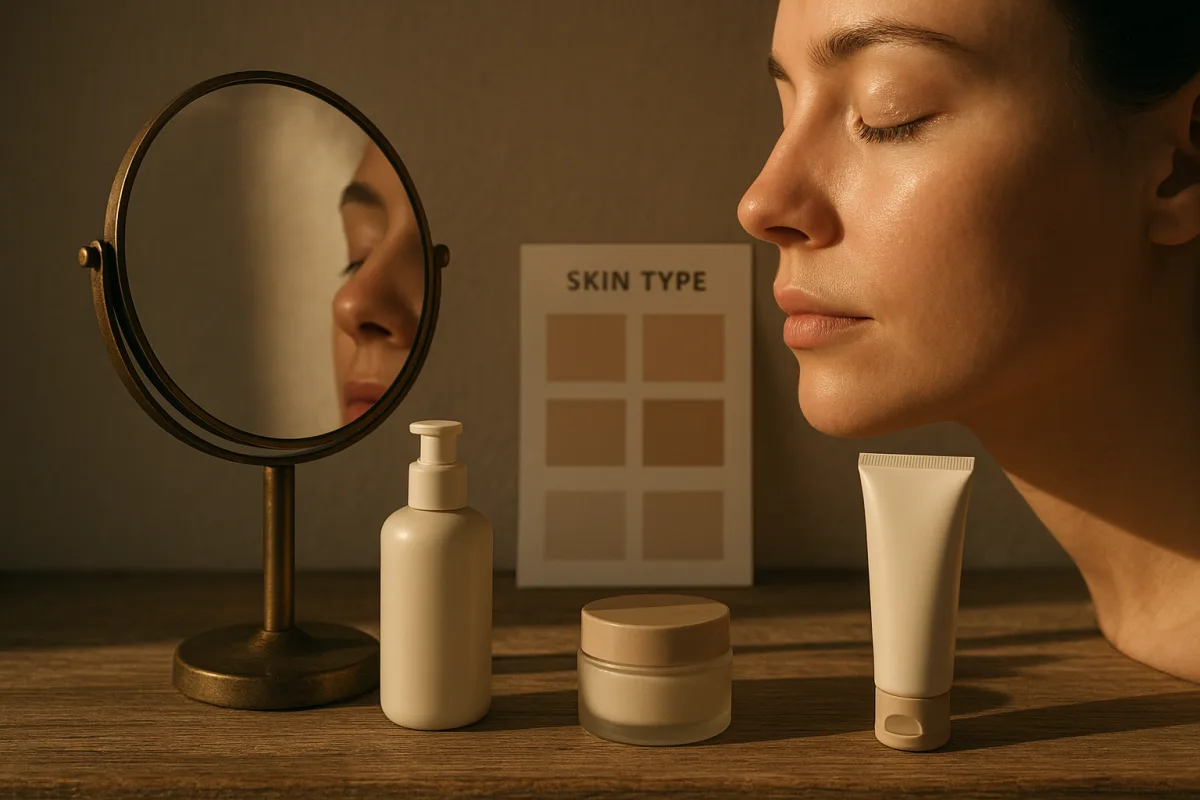
First, separate skin type from the problem you want to fix
Skin type is a practical description of how your skin tends to produce oil, hold moisture and react to products. It is not a diagnosis, a measure of cleanliness or a permanent identity.
The useful categories are normal, oily, dry, combination and sensitive. Cleveland Clinic notes that skin can change with age, hormones, stress and environment, so consider your result a routine-planning note rather than a lifetime label. [14]
Also separate skin type from skin concerns. A person can have oily skin and uneven tone, dry skin and occasional spots, or combination skin with visible lines. Those concerns may influence product choices, but they do not automatically identify type.
This distinction matters because “acne-prone” is not one of the basic skin types. Breakouts can occur on dry and normal skin too, and assuming every spot means oily skin can lead to overly stripping cleansing or exfoliation. [10][11]
If you have persistent acne, recurring rashes, painful bumps, widespread peeling, sudden changes or itching that does not settle, this is beyond an at-home skin-type exercise. A dermatologist can assess the cause rather than having you guess from a mirror.
Do not test the skin you have irritated
The first obstacle is that yesterday’s routine can disguise your baseline. Retinoids and exfoliating acids can leave skin temporarily tight, flaky or stingy, which may look like naturally dry or sensitive skin when it is product-related irritation. [10]
NicerSkin advises a 48-hour product-free period before assessing skin type if you have been using those active ingredients. [10] That is not a license to stop prescribed treatment without medical advice, but it is a sensible reason not to test immediately after a strong routine.
Pick an ordinary day indoors. Avoid testing straight after exercise, sun exposure, a hot shower or a very heated room, because those conditions can alter surface oil, redness and comfort enough to muddy the result. [6]
You need very little equipment: a gentle pH-balanced cleanser, a clean towel, a mirror in normal light and optional blotting papers. There is no good evidence in the research brief for a validated home kit with universal thresholds that can definitively assign a skin type.
Run the 30-minute bare-face check
Cleanse your face gently, pat it dry and apply nothing afterward. Wait 30 minutes in your usual indoor environment, then look and feel rather than immediately reaching for moisturiser. This timing is recommended in skin-type guidance from CeraVe and Healthline. [6][17]
Start by noticing comfort. A tight, rough or itchy feeling, particularly with visible flaking or dullness, points toward a dry pattern. WebMD also lists reduced elasticity, red patches and more noticeable lines among common dry-skin signs. [3]
Then inspect shine by area, not as one verdict for the entire face. A shiny forehead and nose with comfortable cheeks is different from uniform shine across the face, and it calls for a more targeted routine.
Use blotting paper if you want a record rather than relying entirely on lighting. Press one sheet onto the forehead, nose, chin and each cheek. Cleveland Clinic recommends this method to help show the distribution of oil across facial zones. [14]
Do not confuse a small amount of shine with failure. Skin has sebum for a reason, and the goal is not a completely matte face. The useful question is whether oil is evenly modest, concentrated in certain areas or present alongside congestion.
Read the result by pattern, not by one symptom
Normal skin is generally balanced, with few visible imperfections, barely visible pores and an even-looking complexion. [3] In routine terms, that usually means you can choose products for comfort and preference, while avoiding the mistake of adding unnecessary harsh actives.
Oily skin tends to look shiny or greasy and may have more visible pores, blackheads or pimples. [14] That does not mean it needs aggressive cleansing twice over, because over-cleansing can disrupt the barrier and increase irritation. [11]
Dry skin lacks sufficient oil, so it may feel tight and look dull or flaky. [3] The appropriate adjustment is usually a less stripping cleanser and a moisturiser with emollient and barrier-supporting ingredients, rather than simply adding more exfoliation to remove flakes.
Combination skin means different areas behave differently, commonly an oilier T-zone and normal or dry cheeks. [4] It is often easier to customise by facial zone, using a lighter layer on the forehead and nose and more moisturiser where cheeks feel tight.
Sensitive skin is best treated as a reactivity pattern that can sit over any oil pattern. Burning, stinging, itching, bumps or peeling after products are signs of increased reactivity, but they do not tell you whether you are oily or dry. [5][10]
Write down the result in plain language, such as “oily forehead and nose, comfortable cheeks, stings after fragranced products.” That is more useful for choosing skincare than forcing yourself into a single, supposedly precise category.
Confirm it over a normal product-free day
A 30-minute check gives you a starting point, not a final answer. Spend one typical day observing whether shine returns quickly, cheeks become tight by afternoon, or your skin stays comfortable and relatively even without product interference. [6]
Repeat the test on several days when possible. NicerSkin specifically cautions that a single observation is insufficient, and repeated testing in different conditions gives a more dependable picture. [10]
Keep a brief note of weather, indoor heating or air conditioning, cycle changes, stress and any new product. You are looking for patterns, not trying to turn ordinary skin variation into a scientific diagnosis.
This is where many people discover they are not truly “dry,” but temporarily dehydrated. Dryness refers to low oil, while dehydration refers to low water and can happen in oily skin too. [10]
An oily face that feels tight after cleansing may therefore need a gentler wash and a lightweight moisturiser, not necessarily a heavier oil or a drying toner. The distinction is cosmetic and practical, but it prevents a common cycle of stripping then overcorrecting.
Personalise the routine, starting with the cleanser
For consistently oily areas, choose a cleanser that removes excess oil without leaving skin squeaky, tight or burning. OuterDerm identifies salicylic acid cleansers as one option for summer oiliness and congestion, but the research brief does not provide a supported concentration or a guaranteed timeline. [7]
Salicylic acid is an exfoliating ingredient used in cleansers and leave-on products. A wash-off product has brief contact time, so do not expect dramatic change from it alone, and introduce it carefully if you also report stinging or peeling.
For dry-feeling skin, prioritise a gentle cleanser and moisturiser over frequent exfoliation. In colder conditions, OuterDerm recommends richer formulas containing ceramides, squalane or shea butter to counter the greater water loss associated with cold, dry air and indoor heating. [7]
Ceramides are skin-identical lipids commonly used to support the outer barrier, while squalane and shea butter are emollients that soften and reduce the rough feel of dry skin. These are cosmetic comfort and appearance benefits, not medical treatment.
For combination skin, do not assume one texture must serve every facial area equally. A medium-weight moisturiser can be a practical starting point, with a smaller amount on the T-zone and a fuller layer on cheeks if they feel dry. [7]
For sensitive or reactive skin, simplify first. Use fewer products, avoid immediately layering exfoliating acids and retinoids, and add only one new product at a time. The goal is to identify what your skin tolerates, not to chase a long routine. [5][11]
Change the routine when the context changes
Winter can make skin behave drier and more reactive because cold, dry air and indoor heating are linked to increased transepidermal water loss, often shortened to TEWL. [7] That can warrant a richer moisturiser even if you are usually oily.
Heat and humidity can increase sebum and make a heavier cream feel excessive. In summer, a lighter gel moisturiser may suit better, especially on oily areas, but there is no requirement to abandon moisturiser just because the weather is warm. [7]
Spring and autumn may produce mixed signals, with some combination-like oiliness and some dryness. Medium-weight moisturisers and observation-based adjustments are more defensible than buying a separate routine for every calendar month. [7]
Climate matters beyond season. Persistent humidity may favour lighter textures, while a cold, dry location can make barrier-focused products and indoor humidification more relevant. [15] Your skin type label can stay similar while your product texture needs change.
Use sunscreen throughout the year, not only when skin feels oily or when the weather is sunny. Seasonal skincare guidance specifically recommends year-round sunscreen use regardless of seasonal shifts in skin behaviour. [8]
Be realistic about devices, apps and “skin analysis”
Consumer tools may measure hydration in the stratum corneum, surface oil or skin pH. A 2026 Journal of Cosmetic Dermatology paper evaluated the SkinConnect Nomadic Multi-Parametric Device for measuring hydration differences across body areas. [16]
That is not the same as proving that a device can accurately tell every consumer their complete skin type. The research brief found no standard thresholds or robust accuracy comparisons across consumer devices, including AI-led diagnostic tools. [12][13]
An app result can be an extra observation, particularly if it helps you notice change over time. It should not overrule your own repeated notes, and it cannot diagnose a rash, acne severity, dermatitis or another skin condition.
Reassess when life changes, not every morning
Puberty often increases sebum production through higher androgen activity, while later adulthood can bring reduced hydration and elasticity. [8] Hormonal changes during pregnancy may also increase sensitivity or reactivity for some people. [11]
Menopause is associated with declining estrogen and changes including lower collagen and thinner, less elastic skin. [6] Those are reasons to reassess comfort, texture and tolerance, not reasons to assume any one moisturiser will solve every change.
Diet and lifestyle can influence skin appearance and aging processes, but they do not provide a reliable shortcut to a skin-type label. Reviews link diets high in processed foods and sugars with inflammation and glycation, while whole-food plant-based patterns may support antioxidant defenses. [1]
The blunt version is that skin typing should make shopping less random, not make skincare falsely precise. Most cosmetic adjustments are gradual and modest: a more suitable cleanser may reduce tightness, and a better moisturiser may improve comfort, but neither substitutes for dermatological care when symptoms persist.
Frequently Asked Questions
How do I interpret the results of a skin type test?
After cleansing gently and waiting 30 minutes without applying products, observe your skin’s feel and appearance. Tightness, flaking, or dullness suggests dry skin, while uniform shine indicates oily skin. Shine concentrated in areas like the forehead and nose with comfortable cheeks points to combination skin. Also note any irritation or sensitivity separately, as skin type and sensitivity are distinct factors.
What does it mean if my skin is oily in some areas but dry in others?
This pattern is characteristic of combination skin, where oiliness typically appears in the T-zone (forehead, nose, chin) and dryness or normal skin is present elsewhere. Using blotting papers on different areas can help confirm this distribution. Combination skin requires targeted care addressing both oily and dry zones rather than a single uniform routine.
How can I tell if my skin is sensitive after testing?
Sensitive skin shows increased reactivity such as burning, stinging, itching, or visible reactions like bumps or peeling after cleansing and waiting. It is important to treat sensitivity as a separate observation from oiliness or dryness because you can be oily-sensitive, dry-sensitive, or combination-sensitive. Persistent irritation beyond normal testing may require professional evaluation.
What signs indicate dry skin during a skin type test?
Dry skin is indicated by sensations of tightness, roughness, or itchiness, often accompanied by visible flaking, dullness, red patches, reduced elasticity, or more noticeable lines. These signs typically appear after cleansing and waiting 30 minutes without applying products. Dry skin results from insufficient sebum and moisture retention.
How should I adjust my skincare routine based on my skin type test results?
Choose cleanser and moisturizer textures based on where oiliness and dryness appear on your face. For example, use lighter products on oily zones and richer moisturizers on dry areas. Regardless of skin type, applying sunscreen year-round is recommended. Remember that skin type can change with season, hormones, and environment, so reassess regularly and adjust your routine accordingly.
How we researched this
This article was assembled from 17 cited references.
Nothing here is based on hands-on testing. Where a figure or finding appears, it belongs to the source cited beside it, and the writing says so rather than implying otherwise. Every source is listed below so you can check it.
Sources
- A Review of the Effects of Lifestyle Factors on Skin Aging - PMC
- What Is My Skin Type? | Facts & Tips | CeraVe
- What’s Your Skin Type?
- Skin Types & the Fitzpatrick Scale | Dermatology Quest
- What type of skin do I have? List of skin types and their signs
- The No BS Guide to Discovering Your Real Skin Type
- Does Skin Type Change With Season?
- Seasonal Changes in Skin Type — SYNC Skin Encyclopedia
- Does Your Skin Type Actually Change With the Seasons? What Sebum and TEWL Studies Show -- and Where They Disagree > Skin Types - Han Beauty Lab
- How to Determine Your Skin Type: The Complete Guide | NicerSkin
- Normal Skin Care Mistakes to Avoid | Dermatology
- AI Skin Diagnostic Devices 2026: Accuracy Tested & Ranked | BlushPicks
- Beauty Retail Trends: 2026 Guide to Personalization and Skin Diagnostics – Global Beauty News | Skincare, Cosmetics and Beauty Industry Updates
- What Is My Skin Type and Why Does It Matter?
- Seasonal Skincare: Adjusting Your Routine Throughout the Year | Skincare Insights
- Validation of the SkinConnect Nomadic Multi‐Parametric Device for Assessing Stratum Corneum Hydration - Flament - 2026 - Journal of Cosmetic Dermatology - Wiley Online Library
- What Skin Type Do I Have? | Determine Your Skin Type | CeraVe
Related Articles
How to Read Skincare Labels: A Clear Ingredient Guide
Learn how to read skincare labels to understand ingredients, claims, and ingredient order for better product choices.

How to Identify Your Skin Type: A Practical Beginner's Guide
Learn how to identify your skin type accurately with at-home tests, avoid common mistakes, and understand how it changes over time.
Best Ingredients for Skin Hydration
Discover the best ingredients for skin hydration, how to use humectants and moisturizers for effective water retention and skin barrier support.
How to Choose a Toner for Dry Skin: Key Tips and Ingredients
Learn how to choose a toner for dry skin with expert tips on ingredients, usage, and what to avoid for better hydration and skin comfort.