
Best Time to Exfoliate Skin: Morning or Night Explained
Discover the best time to exfoliate skin, why night is preferred, and how to protect your skin after exfoliation with sunscreen.
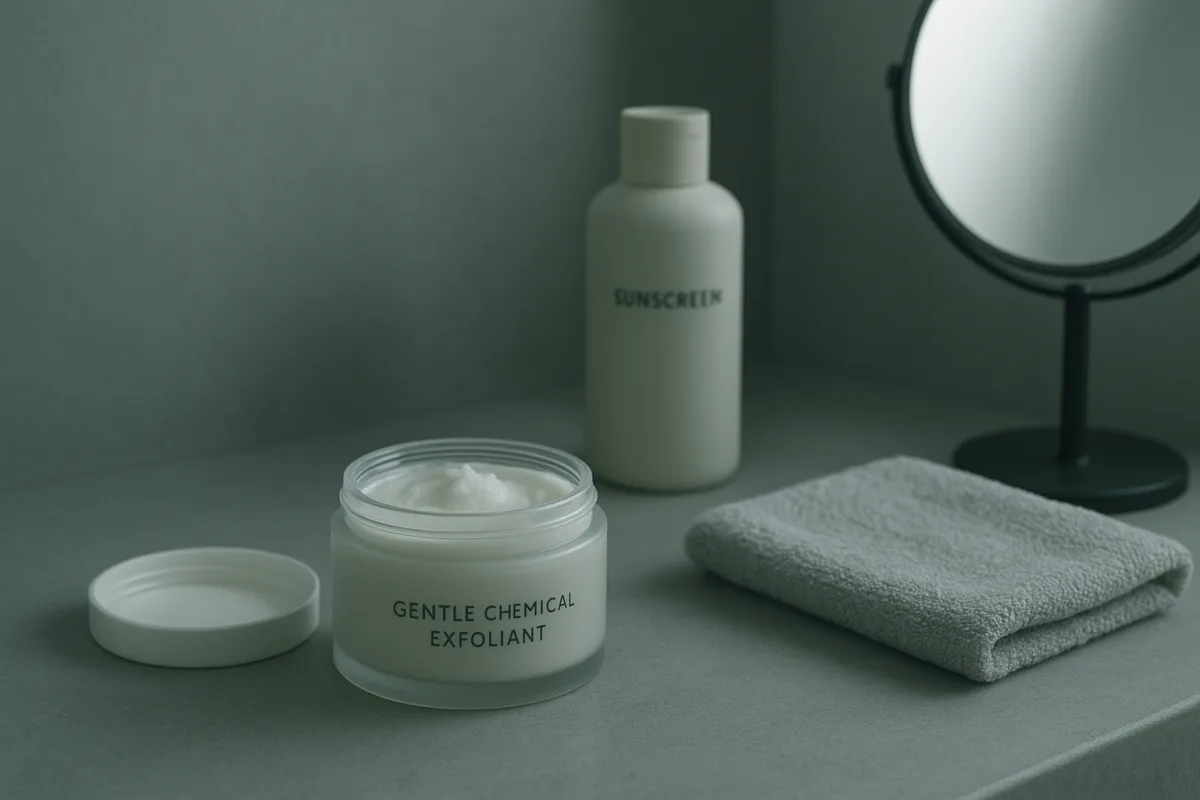
The best time is really about the daylight gap
The useful answer is not that skin has a magical exfoliation hour. It is that nighttime creates the longest gap between removing surface cells and encountering sunlight, heat, sweat, makeup, and other routine irritants.
That matters most for chemical exfoliants. Alpha hydroxy acids, or AHAs, and beta hydroxy acids, or BHAs, loosen the bonds between dead surface skin cells so they shed more readily. The cosmetic payoff can be smoother-looking texture and a more even-looking surface.
The cost is that recently exfoliated skin can be more vulnerable to irritation, particularly when UV exposure enters the picture. Healthline’s guidance notes that chemical exfoliation can increase sun sensitivity, which is why broad-spectrum SPF 30 or higher is the baseline, not an optional finishing step. [2]
This is why night is the sensible default for most routines. Apply your exfoliant after cleansing, let it sit as directed, follow with a plain moisturizer if your skin tolerates it, and spend the next day wearing sunscreen.
NIVEA and ToolGuideDaily both frame evening exfoliation around reduced sun exposure and the skin’s overnight repair processes. [5][11] The first reason is the more practical one. Your skin does not need a dramatic “repair window” to make night use worthwhile.
There is a tendency to turn nighttime skincare into biology cosplay, complete with claims that every product works better after 10 p.m. The research brief does not support that level of precision. What it supports is a simpler risk-management calculation: less immediate UV exposure is useful.
What exfoliation changes, and what it does not
Exfoliation removes or loosens some of the dead cells held at the skin’s outermost layer, the stratum corneum. That can make skin feel less rough, help makeup sit more evenly, and temporarily make dullness less visually obvious.
It does not “detox” skin, purge toxins, or replace treatment for a dermatologic condition. If you have painful breakouts, persistent redness, scaling, sudden pigment changes, or a rash, the sensible next step is a dermatologist, not a stronger acid.
The same distinction matters for pores. A BHA can help reduce the look of congestion because it is oil-soluble and can work within pore lining, but it cannot physically shrink a pore permanently. [4] Marketing language often outruns that modest reality.
Results are also slow and conditional. A single use may leave skin feeling smoother because it changes the surface immediately. More meaningful changes in texture or the appearance of uneven tone usually require consistent use over weeks, assuming your skin tolerates it.
There is no credible reason to exfoliate twice daily just to chase that faster result. Irritation interrupts consistency, and a compromised barrier can leave skin feeling rougher, tighter, and more uneven than the concern you were trying to improve. [9]
The number to understand: acid concentration is only half the formula
If you use a chemical exfoliant, the percentage on the front label is useful, but incomplete. The other number that shapes performance is pH, which affects how much of an acid is available in its active form.
ScienceInsights places the useful pH range for AHAs and BHAs around 3.2 to 3.9. [1] Products below pH 2.5 may pose a greater barrier-damage risk, which is a reminder that “professional strength” is not automatically a consumer advantage. [1]
For AHAs, guidance collected by Paula’s Choice and Layered Skincare puts typical daily-use formulas in the 4% to 10% range. [3][4] That is broad enough that you still need to read the specific ingredient and product directions.
Glycolic acid is generally suggested as a 5% to 8% starting range, while lactic acid often starts around 5%. Mandelic acid is commonly found around 5% to 10%. [3][4] These percentages do not make the acids interchangeable.
Glycolic acid is often chosen for its smaller molecular size and can feel more intense. Lactic and mandelic acids are frequently positioned as gentler options, but “gentler” is not the same as irritation-proof, especially alongside retinoids or benzoyl peroxide.
BHA, usually salicylic acid in skincare, is commonly used up to 2% when the aim is more active exfoliation. Maintenance formulas are often 0.5% to 1%. [4] If you are new to it, start at the low end and use it less often.
This is the system that determines timing. A low-strength acid used once or twice weekly gives you more room to use it in either morning or evening. A stronger or more frequent formula makes night use, followed by serious sunscreen use, the more cautious choice.
Morning exfoliation is possible, not necessarily better
Some advice promotes morning exfoliation for a fresher-looking face, less puffiness, or improved product absorption. ScienceInsights mentions circulation stimulation among the potential benefits. [1] These claims are less firmly supported than the basic concern about post-exfoliation UV exposure.
A smoother surface can certainly change how skincare and makeup spread that day. But do not confuse easier application with proof of a long-term skin benefit. There is limited clinical evidence establishing a superior time of day for exfoliation beyond the sun-exposure issue.
If morning is the only time you will reliably do it, a conservative routine can still be reasonable. Use a gentle formula, avoid pairing it with another exfoliant, moisturize, and apply broad-spectrum SPF 30 or higher generously. [2][4]
The trade-off is simple: you are putting your freshly exfoliated skin into its highest-exposure part of the day. That does not guarantee harm, but it raises the importance of sunscreen, shade, and realistic expectations about how much your skin can tolerate.
Do not treat sunscreen as a workaround that permits unlimited acid use. It is protection, not a license to ignore irritation. If your face burns when applying basic moisturizer or sunscreen, pause exfoliation rather than trying to schedule around the problem.
Frequency comes before the clock
A person asking for the perfect exfoliation time is often trying to optimize the wrong variable. The bigger determinant of whether the routine works is frequency, because repeated irritation is more damaging than choosing 8 a.m. instead of 8 p.m.
Healthline’s 2023 guidance suggests normal and oily skin may tolerate exfoliation two to three times weekly. Dry, sensitive, and combination skin are generally better served by one to two weekly sessions or less. [2]
Those are starting points, not a challenge to reach the maximum. Oily or breakout-prone skin is often told it can exfoliate daily, but the research brief identifies that recommendation as contested rather than universally accepted. Start slower, then assess tolerance.
The type of exfoliant changes the calculation. Physical exfoliants, meaning scrubs, brushes, or textured particles that abrade the surface, are generally recommended no more than once per week. [10] Their effect depends partly on pressure, particle shape, and technique.
Chemical exfoliants have more predictable dosing because the acid percentage and formula are fixed. Depending on strength and tolerance, they may be used one to four times weekly. [4] That does not mean every acid product suits four uses weekly.
Enzymatic exfoliants occupy a less certain middle ground. They use enzymes to break down material at the surface, but the brief found no direct research establishing a distinct optimal time of day for them. Follow the product directions and treat night as the cautious default.
The routine that avoids the common mistakes
On an exfoliation night, use lukewarm water and a gentle cleanser. Hot water can increase dryness and irritation, particularly when paired with acids or scrubbing. [2][9] Your routine does not become more effective because it feels more aggressive.
Then apply one exfoliating product, not an acid toner followed by an exfoliating serum followed by a scrub. Layering multiple exfoliants is a common route to over-exfoliation, and it makes it difficult to identify what your skin actually tolerates. [9]
Follow with a straightforward moisturizer. You do not need a crowded recovery routine full of fragranced masks, additional peeling ingredients, or “tingling” treatments. A bland moisturizer is less exciting, but irritation management is usually more valuable than novelty.
Be particularly careful about combining exfoliants with other potentially irritating actives. If your routine already includes a retinoid, benzoyl peroxide, or multiple acids, alternating nights is generally easier to manage than stacking everything in one ambitious evening.
This is also where a dermatologist can be useful. If you are trying to manage persistent acne, eczema-like irritation, rosacea symptoms, melasma, or another ongoing concern, product scheduling is not a substitute for a proper diagnosis and treatment plan.
Adjust the schedule when the environment changes
Your skin does not experience the same conditions in July and January. In humid summer weather, oiliness and the appearance of clogged pores may increase, and some sources suggest gentle chemical exfoliation two to three times weekly for those who tolerate it. [6][8]
High UV periods also make the timing decision more consequential. KojieCare emphasizes stricter sunscreen practice after exfoliation during high-UV seasons. [7] In practical terms, that means night use becomes even more appealing, but daytime SPF remains essential.
Winter and low-humidity conditions are different. The Beauty Connection guidance cited in the research brief recommends reducing exfoliation to one or two times weekly, using gentler physical options where appropriate, and leaning more heavily on richer moisturizers.
That is not an argument for physical scrubs as a universal winter solution. They still should generally remain weekly or less. [10] It is an argument for reducing total exfoliation stress when indoor heating, cold air, and lower humidity already leave skin feeling tight.
The best time to exfoliate, then, is usually the evening before a day when you can reliably wear sunscreen. Keep the formula modest, the frequency lower than your ambition suggests, and the rest of the routine boring enough that your skin can actually tolerate it.
Frequently Asked Questions
What is the best time to exfoliate skin?
For most people, exfoliating at night is recommended because it creates the longest gap between exfoliation and exposure to sunlight, heat, and other irritants. This timing helps reduce the risk of irritation and allows the skin to repair overnight. However, the choice of exfoliant type and frequency should guide your routine first.
Should I exfoliate my skin in the morning or at night?
Nighttime exfoliation is generally safer and preferred because it avoids immediate UV exposure, which can increase skin sensitivity. Morning exfoliation is possible but requires diligent use of broad-spectrum sunscreen to protect against increased sun sensitivity caused by exfoliation.
Why is exfoliating at night recommended?
Exfoliating at night reduces the risk of irritation from UV rays and environmental factors encountered during the day. It also aligns with the skin’s natural repair processes overnight, although the main benefit is minimizing immediate sun exposure rather than a specific biological timing.
How does exfoliation timing affect sun sensitivity?
Chemical exfoliants like AHAs and BHAs increase the skin’s photosensitivity, making it more vulnerable to UV damage. Exfoliating at night helps avoid direct sun exposure immediately after treatment, but wearing broad-spectrum SPF 30 or higher the following day remains essential to protect the skin.
Can I exfoliate skin in the morning safely?
Yes, you can exfoliate in the morning, but it requires strict sunscreen application afterward to protect against increased UV sensitivity. Morning exfoliation may offer benefits like stimulating blood circulation, but it carries a higher risk of sun-related irritation if sunscreen is not used properly.
How we researched this
This article was assembled from 11 cited references.
Nothing here is based on hands-on testing. Where a figure or finding appears, it belongs to the source cited beside it, and the writing says so rather than implying otherwise. Every source is listed below so you can check it.
Sources
- When Should You Exfoliate in Your Skincare Routine? - ScienceInsights
- How Often Should You Exfoliate Your Body? It Depends
- How to Avoid Over-Exfoliated Skin | Paula's Choice
- Chemical Exfoliants Explained: AHA vs BHA vs PHA | Layered Skincare
- Is It Better To Exfoliate Morning Or Night Dermatologist Advice | ToolGuideDaily
- Exfoliating Oily Skin: Seasonal Adjustments Explained | Journal
- The Best Time of Year to Use Kojic Acid Soap: A Seasonal Skincare Guid – KojieCare
- How Seasonal Changes Affect Your Acne (And When to Switch Products) | Teen Acne Solutions
- How To Heal Over Exfoliated Skin | Ulta Beauty
- How Often to Use Physical Exfoliants | Dermatology
- What Is Exfoliation | How To Exfoliate | NIVEA Advice
Related Articles
Best Time to Apply Moisturizer: When and How to Do It Right
Learn the best time to apply moisturizer for optimal hydration and how to layer it properly in your skincare routine.
Best Time of Year for Chemical Peels: What You Need to Know
Discover the best time of year for chemical peels, how sun exposure and downtime affect results, and essential aftercare tips for any season.

How to Apply Face Oil: Best Practices and Tips
Learn how to apply face oil correctly, including layering order, amount, and timing for glowing, hydrated skin in your skincare routine.
Signs of Over-Exfoliation: How to Recognize Skin Damage
Learn the signs of over-exfoliation and how to recognize when your skin barrier is compromised for healthier skincare choices.