
Best Time to Apply Retinol: Nighttime and Dry Skin Tips
Learn the best time to apply retinol, why nighttime matters, and how waiting after cleansing reduces irritation for a better skincare routine.
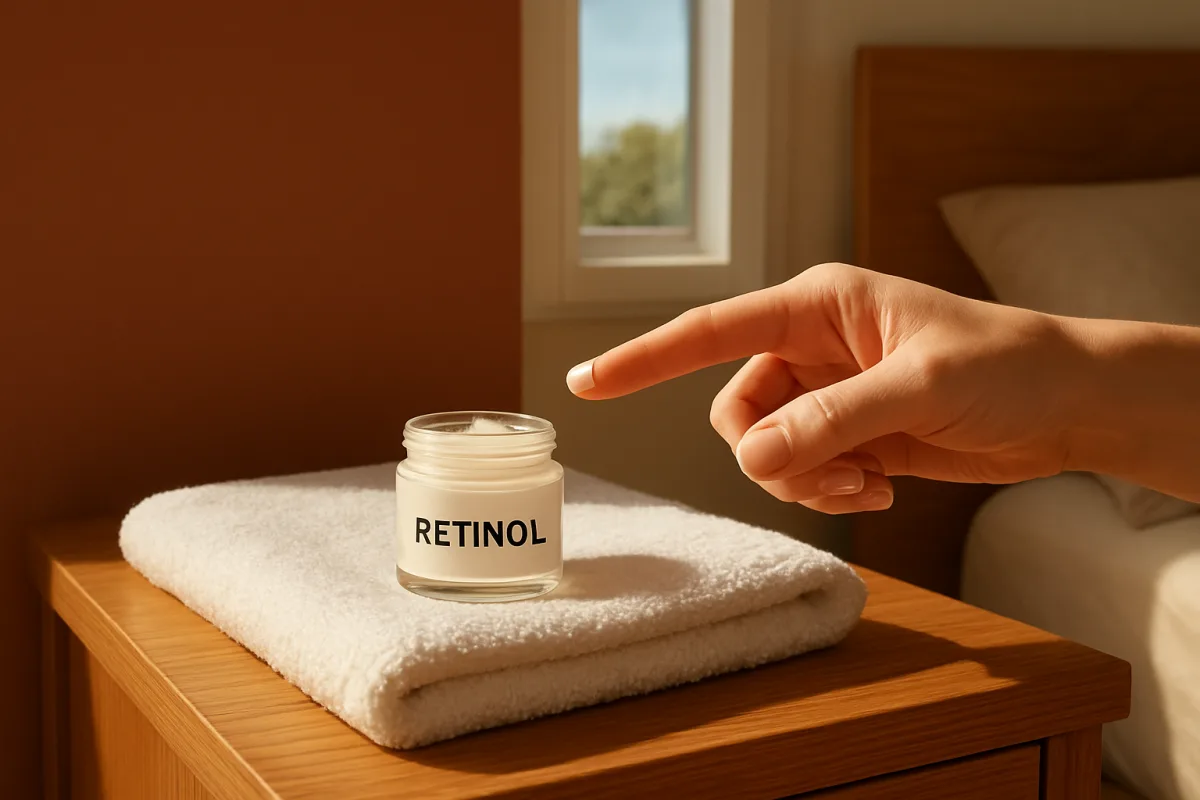
Best Time to Apply Retinol: Why “Nighttime” Is Not the Whole Answer
The timing that matters is the dry-skin interval
People asking for the best time to apply retinol usually mean 8 p.m. versus 11 p.m., or whether summer requires a different routine. That is not really the decision that determines whether a routine is tolerable.
The relevant system has three parts: cleanse, let the skin dry fully, then apply retinol at night. Nighttime is the broad rule, but the interval after cleansing is the detail most likely to affect irritation. [1][4]
Retinol is a vitamin A derivative used in cosmetic skincare. It is not a medication plan, and the sources supplied for this article do not support promises about treating acne, pigmentation, rosacea, eczema, or any other condition.
That distinction matters because “best time” advice often gets inflated into a claim that better scheduling will produce dramatic results. It will not. Timing mainly helps protect the product and make a routine easier to continue.
Dermatology guidance collected in the research brief recommends applying retinol at night because sunlight can degrade it. Vogue also frames nighttime application as the standard approach, rather than a seasonal option. [1][5]
So, the best time is simply the evening when you can reliably complete the sequence. It can be 7 p.m. after dinner or midnight before bed. Retinol does not require a particular clock time in the sources provided.
Why damp skin changes the equation
The reason for waiting after cleansing is not that skin needs to “open” or “close” its pores. That is not a useful way to think about topical skincare. The concern is reducing the chance of irritation.
Dermathub and Ulta Beauty both advise waiting 20 to 30 minutes after cleansing, until skin is completely dry, before applying retinol. Beauty Hygiene gives a shorter estimate of 10 to 15 minutes. [1][3][4]
The disagreement is modest, but it is real. A person does not need to set a timer for exactly 27 minutes, yet applying retinol immediately onto visibly damp skin ignores the more cautious, more commonly recommended version of the guidance.
Damp application is repeatedly flagged as a common mistake in beginner retinol routines. Cleveland Clinic and Beauty Hygiene both include it among errors associated with a greater likelihood of irritation. [3][14]
That does not mean every person who applies retinol after washing will react badly. It means the potential benefit of rushing is small, while the cost can be a compromised skin barrier and an interrupted routine.
If waiting 20 to 30 minutes makes your routine impractical, the useful compromise is not to apply retinol on wet skin. Cleanse earlier in the evening, then return for the treatment and moisturizer later. [1][4]
This is also why “apply it right before bed” can be incomplete advice. Retinol belongs in a nighttime routine, but it should not be the next step after splashing water on your face.
Nighttime protects the routine, not just the product
Nighttime application is often explained only as a stability issue. That is part of it: the sources advise nighttime use to minimize degradation from sunlight. [1][5]
The other half is sun protection. Retinol can make skin more sensitive to UV exposure, so daytime broad-spectrum sunscreen with SPF 30 or above is not an optional supporting product in this system. [6][7]
British Vogue’s sun-protection guidance specifies SPF 30 or higher and reapplication every two hours during sun exposure. That is a daytime instruction, not a reason to put retinol on in the morning. [13]
This is where optimization becomes boring but effective. A carefully timed retinol application cannot compensate for skipping sunscreen the following day. The sensible sequence is night retinol, morning sunscreen, repeated consistently.
Do not read this as a claim that retinol makes sun protection newly necessary only for retinol users. Sunscreen is generally relevant for exposed skin, but retinol adds a specific reason to take daytime UV protection seriously. [6][7]
The research brief found no evidence that humidity, temperature, regional UV index, or season changes the time of day when retinol should be applied. Summer does not convert it into a morning active, and winter does not remove the need for sunscreen.
What may change with the season is personal comfort, especially if skin feels drier or more reactive. That is a reason to reduce frequency or use more moisturizer, not a reason to ignore the nighttime and dry-skin rules.
The practical order: cleanse, wait, retinol, moisturize
A basic retinol night has very few moving parts. Cleanse gently, wait until the face is fully dry, apply a small amount of retinol, then use a gentle, fragrance-free moisturizer. [1][2][4]
Ulta Beauty specifies a pea-sized amount, approximately 0.5 grams, for the entire face. That is smaller than many people expect, particularly when using a thin serum rather than a cream. [4]
More is not a shortcut. The supplied guidance emphasizes gradual use because irritation is a predictable limiting factor. Using an oversized amount is therefore a poor trade-off, especially when beginning. [4]
The moisturizer step is not merely decorative. Skincare.com recommends following retinol with gentle, fragrance-free moisturizer, and identifies the moisturizer-retinol-moisturizer “sandwich method” as one way to reduce irritation. [2]
In that sandwich version, moisturizer goes on first, retinol follows, and another layer of moisturizer finishes the routine. It may be useful for people who find direct application too uncomfortable, though it is a tolerability strategy rather than a proven way to accelerate cosmetic results. [2]
The sources do not provide a clinical trial showing that a 20-minute wait performs better than a 10-minute wait, or that the sandwich method delivers a specific improvement. These are practical expert-routine recommendations, not precision-tested guarantees.
That limitation is worth stating plainly. The research brief names no individual randomized trial that can establish one perfect minute, universal concentration, or expected timeline for visible results.
Frequency is part of timing, too
Retinol timing is not only about the hour of application. It also means spacing applications far enough apart that your skin can tolerate the routine, rather than treating nightly use as the default.
Dermathub suggests starting twice weekly, with an example of Monday and Thursday nights. Ulta Beauty takes a more cautious route, suggesting once weekly and gradual increases across six weeks. [1][4]
Neither source presents these schedules as a magic formula. They are two reasonable ways to begin with gaps between applications, observe how your skin responds, and avoid starting at full frequency.
For a cautious beginner, once weekly is the lower-pressure starting point. If that is comfortable over time, moving to twice weekly is a more sensible next adjustment than immediately using retinol every night. [4]
Concentration matters alongside frequency. Ulta Beauty places beginner products around 0.025% to 0.05%, while Dermathub gives a wider beginner range of 0.025% to 0.1%. [1][4]
The overlap, 0.025% to 0.05%, is the least disputed place to start based on this brief. Ulta Beauty lists 0.3% to 0.5% for experienced users, but higher numbers are not automatically better choices. [4]
One source apparently refers to beginning as low as 0.25%, but that conflicts with the otherwise consistent 0.025% to 0.05% beginner range and appears likely to be a typographical error. Treat decimal points carefully with retinol.
What not to layer into the same night
The simplest way to protect the timing system is to give retinol its own evening. Brackenwise advises avoiding other potent actives, including AHAs, BHAs, and vitamin C, on the same night to limit irritation. [8]
That does not mean these ingredients are inherently bad or that every person must permanently separate them. It means a beginner cannot easily identify what caused stinging, dryness, or peeling when several strong products arrive together.
Alternating nights is usually the more legible approach. One night can be retinol plus moisturizer, while another can hold a different active if you already know your skin handles it. This is routine management, not an attempt to maximize intensity.
The same principle applies to adding new products. Change one variable at a time, then give the routine time. Most cosmetic skincare results, when they occur, are gradual and modest, while irritation can arrive much faster.
If you are experiencing persistent burning, marked swelling, a spreading rash, painful cracking, or symptoms that seem beyond ordinary product irritation, stop trying to optimize the schedule and consult a dermatologist. Those symptoms need individual assessment, not internet routine math.
Frequently Asked Questions
What is the best time to apply retinol for minimal irritation?
The best time to apply retinol is at night, after cleansing and once the skin is completely dry. Waiting 20 to 30 minutes after washing your face before applying retinol is commonly recommended to reduce irritation. Starting slowly, such as once or twice a week, also helps minimize irritation.
Why should retinol be applied at night instead of morning?
Retinol should be applied at night because sunlight can degrade the ingredient, reducing its effectiveness. Nighttime use also allows for consistent application of broad-spectrum SPF 30 or higher during the day to protect sensitive skin.
How long should I wait after cleansing before applying retinol?
Most dermatology sources recommend waiting 20 to 30 minutes after cleansing to ensure the skin is completely dry before applying retinol. Some sources suggest 10 to 15 minutes may be sufficient, but the longer wait is more widely endorsed to minimize irritation.
Can I apply retinol on damp skin?
Applying retinol on damp skin is generally discouraged because it increases the risk of irritation and can compromise the skin barrier. It is better to wait until the skin is fully dry before applying retinol.
Does climate affect the best time to apply retinol?
No, there is no evidence that climate factors such as humidity, temperature, or seasonal changes affect the optimal timing of retinol application. Nighttime use is recommended universally, regardless of environmental conditions.
How we researched this
This article was assembled from 16 cited references.
Nothing here is based on hands-on testing. Where a figure or finding appears, it belongs to the source cited beside it, and the writing says so rather than implying otherwise. Every source is listed below so you can check it.
Sources
- How to Use Retinol | Dermatology
- How to Incorporate Retinol Into Your Skincare Routine | Skincare.com
- Retinol Beginner's Guide: 5 Mistakes to Avoid (2026) | Beauty Hygiene
- How to Use Retinol For Beginners | Ulta Beauty
- How to Use Retinol and Retinoids: 14 Things to Know | Vogue
- Retinol and Sun Exposure: Protection Tips and Precautions - The Skincare Source
- The Right Skincare Routine Order, According to Dermatologists
- The Dos and Don'ts While Using Retinol – Riversol
- Can You Safely Use Retinol in the Summer? | Allure
- Do You Need Sunscreen With Retinol? The Truth - ScienceInsights
- How To Store Retinol Products To Prevent Oxidation When Living In Humid Climates | ToolGuideDaily
- Can You Safely Use Retinol in the Summer?
- Should I Use Retinol In Summer? Two Skin Ageing Specialists Weigh In | British Vogue
- Retinol: Cream, Serum, What It Is, Benefits, How To Use
- Retinol Mistakes That Are Sabotaging Your Results | Dermaworks
- The Skincare Order That Dermatologists Actually Recommend-Here's Exactly Where Every Product Goes
Related Articles
Best Time to Apply Moisturizer: When and How to Do It Right
Learn the best time to apply moisturizer for optimal hydration and how to layer it properly in your skincare routine.
Best Time to Exfoliate Skin: Morning or Night Explained
Discover the best time to exfoliate skin, why night is preferred, and how to protect your skin after exfoliation with sunscreen.

How to Apply Face Oil: Best Practices and Tips
Learn how to apply face oil correctly, including layering order, amount, and timing for glowing, hydrated skin in your skincare routine.
How to Layer Serums: Correct Order and Application Tips
Learn how to layer serums properly with tips on order, wait times, and amounts for effective skincare routines.