
Benefits of Hyaluronic Acid: Hydration and Skin Improvement
Discover the benefits of hyaluronic acid for skin hydration, molecular weight effects, and how to use it for smoother, plumper skin.
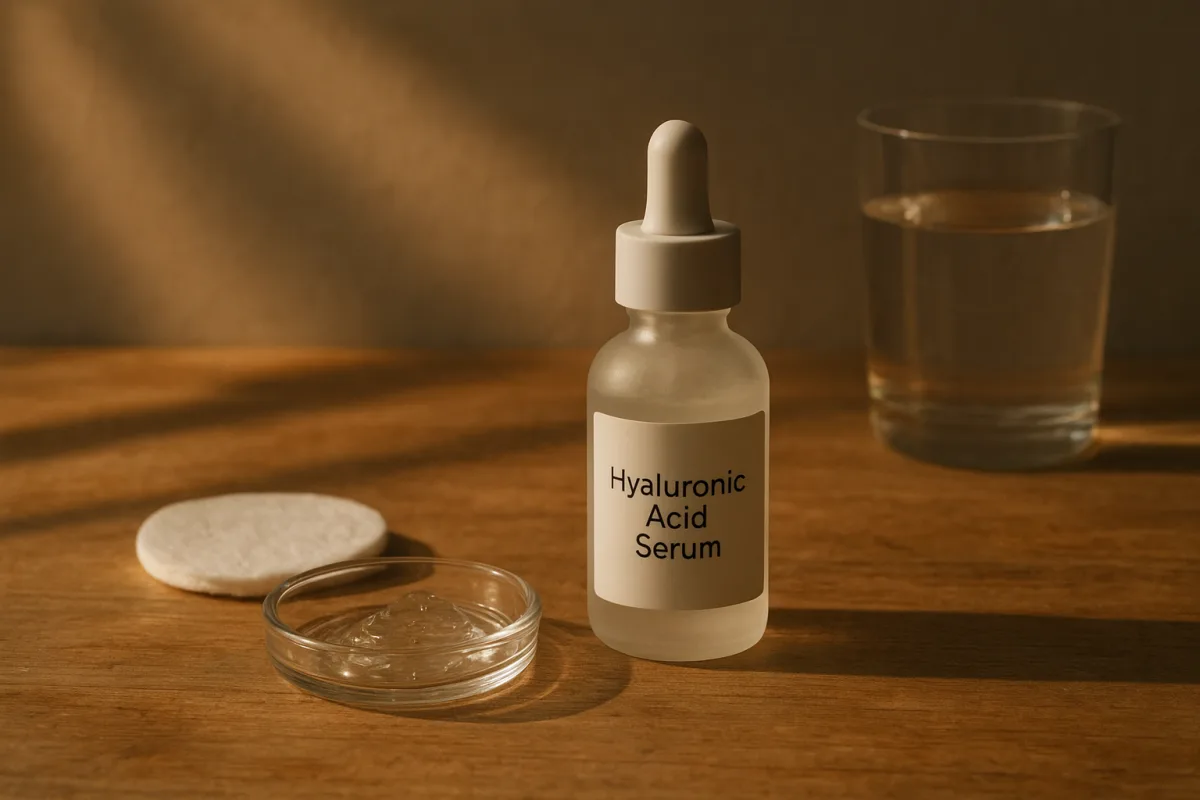
The benefit is not “moisture”, exactly
Hyaluronic acid is often marketed as though it adds water to skin in the same way a drink adds water to the body. That is not quite the mechanism. It is a humectant, meaning it binds water that is already present in the formula, the air, or the upper layers of skin. [1][2]
The headline figure is that hyaluronic acid can bind up to 1,000 times its weight in water. [1][3] That sounds spectacular, but it does not mean a serum can store a thousand times its own weight in water on your face all day.
What it can do is improve the water content of the stratum corneum, the thin outer layer of skin that regulates how rough, tight or comfortable the surface feels. Better hydrated surface cells swell slightly, creating a smoother-looking texture. [2][3]
That is why the most immediate benefit is cosmetic rather than medical. Skin may look plumper, feel less papery under makeup, and show fine lines less sharply while hydration is improved. It does not erase established wrinkles or alter the deeper structural reasons skin changes with age.
Molecular weight is the useful number to understand
The most important concept in hyaluronic acid skincare is molecular weight. This tells you the size of the hyaluronic acid molecule, usually measured in kilodaltons, or kDa. Smaller molecules and larger molecules behave differently on the skin. [10][11]
High-molecular-weight hyaluronic acid, generally above 500 kDa, is too large to move far through the outer skin barrier. It sits primarily at the surface, where it forms a water-binding film and offers relatively immediate, surface-level hydration. [10][11]
That surface film is not a failure. For someone whose skin feels temporarily dry after cleansing, exposure to cold weather, air conditioning or a harsh cleanser, this is the benefit they are likely to notice first: less tightness and a smoother finish.
Lower-molecular-weight hyaluronic acid, commonly described as below 300 kDa, may move further into the outer layers of skin. [10][11] It is often included for a longer-lasting hydration effect rather than simply the initially glossy finish associated with a large-molecule serum.
One frequently cited size is around 130 kDa. Research summarised in the scientific and clinical evidence review found that 130 kDa hyaluronic acid was associated with an approximately 20% improvement in skin elasticity after one month of regular use. [3]
That figure is encouraging, but it needs sensible context. An elasticity measurement is not the same thing as a visible facelift, and one month is short. The brief found no robust data on topical hyaluronic acid effects lasting beyond two months.
The research also reports improvements in wrinkle depth and skin roughness after around 60 days of consistent use. [3][18] Again, think refinement rather than correction. Hydrated skin reflects light differently and has a more even surface, so modest changes can look meaningful without being dramatic.
Why multi-weight formulas make sense
A multi-molecular-weight hyaluronic acid product tries to cover two jobs at once. Larger molecules remain near the surface for immediate water binding, while smaller molecules are intended to support hydration in the layers beneath the surface. [10][11]
This is why a label that lists several forms, such as sodium hyaluronate alongside hydrolysed hyaluronic acid, may be more informative than one that simply announces “hyaluronic acid” on the front. The names can indicate different molecular sizes or delivery approaches.
Still, an ingredient list cannot tell you everything. Brands rarely disclose the exact molecular-weight distribution, the amount of each form, or the finished formula’s performance. A long list of hyaluronic-acid derivatives is not proof that a product will work better.
The more useful question is whether the product is designed as a hydration layer and whether it includes a sensible supporting formula. Humectants need water, and skin also needs ingredients that reduce water loss, such as emollients and occlusives in a moisturiser.
Small is not always better
Skincare marketing often treats deeper penetration as an automatic advantage. It is not that simple. Very low-molecular-weight hyaluronic acid, especially below 50 kDa, has raised concerns about possible irritation or inflammatory signalling in some discussions of the research. [1][10]
That risk remains debated, not settled. The systematic-review literature supports hyaluronic acid’s broader anti-inflammatory and wound-healing roles, but those findings do not establish that every tiny topical fragment is ideal for every reactive face. [1][3]
Absorption numbers are also less decisive than they look. Some reports put dermal absorption of lower-molecular-weight hyaluronic acid around 14% to 19%, but methods differ enough that these figures should not be used as a shopping rule. [10][18]
For most people, a mixture of sizes is a reasonable middle ground. It aims for surface hydration and some deeper barrier support without making ultra-low molecular weight the entire sales pitch. That is a formulation preference, not a clinically proven universal optimum.
If your skin is easily irritated, patch test a new formula before using it across your face. Topical hyaluronic acid is generally well tolerated, but mild stinging, redness or irritation can happen, particularly in formulas containing fragrance, acids or other added actives. [2][15]
Concentration has a ceiling
The sensible concentration range for topical hyaluronic acid is usually cited as 0.5% to 2%. [4][18] That range is more useful than the assumption that a higher percentage must produce more hydration.
At around 0.5% to 2%, hyaluronic acid can contribute meaningful humectant activity without dominating the formula. The product still needs an elegant base, preservatives, texture agents, and often barrier-supporting ingredients that make it comfortable to wear. [4]
Formulas above 2% are relatively uncommon, and for good reason. A heavily humectant formula can feel sticky, pill beneath sunscreen or makeup, and potentially leave skin feeling drier when the surrounding environment does not provide enough available water. [16][18]
A brand’s refusal to print a percentage is frustrating, but it is not automatic evidence of a weak product. Percentages alone do not reveal molecular size, the formula’s water content, packaging, or whether the product is used with an appropriate moisturiser.
Dry climate changes the result
Hyaluronic acid does not create water. It attracts and holds it. In humid conditions, there is more ambient water available, while cold, heated or air-conditioned rooms can be much less forgiving. [16][17]
In low humidity, an unsealed humectant layer may pull water from the upper layers of skin toward the surface, where it can evaporate. The result can be the opposite of what the user expected: tightness, discomfort and a dehydrated-looking finish. [16]
The practical fix is unglamorous but effective. Apply a hyaluronic acid serum to skin that is still slightly damp after cleansing, then use a moisturiser over it. This gives the humectant water to bind and adds ingredients that slow evaporation. [2][17]
Morning and evening use is reasonable if your skin tolerates it. [12][13] But twice daily is not a moral obligation, and more layers are not necessarily better. Once-daily use can be enough if it fits your routine and your skin already feels comfortably hydrated.
What the evidence can, and cannot, support
A systematic review of hyaluronic acid’s physicochemical properties and applications describes roles in hydration, inflammation and wound-healing processes. [1] Those biological functions are real reasons the ingredient is interesting, but they should not be stretched into a self-treatment plan.
A topical cosmetic serum can support a hydrated, comfortable skin surface. It is not a substitute for medical assessment of a wound, persistent rash, painful cracking, swelling, sudden irritation or a skin change that concerns you. Those belong with a dermatologist.
The evidence for topical hyaluronic acid is strongest for relatively short-term cosmetic outcomes: hydration, smoother texture and modest changes in the appearance of fine lines. [2][3] It is weaker on long-term outcomes, exact ideal molecular weight, and combinations with retinol or vitamin C.
There is also no direct evidence that a luxury price means better clinical performance. A comparison published by CosmeticRetailer spans hyaluronic acid serums from $8 to $98, illustrating the category’s enormous price range, not a proven efficacy ladder. [21]
A higher price may reflect a better pump, more refined texture, added ceramides, fragrance-free positioning, brand reputation or marketing. It may be worth paying for those things if they suit you, but none proves the hyaluronic acid itself is superior.
How to choose one without overthinking it
Look first for a simple, fragrance-free formula if you are trying hyaluronic acid for the first time or know your skin is reactive. A product with a stated multi-weight approach may be useful, but do not treat that phrase as a guarantee. [10][11]
Choose a serum if you want a lightweight hydration layer beneath moisturiser and sunscreen. Choose a moisturiser containing hyaluronic acid if you prefer fewer steps, live in a dry climate, or tend to forget the essential moisturiser step after a serum.
The Ordinary Hyaluronic Acid 2% + B5 Hydrating Serum is one example of a 2% formula sold through Sephora. [19] It may suit shoppers who want a straightforward high-end-of-the-usual-range serum, though 2% is not inherently better than a lower-concentration alternative.
Give any new hyaluronic acid product several weeks, not several hours, before judging its broader effect on texture. Immediate slip and plumping are mostly hydration effects. Research suggesting changes in roughness and wrinkle depth looked at consistent use over roughly 60 days. [3][18]
Frequently Asked Questions
What are the benefits of hyaluronic acid for skin?
Hyaluronic acid primarily provides temporary hydration by binding water around the skin’s surface, which can make skin feel smoother and reduce the appearance of fine dehydration lines. It improves the water content of the outer skin layer, leading to a plumper, less rough texture, though it does not erase deep wrinkles or change skin structure.
How does molecular weight affect hyaluronic acid's effectiveness?
Molecular weight determines how far hyaluronic acid penetrates the skin. High-molecular-weight HA (above 500 kDa) stays on the surface, providing immediate hydration and a smooth finish, while low-molecular-weight HA (below 300 kDa) can penetrate deeper into the outer skin layers for longer-lasting hydration effects.
What concentration of hyaluronic acid is best for skin hydration?
A concentration between 0.5% and 2% is typically effective for skin hydration. Concentrations above 2% are uncommon and may actually feel drying in some conditions, so more is not always better.
How should I apply hyaluronic acid for best results?
Apply hyaluronic acid to damp skin and follow with a moisturizer to lock in hydration, especially in dry environments. Using it alone on dry skin can sometimes cause a feeling of tightness rather than improved hydration.
Why do multi-weight hyaluronic acid products work better?
Multi-weight hyaluronic acid products combine molecules of different sizes, allowing them to hydrate multiple layers of the skin. Larger molecules hydrate the surface immediately, while smaller molecules penetrate deeper for longer-lasting hydration, providing a more comprehensive effect.
How we researched this
This article was assembled from 22 cited references.
Nothing here is based on hands-on testing. Where a figure or finding appears, it belongs to the source cited beside it, and the writing says so rather than implying otherwise. Every source is listed below so you can check it.
Sources
- Physiochemical properties and application of hyaluronic acid: a systematic review.
- Hyaluronic acid for skin: Benefits, how to use it, and side effects - Harvard Health
- Hyaluronic acid: the scientific and clinical evidence - ScienceDirect
- Hyaluronic Acid: Benefits & Safety - cosmetic.science
- Hyaluronic Acid: Skin Benefits, Products to Use, and More
- Best Hyaluronic Acid: Serums, Moisturizers 2026 | Ulta Beauty
- 12 Best Hyaluronic Acid Serums of 2026, Tested by Experts
- Acide hyaluronique visage : bienfaits et recommandations | Le Journal de la Cosmétique
- The Ultimate Guide to Hyaluronic Acid in 2026: Science, Trends, and Expert Application | Beauty Zara
- Hyaluronic Acid: Molecular Weight and Delivery | Vegalab
- Hyaluronic Acid Molecular Weight: What It Means and Why It Determines Results | 1st Beauty Lab
- Hyaluronic Acid: Morning or Night? Frequency Guide
- Where Does Hyaluronic Acid Go in Your Skincare Routine? - ScienceInsights
- Hyaluronic acid (injection route) - Side effects & uses - Mayo Clinic
- Hyaluronic acid: Uses, side effects, and risks
- Hyaluronic Acid: Why Your Moisturizer Might Be Drying You Out | DermaWise Clinical Journal
- How to Apply Hyaluronic Acid: Why Wet vs Dry Skin Changes Everything — Oriva Blog · Oriva Skincare Intelligence
- Hyaluronic Acid - Usage, Research & Evidence | Skincare Database
- Hyaluronic Acid 2% + B5 Hydrating Serum - The Ordinary | Sephora
- Best Hyaluronic Acid Serums (2026): Ranked & Compared | Actives & Acids
- Hyaluronic Acid Serums Head to Head: Good Molecules, The Ordinary, and PCA SKIN From $8 to $98 | CosmeticRetailer
- Hyaluronic Acid Serum — Diana Ralys Skin Health
Related Articles
Difference Between Serums and Oils: What You Need to Know
Learn the difference between serums and oils, how they work, and which suits your skincare routine best.
Best Ingredients for Skin Hydration
Discover the best ingredients for skin hydration, how to use humectants and moisturizers for effective water retention and skin barrier support.
How to Choose a Skincare Routine for Aging Skin
Learn how to choose a skincare routine for aging skin with tips on sunscreen, retinoids, and avoiding irritation for effective anti-aging care.

Best Time to Apply Moisturizer: When and How to Do It Right
Learn the best time to apply moisturizer for optimal hydration and how to layer it properly in your skincare routine.