
How to Fix Pilling in Skincare: Causes and Solutions
Learn how to fix pilling in skincare with tips on layering, product amounts, and application techniques to prevent product rolling and flaking.
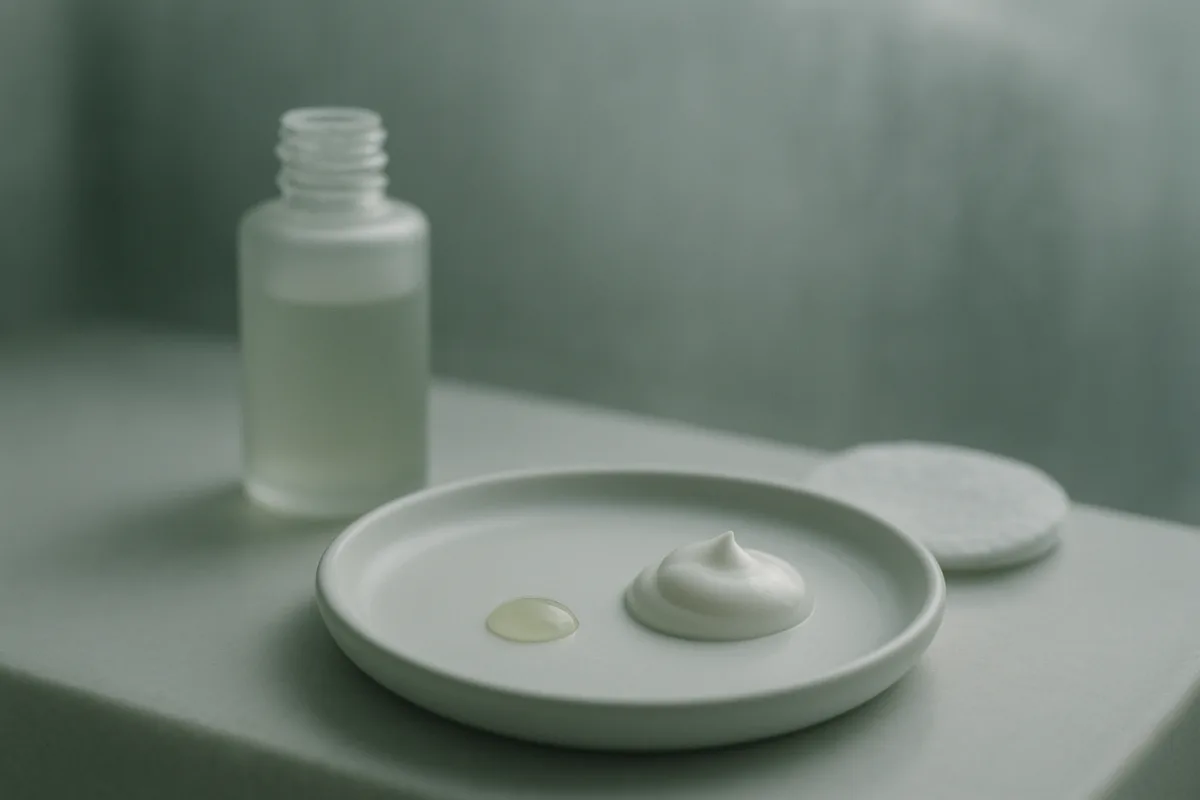
Pilling is what happens when skincare forms a bad surface film
Pilling is not usually a sign that your skin is “rejecting” a product. It is the visible rolling or balling-up of product on the surface, often when you apply the next layer or begin makeup.
The useful way to understand it is as a surface-film problem. Each skincare product leaves some combination of water, oils, humectants, silicones, powders, emulsifiers and film-forming ingredients behind. Add another formula before that layer has settled, then rub, and those films can catch and roll.
That is why pilling can look deceptively like dead skin. Sometimes loose surface cells contribute, particularly if skin is flaky. More often, though, the soft grey or white rolls are your products gathering together under friction. [1][7]
The fix is not automatically a new serum, a more expensive moisturiser, or aggressive exfoliation. It is making the films you put on your face thinner, more compatible and less disturbed while they settle.
The key mechanic: friction turns excess product into little rolls
Think about rolling an eraser across paper. The rubber does not disappear, it collects into crumbs as pressure and movement pull it across the surface. Skincare pilling works in a similarly simple way.
A product layer that is still wet, tacky, overly thick or poorly compatible with the layer below can be displaced instead of lying smoothly. Circular rubbing creates the friction that gathers that displaced material into visible pills. Pressing or patting is less likely to do this. [2][15]
This is why a routine may look fine in the mirror immediately after application, then fail when you apply sunscreen, foundation or concealer. The later product is not necessarily the culprit. It may simply be the step that supplies enough movement to expose a problem created earlier.
There are no strong clinical trials that measure pilling under patting versus rubbing, or establish a precise amount of friction that causes it. The advice to press rather than rub is consistent expert guidance and mechanically plausible, but it is not a tightly quantified medical finding. [1][7]
That distinction matters because skincare advice often turns a practical observation into fake precision. You do not need to pat every product for exactly 17 seconds. You need to avoid repeatedly moving a thick, partially dry stack of products around your face.
Why “silicone over water” is a useful warning, not a complete rule
A common explanation is that silicone-based products pill over water-based ones. There is something useful in this, but the shorthand is clumsy. The real issue is whether the films formed by two complete formulations can sit together without separating, sliding or rolling under the next layer. [1][17]
Silicones can create a smooth, slip-heavy surface, which is valuable in primers, sunscreens and some moisturisers. But if a watery layer underneath remains damp, or if there is too much of either product, the upper layer may not spread evenly. Rubbing can then turn that uneven film into flakes or rolls.
Water-based serums can also pill with other water-based products. Thick gel textures, formulas that leave a tacky film, rich creams, oils and some sunscreens can all contribute if they are layered too generously or too quickly. There is no reliable list of specific skincare brands that are universal pilling offenders. [5][9]
That is why ingredient-list detective work has limits here. Seeing dimethicone, cyclopentasiloxane or water near the top of an INCI list does not tell you, by itself, whether two products will pill together. Formula structure, how much you apply, your climate and your application technique all change the outcome.
Instead, use product texture as a practical starting point. Apply the most fluid products first, then progressively richer products: watery serum, gel serum, moisturiser, facial oil if used, then sunscreen during the day. This thinnest-to-thickest sequence gives each layer a better chance to form a coherent film. [3][17]
Quantity is the cheapest variable to change
Most pilling routines involve too much product somewhere. Skincare is marketed as a generous ritual, but a face can only hold so many layers before the surface becomes crowded.
For troubleshooting, use roughly a pea-sized amount of serum. Use about a dime-sized amount of moisturiser or sunscreen, then spread it gently in a thin, even layer rather than repeatedly massaging it until it feels dry. [9][16]
These are rough application guides, not laboratory thresholds. No research establishes the exact product thickness at which a serum begins to pill, and different pumps, droppers and textures dispense very different amounts. Still, reducing quantity is a sensible first test because it changes the physical stack without requiring a purchase.
Do not solve sunscreen pilling by applying less than the amount directed on its label or by treating it as optional. If a sunscreen does not apply comfortably over your routine at an appropriate amount, simplify the layers underneath or choose a different sunscreen texture. Cosmetic elegance matters, but so does using the product as directed.
A useful experiment is to change one variable for three mornings. Keep your cleanser, serum and sunscreen the same, but halve the serum amount. If pilling stops, you have evidence that product load, rather than one supposedly incompatible ingredient, was the bigger issue.
Waiting time is about settling, not an absorption countdown
The familiar recommendation is to wait 30 to 60 seconds between skincare layers. That is a sensible general pause, long enough for a product to spread, lose obvious wetness and become less likely to mix physically with the product on top. [4][14]
It is not a proven universal absorption time. There are no robust quantitative studies showing that every serum becomes pilling-proof at 30 seconds, nor evidence for a single ideal wait time across all skin types, climates and formulas. [1][4]
Actives deserve more patience. For vitamin C, retinoids and chemical exfoliants, guidance commonly extends the pause to 10 to 20 minutes before the next layer, particularly if your routine has been pilling. [4][13]
That longer interval should not be sold as a way to force a treatment-level result from a cosmetic product. It is a practical layering measure, intended to let the active formula settle and to reduce the chance that the next product drags it into pills.
If a 10-minute wait makes your morning unworkable, do not build a ritual around a stopwatch. Use the active at night when appropriate, use fewer layers, or accept that two formulas may not be convenient partners. A routine you can apply consistently is more useful than a theoretically perfect one.
Your climate changes the surface you are layering onto
Pilling is not only about the bottles. Heat and humidity can increase skin oiliness, leaving a more slippery surface for rich moisturisers, sunscreens and makeup to sit on. That can make an otherwise workable winter routine behave badly in July. [10]
The practical seasonal adjustment is straightforward: use lighter textures in warm, humid conditions and reserve richer layers for colder, drier weather. A gel moisturiser or one uncomplicated hydrating serum may be enough when skin already feels more emollient from humidity. [11][18]
This does not mean humidity has been proven to cause pilling at a measurable rate, or that every oily skin type needs oil-free products. Evidence on precise humidity, temperature and pilling thresholds is limited. But environmental oiliness is a credible, often overlooked part of the application problem. [10]
If your routine only pills on hot commutes or in a steamy bathroom, test application in a cooler, drier room before replacing products. Give each layer time to settle, reduce the amount slightly, and avoid rubbing sunscreen or makeup over a shiny, still-wet base.
Where exfoliation helps, and where it makes things worse
A rough, flaky surface can provide more texture for product to catch on. Gentle exfoliation one to three times weekly may remove loose surface cells and make application smoother for some people. [8][9]
But exfoliation is not a universal pilling cure. There is no conclusive evidence that one exfoliant type, physical or chemical, prevents pilling better than another. Overusing scrubs, acids or retinoids can also leave skin feeling dry and irritated, creating more visible flaking to confuse with product pills. [1]
Keep this practical. If the rolls appear only after you add a second product, investigate layering first. If you have persistent scaling, burning, redness, itching or patches that do not behave like ordinary product residue, stop trying to exfoliate the problem away and ask a dermatologist for advice.
A controlled way to find the failing layer
Strip the routine back for one application. Apply your usual serum in a small amount, wait a minute, then apply sunscreen by pressing it across the face. If there is no pilling, add moisturiser on the next test day.
If pills appear only after moisturiser, reduce its amount first. If they appear only when sunscreen goes over moisturiser, extend the wait time and use a lighter moisturiser texture before assuming the sunscreen is defective.
This is slower than throwing out every product with silicone on the label, but it identifies the interaction that matters. Pilling is usually not a verdict on one product. It is a failure in the system: too much product, too little settling time, too much friction, or layers that do not form a stable surface together.
Frequently Asked Questions
What causes skincare to pill and how can I fix it?
Skincare pills when layers of products form films that do not settle smoothly, especially if applied too thickly or too quickly. Pilling happens because of friction moving wet or incompatible layers around, causing them to roll into visible flakes. To fix it, use thinner layers, apply products in the correct order from lightest to heaviest, and allow adequate time for absorption between layers.
How do I layer skincare products to prevent pilling?
Start with thin, water-based products like serums and follow with thicker creams, oils, and sunscreens. Wait 30 to 60 seconds between ordinary layers, and longer—about 10 to 20 minutes—when using active ingredients like vitamin C, retinoids, or chemical exfoliants. This helps each layer settle and reduces the chance of films separating and pilling.
Why does my moisturizer or sunscreen pill on my skin?
Moisturizers and sunscreens can pill if applied over layers that are still wet or tacky, or if too much product is used. Silicone-based sunscreens or creams over water-based layers may not spread evenly, especially if the underlying layer hasn’t fully absorbed, leading to product rolling when rubbed or moved.
How much product should I apply to avoid pilling?
Use roughly a pea-sized amount of serum and a dime-sized amount of moisturizer or sunscreen. Applying more than these amounts increases the risk of thick, wet layers that do not absorb well and can pill when disturbed.
Does rubbing vs pressing affect skincare pilling?
Yes, rubbing creates friction that can displace product layers and cause pilling, while pressing or patting applies product with less movement and is less likely to disturb the layers. Although there are no precise clinical measurements, experts consistently recommend pressing rather than rubbing to minimize pilling.
How we researched this
This article was assembled from 18 cited references.
Nothing here is based on hands-on testing. Where a figure or finding appears, it belongs to the source cited beside it, and the writing says so rather than implying otherwise. Every source is listed below so you can check it.
Sources
- Understanding the causes of skincare product pilling - PMC
- Why Does My Skincare Pill on My Skin? Causes | Dr. Dermaluci – Dermaluci Lab
- Skincare and makeup: the order that prevents pilling
- Skincare Wait Times: The Definitive Reference | Layered Skincare
- Why Is My Skincare Pilling? 7 Causes & How to Fix It
- Why is my makeup pilling? Here are the 7 potential culprits
- Why Your Skin-Care Products Pill and How to Prevent It — Expert Advice | Allure
- Prevent Skincare Pilling | PMD Beauty
- What is skin pilling? Causes, fixes & prevention tips - Inspire Me - Boots Ireland
- Why Humidity Wrecks Your Skincare Routine and the Ingredient Swaps That Actually Help | Dermatocare
- Seasonal Skincare Routine Changes: Expert Tips - velotouch
- How To Layer Skincare Without Pilling Proven Techniques For Smooth Application
- How to Layer Skincare Without Pilling — Klairs Skin School – Dear, Klairs
- How to Prevent Pilling: Mastering Your Skincare Layering Techniques
- 6 Ways to Stop Your Skincare and Makeup From Pilling | Who What Wear
- Why Is My Skincare Pilling? - Beauty Advice
- Skin Pilling & How to Layer Skincare | Eucerin UK
- How to Transition Your Skincare from Summer to Autumn-According to the Experts
Related Articles
How to Prevent Skincare Irritation: Tips for Sensitive Skin
Learn how to prevent skincare irritation by managing total irritation load and introducing products safely for healthier, calmer skin.
How to Layer Products for Acne-Prone Skin Correctly
Learn how to layer products for acne-prone skin with the right order, timing, and active ingredient use to avoid irritation and maximize results.
How to Introduce New Skincare Products Safely
Learn how to introduce new skincare products safely with patch testing, gradual use, and tips to avoid irritation and track reactions.

How to Apply Face Oil: Best Practices and Tips
Learn how to apply face oil correctly, including layering order, amount, and timing for glowing, hydrated skin in your skincare routine.