
How to Choose a Gentle Exfoliant for Sensitive Skin
Learn how to choose a gentle exfoliant with safe acids, enzymes, and scrubs suitable for sensitive skin and avoid irritation.
Problem one: deciding whether your skin needs exfoliation at all
Exfoliation is not an essential step for every sensitive-skinned person. It removes some of the compacted dead cells at the surface, which can make skin feel smoother and help makeup apply more evenly. That is a cosmetic improvement, not a treatment for a skin disorder.
The marketing problem is that “sensitive” gets used for anything from temporary dryness to persistent redness, stinging, scaling, acne-like bumps, or eczema. Those are not interchangeable. If your skin repeatedly burns with bland products, cracks, swells, or develops an ongoing rash, skip the exfoliant experiment and see a dermatologist.
A reasonable reason to try exfoliation is modest: skin feels rough or looks dull despite a basic cleanser and moisturiser, or you have occasional congestion and already tolerate your routine. Do not introduce it during a flare-up, after sunburn, or when your barrier already feels raw.
Sensitive skin has less margin for error. The most common mistake is interpreting tingling as proof an active is working, then adding more product or using it more often. The Estetica’s guidance on sensitive-skin mistakes specifically flags over-exfoliation and ignoring irritation signals as problems to correct. [6]
Problem two: choosing between acids, enzymes and scrubs
The gentlest category is usually not “natural” or “clean”. It is a formula with a known exfoliating ingredient, a conservative concentration, and a format you can use infrequently. Read the full ingredient list, not just the front label’s promise of glow.
For most sensitive skin, begin with a chemical or enzyme exfoliant rather than a grainy scrub. Chemical exfoliants loosen the bonds between surface cells. Enzymes act more superficially, while physical scrubs depend on friction, which makes pressure and particle shape part of the risk. [2][5]
There is no useful clinical head-to-head trial proving one exfoliant is best for every sensitive-skin type. The evidence is ingredient-specific, formulation-dependent, and often based on short studies. Choose the lowest-risk category for your particular concern, then give it time.
Problem three: finding an acid that is actually gentle enough
Polyhydroxy acids, usually listed as gluconolactone or lactobionic acid, are a sensible first place to look. They penetrate more slowly than conventional AHAs and have humectant properties, meaning they can help hold water at the skin surface while providing mild exfoliation. [2][3]
That does not mean PHAs cannot sting. A leave-on PHA can still be poorly tolerated when paired with fragrance, alcohol, strong surfactants, or several other actives. “PHA” tells you something useful about the active, not everything about the finished product.
Lactic acid is another practical option, especially at 5% or less. It is an alpha hydroxy acid, or AHA, and lower-strength formulas are generally positioned as gentler than stronger glycolic-acid products for sensitive skin. [3][8]
A 2009 Journal of Cosmetic Dermatology comparison of lactic and glycolic acid is part of the reason lactic acid is commonly framed as the milder AHA choice. Still, that does not establish that every lactic-acid formula is irritation-free, or that it will suit rosacea, dermatitis, or other diagnosed conditions.
The 2024 Journal of Cosmetic Dermatology research on triple-acid blends, including lactic acid, is relevant to how formulators combine exfoliating acids. Its limitation is obvious: a blend cannot tell you exactly which acid, concentration, vehicle, or use pattern caused a response in an individual consumer.
Mandelic acid is also worth considering if you want an AHA but have been wary of stronger formulas. Its larger molecular size is generally understood to correspond with slower penetration, and it is often recommended for sensitive skin in ingredient guides. [2][3]
Be realistic about the result. With a gentle acid used once weekly, expect gradual smoothing over several weeks, not a next-morning transformation. More frequent application may create a temporarily polished look, then leave you with redness and roughness that make texture appear worse.
Problem four: choosing an option for congestion without overdoing it
Salicylic acid is the main beta hydroxy acid, or BHA, found in cosmetic exfoliants. Unlike water-soluble AHAs, it is oil-soluble, which is why it is commonly chosen for skin that is both sensitive and prone to visible congestion. [3]
The useful range here is 0.5% to 2%. The 2024 Journal of Clinical and Aesthetic Dermatology review of salicylic acid concentrations supports that low-concentration approach, but tolerability still varies substantially by person and by formula. [3]
If you are cautious, begin with 0.5% or a rinse-off product rather than jumping directly to a 2% leave-on liquid. Use it once weekly, on dry skin, and do not pair it that night with retinoids, another acid, exfoliating pads, or a scrub. [3][6]
Salicylic acid may improve the appearance of blocked pores and uneven texture, but it is not a substitute for medical advice about acne, inflamed lesions, persistent redness, or a changing skin condition. A dermatologist can distinguish ordinary congestion from something requiring a different approach.
Problem five: wanting a non-acid option
Enzyme exfoliants usually use papain, from papaya, or bromelain, from pineapple. They work at the surface rather than relying on the same acid pathway, so they can be a useful alternative for people who find leave-on acids consistently uncomfortable. [2][3]
The catch is that enzyme products vary widely. A “fruit enzyme mask” may also contain fragrance, essential oils, clay, or abrasive grains, any of which can be the real irritant. Check whether papain or bromelain is actually listed, and whether the rest of the formula is simple.
A rinse-off enzyme product is often easier to control than a leave-on acid. Follow its stated contact time exactly for the first use. Leaving a wash-off mask on longer does not produce proportionately better exfoliation, but it can increase irritation.
Problem six: being tempted by a scrub
Physical exfoliation is the category to approach most skeptically. Sensitive skin does not need aggressive friction, and coarse natural powders are not automatically kinder than acids. Walnut shell powder is specifically a poor choice because its particles can be angular and abrasive. [1][5]
If you strongly prefer a scrub, the cautious specification is smooth, rounded particles around 100 to 250 microns in diameter, such as jojoba beads. Particle sizes above 300 microns and sharp or irregular particles are more likely to feel harsh. [1][5]
This particle guidance is expert and industry guidance, not a detailed body of clinical research comparing every shape on sensitive skin. That limitation matters. Even a well-designed scrub can irritate if you massage too hard, use it too often, or apply it to already compromised skin.
Use no washcloth, cleansing brush, or second scrub in the same routine. Apply with fingertips and barely any pressure, then rinse. If your skin feels squeaky, hot, or tight immediately afterward, the product or technique is not gentle enough for you.
Problem seven: working out frequency without wrecking your barrier
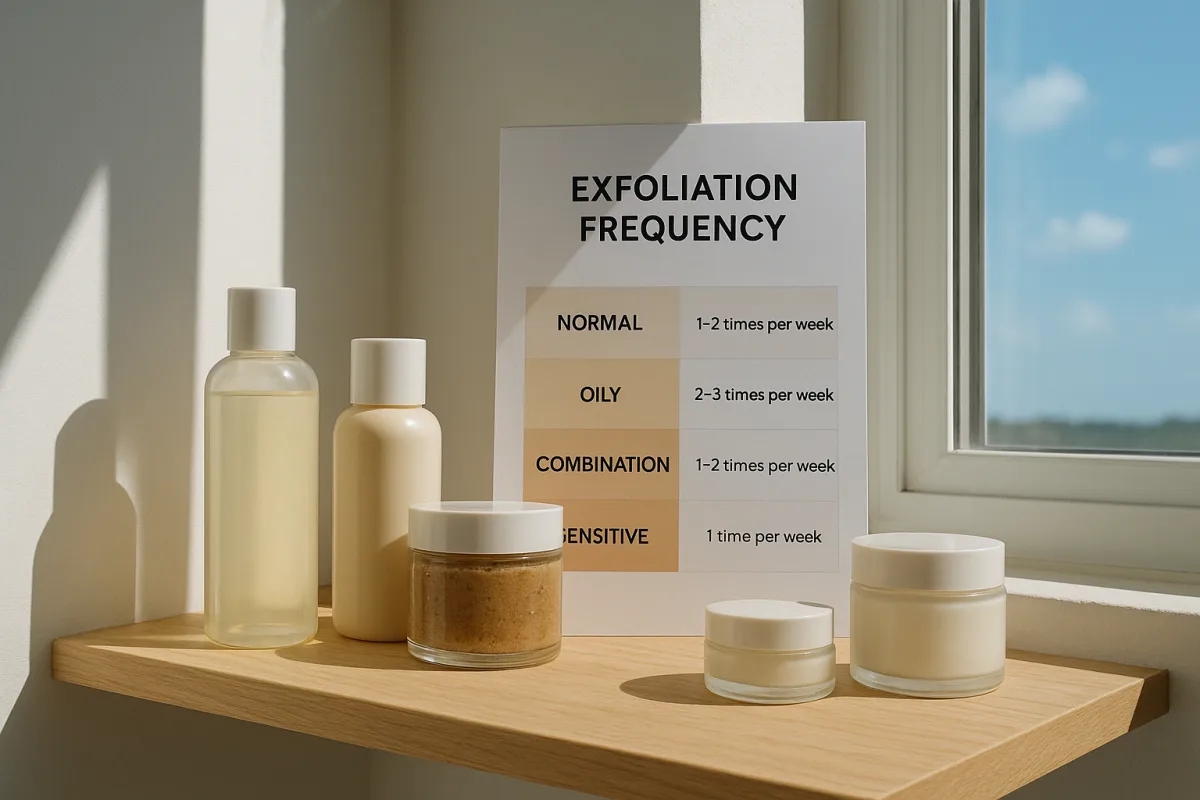
Advice to exfoliate two or three times weekly is common, but it is too broad for this audience. More conservative sensitive-skin guidance recommends once weekly, with twice weekly as the upper limit if your skin has stayed calm over time. [2][4]
There is no strong clinical consensus pinning down one exact frequency for all sensitive skin. That is not a gap to solve by guessing. Treat once weekly as the default, keep it there for at least several weeks, and assess comfort before changing anything.
A practical schedule is to exfoliate one evening, then use only a gentle cleanser, bland moisturiser, and daytime sunscreen for the following day. Do not judge tolerance solely by the first ten minutes. Delayed dryness or stinging the next day counts.
In colder, drier weather, reduce frequency rather than trying to exfoliate through flaking. Humidity, heat, pollution, and seasonal changes can also affect how reactive skin feels, although evidence does not quantify a universal adjustment for every environment. [2][6]
Problem eight: combining it with the rest of your routine
The night you exfoliate is not the night to stack actives. Skip retinoids, another AHA or BHA, strong vitamin C formulas, benzoyl peroxide, and scrubs unless a dermatologist has given you a specific plan. Layering multiple actives is a recognised route to irritation. [6]
Keep the routine boring: cleanse, exfoliate as directed, moisturise. A fragrance-free moisturiser with humectants and barrier-supporting lipids can make the routine more tolerable, but it does not cancel out an overly strong exfoliant or an excessive schedule.
Sun protection is not optional after exfoliation. Use a broad-spectrum SPF 30 or higher every morning, particularly after using AHAs, which can leave recently exfoliated skin more vulnerable to visible sun-related damage. [4]
If an exfoliant causes sustained stinging, increasing redness, itch, swelling, peeling, cracking, or tenderness, rinse it off if appropriate and stop using it. Do not try to “build tolerance” through symptoms that are worsening. Seek professional advice for persistent reactions.
Problem nine: checking the label in your region
Concentration and ingredient rules differ by market, so a product sold in the United States may not be formulated or labelled identically in the European Union. Check the ingredient list on the actual package, rather than relying on an overseas retailer’s product page.
For consumers concerned about contaminants, New York law prohibits cosmetic and personal-care products containing specified levels of 1,4-dioxane or mercury. That is a regulatory safeguard, not a guarantee that any product will suit reactive skin. [9]
European rules are changing too. Ireland’s Health Products Regulatory Authority notes that Omnibus Act VIII added 18 substances to cosmetic restrictions or prohibitions from 1 May 2026. [7] EU Regulation 2026/909 will further restrict citral and benzyl salicylate concentrations from 1 January 2027.
Those rules matter because fragrance allergens can complicate a sensitive-skin routine, but regulatory compliance is the floor, not a personal compatibility test. Patch testing a new exfoliant on a small area is still sensible, particularly if you have reacted to cosmetics before.
Frequently Asked Questions
What is the safest exfoliant for sensitive skin?
The safest exfoliants for sensitive skin are chemical or enzyme exfoliants rather than physical scrubs. Recommended ingredients include polyhydroxy acids (PHAs) like gluconolactone or lactobionic acid, low-concentration lactic acid (5% or less), mandelic acid, and enzymes such as papain or bromelain. These ingredients penetrate gently and are less likely to cause irritation.
How often should I use a gentle exfoliant?
For sensitive skin, it is advisable to start with one exfoliation per week. If the skin tolerates this well, a second weekly use may be considered. More frequent exfoliation risks barrier damage and irritation, so caution and gradual introduction are important.
Which acids are best for gentle exfoliation?
PHAs such as gluconolactone and lactobionic acid are recommended due to their slow penetration and humectant properties. Low-strength lactic acid (5% or less) and mandelic acid are also suitable options because they tend to be gentler than stronger AHAs like glycolic acid.
Can I use salicylic acid on sensitive skin?
Salicylic acid at low concentrations (0.5% to 2%) can be used on sensitive skin, particularly if clogged pores are a concern. However, it is important to start with the lowest concentration and monitor skin response carefully, as salicylic acid can still cause irritation in some individuals.
Are enzyme exfoliants better for sensitive skin?
Enzyme exfoliants such as papain and bromelain are considered gentle because they act more superficially than acids. They can be a good choice for sensitive skin, especially when used as rinse-off products, minimizing the risk of irritation.
How we researched this
This article was assembled from 9 cited references.
Nothing here is based on hands-on testing. Where a figure or finding appears, it belongs to the source cited beside it, and the writing says so rather than implying otherwise. Every source is listed below so you can check it.
Sources
- Can You Exfoliate Sensitive Skin And What Ingredients Are Safest
- Best Exfoliants for Sensitive Skin: Gentle Picks — NeedSkincare
- Best Chemical Exfoliant for Sensitive Skin
- How to Exfoliate if You Have Sensitive Skin | Skincare.com
- Physical Exfoliants for Sensitive Skin | Dermatology
- Common Mistakes With Skincare for Sensitive Skin (and How to Fix Them) - The Estetica
- Omnibus Act VIII – new substances added to the list of ingredients restricted or prohibited in cosmetics from May 2026
- Lactic Acid: The Gentle, Hydrating Exfoliator Adored By Experts And Sensitive Skin-Sufferers Alike
- N.Y. Environmental Conservation Law Section 37-0117 – Prohibition of cosmetic products and personal care products containing 1,4-dioxane or mercury (2026)
Related Articles
How to Choose a Toner for Oily Skin
Learn how to choose a toner for oily skin with tips on ingredients, pH, and usage to control shine and avoid irritation.
How to Choose a Face Scrub for Sensitive Skin Safely
Learn how to choose a face scrub for sensitive skin with gentle ingredients, proper exfoliation frequency, and what to avoid to prevent irritation.
How to Treat Uneven Skin Texture: Effective Skincare Tips
Learn how to treat uneven skin texture with targeted actives, routines, and product tips for smoother, healthier skin.
How Often Should You Exfoliate? Expert Frequency Guide
Learn how often you should exfoliate based on skin type, exfoliant type, and signs of over-exfoliation to build a safe skincare routine.