
How to Prevent Skincare Irritation: Tips for Sensitive Skin
Learn how to prevent skincare irritation by managing total irritation load and introducing products safely for healthier, calmer skin.
Think in terms of total irritation load
The most useful way to prevent skincare irritation is not memorising a blacklist of ingredients. It is learning to assess your total irritation load, meaning everything that challenges skin’s protective barrier in the same period.
That load includes the obvious things, such as retinol, exfoliating acids, and strong vitamin C formulas. It also includes hot water, foaming cleanser, rubbing with towels, shaving, dry indoor heating, cold wind, sweat, and friction from masks.
Skin does not experience those exposures as separate spreadsheet columns. If its barrier is already struggling after a cold commute and a twice-daily cleanser, an active that seemed fine last month may suddenly sting.
This explains why a product can be tolerable for weeks, then appear to “cause a reaction” without a formula change. Seasonal shifts matter: cold, dry air and indoor heating can increase dryness and sensitivity, while heat and humidity change oil production and breakouts. [5][6]
The practical cost of ignoring that background load is confusion. People often respond to redness by adding a calming serum, another exfoliant for texture, or a heavier routine, when the more rational move is usually subtraction.
What the barrier is doing, and why it reaches a limit
Your outer skin layer is not a sealed surface. It is a living interface designed to hold onto water while limiting entry by irritants from the environment and products.
Cleansers, solvents, acids, retinoids, weather, and physical rubbing can all make that job harder. The result may be tightness, stinging, flaking, redness, or a sudden tendency for products that once felt neutral to burn.
That is not proof of a particular diagnosis. Irritant contact dermatitis and allergic contact dermatitis are different processes, and they can look similar enough that persistent or significant symptoms deserve clinical assessment, not social-media detective work.
Irritant contact dermatitis is associated with repeated exposure to water, soaps, detergents, temperature extremes, ultraviolet exposure, low humidity, and mechanical friction. Allergic contact dermatitis involves an immune response to a particular allergen, including fragrance, preservatives, nickel, rubber accelerators, or biocides. [9][10]
The distinction matters because “use less” may help with an irritant overload, but it does not establish whether someone is allergic to an ingredient. Repeatedly reapplying a suspected product to test yourself is a poor substitute for a dermatologist-led evaluation.
Concentration is only one part of the dose
A percentage on a label matters, but it is not the whole dose your skin receives. The real exposure is concentration multiplied by amount, frequency, application area, formula, layering, and the condition of your skin on that day.
A 0.1% retinol product used twice weekly on dry skin is a different proposition from that same formula applied nightly after an acid toner. The ingredient percentage has not changed, but the irritation load has.
For sensitive skin, the guidance in the research brief places retinol around 0.05% to 0.10%, used two or three times weekly at first. That is a cautious entry range, not a guarantee that either concentration will suit every person.
For leave-on acids, the cited guidance places lactic or mandelic acid at 5% to 10%, and salicylic acid at 0.5% to 2%, for sensitive users. [8] Lower percentages still can sting, especially when a barrier is already compromised.
Vitamin C is similar. A 10% to 15% L-ascorbic acid formula is often suggested as a moderate range for sensitive skin, but its naturally acidic working environment matters as much as its percentage.
L-ascorbic acid products commonly work around pH 2.5 to 3.5, while AHAs and BHAs commonly sit around pH 3.0 to 4.0. Retinoids are generally formulated nearer pH 5.5 to 6.5. [7][8]
Those figures are useful for understanding formula design, not for turning your bathroom into a chemistry lab. You cannot reliably calculate comfort from pH and percentages alone because the vehicle, preservatives, solvents, and your existing routine all affect the outcome.
The combination with the clearest downside
If there is one pairing worth taking seriously, it is retinoids plus exfoliating acids in the same routine. Both can be useful cosmetic ingredients, but applying both together increases the chance of dryness and irritation. [8]
This is not because acids and retinoids “cancel each other out.” The problem is cumulative stress: acids loosen surface-cell cohesion, while retinoids can also cause dryness and visible peeling during the adjustment period.
Use a simple calendar instead. An acid night, a retinoid night, and rest nights with cleanser, moisturiser, and sunscreen make it easier to see whether either active is working within your tolerance.
The old warning against using niacinamide and vitamin C together is less useful. Available guidance indicates that L-ascorbic acid and niacinamide can be used in the same routine without the adverse interaction once commonly claimed. [4]
That does not mean every vitamin C and niacinamide combination will feel comfortable. A low-pH vitamin C formula may still sting, and adding it to an already crowded routine can still push total exposure beyond your personal limit.
Use a slow introduction protocol, not optimism
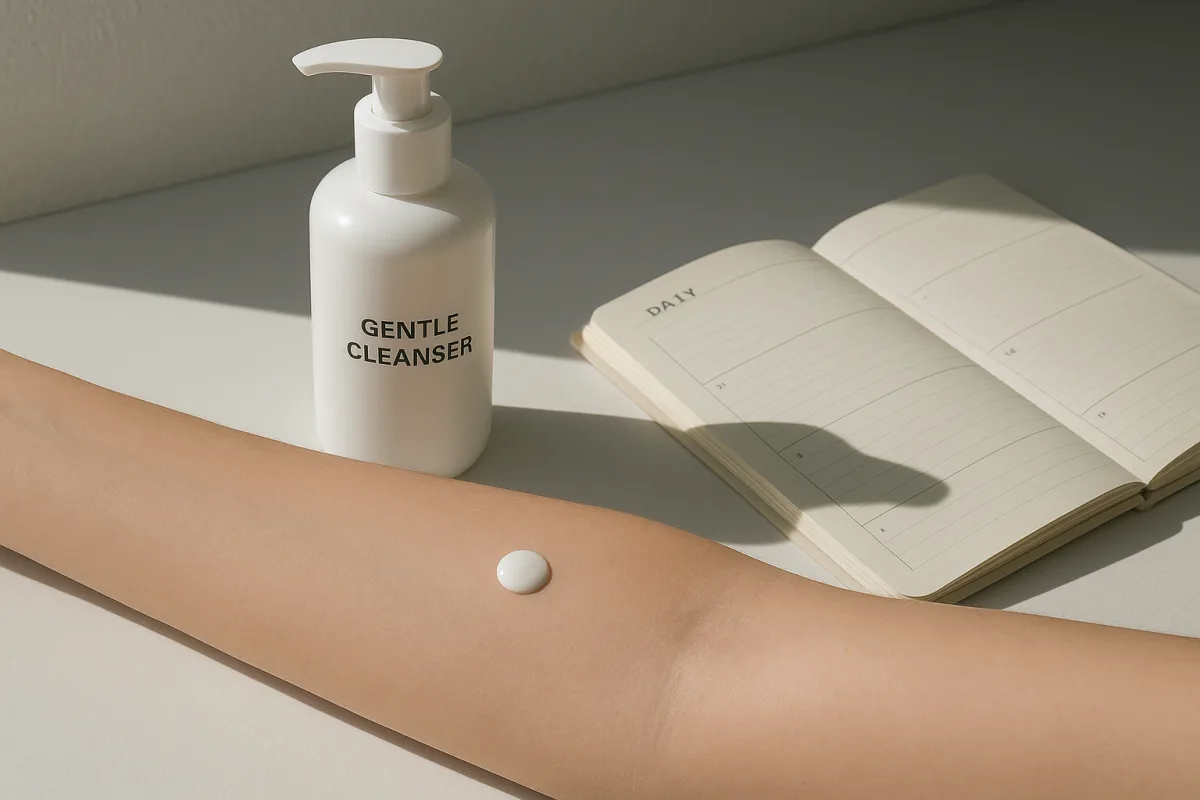
The source guidance recommends patch testing a new product for 7 to 10 days, then introducing it at one or two uses per week. [2][3] This is tedious, but it is cheaper than losing track of which new serum caused the problem.
Apply the product to a small, discreet area according to its instructions, rather than testing it on visibly irritated skin. A patch test is a screening tool, not a medical allergy test and not proof that a full-face application will be uneventful.
After that initial period, use the product on the intended area at low frequency. Give it 2 to 4 weeks of observation before deciding to increase use, while keeping the rest of the routine as stable as possible. [2][3]
One new product at a time is the part people skip. If you start a retinal serum, an exfoliating toner, and a new sunscreen in the same week, any reaction becomes an unsolved three-product problem.
The slow approach also gives cosmetic results time to be modest. Hydration and surface smoothness can be noticed relatively quickly, but changes in uneven tone or texture from an active are generally gradual, not a seven-day verdict.
There is no good evidence in the supplied research for a universal schedule that predicts exactly who will react to which active at which percentage. Skin tolerance is individual, and a careful ramp-up is risk management, not a precision science.
Keep layering boring when skin is unsettled
Apply products from thinner to thicker consistencies, allowing roughly 30 to 60 seconds between layers. [7][8] The pause is not a magical absorption ritual, but it reduces unnecessary rubbing and gives fluid layers a chance to settle.
On a low-irritation evening, that may mean a gentle cleanse, one moisturising or soothing product, then moisturiser. Adding every product you own does not necessarily strengthen the barrier faster.
Ceramides, squalane, aloe, chamomile, and cica are commonly used in gentle post-irritation routines. [16][19] These are supportive cosmetic choices, not a standardised clinical protocol for managing a reaction.
Panthenol has evidence for hydration and barrier support, while centella asiatica is associated with barrier-repair and wound-healing mechanisms. [16][17] Neither ingredient makes a product automatically suitable, since the full formula still matters.
Bisabolol is often marketed as a soothing ingredient with anti-inflammatory potential. The limitation is that it frequently appears in multi-ingredient formulas, making its isolated cosmetic effect difficult to separate from the rest of the product. [15]
Witch hazel needs more skepticism than its “natural toner” reputation gets. It has moderate evidence for anti-inflammatory effects, but its tannins and astringency mean it is also listed among ingredients rosacea-prone people may wish to avoid. [11][15]
Match the routine to your current skin, not your ideal routine
Eczema-prone skin and rosacea-prone skin require extra caution because baseline sensitivity changes the margin for experimentation. If either term describes a diagnosed condition or a persistent pattern of symptoms, a dermatologist should guide treatment decisions.
During eczema flare-ups, sources advise avoiding retinoids, fragrance, essential oils, denatured alcohol, sodium lauryl sulfate, lanolin, propylene glycol, and, in some guidance, urea. [9][10]
Urea is a good example of why ingredient lists need context. It can support hydration in many formulas, yet it may sting or aggravate already inflamed eczema-prone skin, so “good ingredient” is not the same as “good for every moment.”
For rosacea-prone skin, commonly flagged triggers include fragrance, denatured alcohol, witch hazel, menthol, peppermint, camphor, and harsh physical exfoliants such as walnut shell powder. [11][12]
None of these lists can diagnose the reason your face is red. They are practical reasons to simplify a routine and seek professional advice if symptoms recur, spread, become painful, or do not settle after stopping suspected triggers.
The boring reset is often the sensible one
When a product appears to irritate, stop the suspected new addition rather than layering more actives to correct the visible aftermath. Use gentle cleansing, a straightforward moisturiser, and daily sun protection while the skin settles. [19]
Do not assume that more soothing ingredients equals more safety. Fragrance, essential oils, botanical extracts, and preservative systems can all complicate a product, which is why a short ingredient list can be easier to troubleshoot.
There is no detailed, clinically standardised “post-irritation routine” with a guaranteed timeline in the available research. General advice is based largely on barrier support and avoiding known irritants, not on a proven three-day reset formula.
That uncertainty is worth stating plainly. Skincare can improve comfort, hydration, and appearance, but a persistent adverse reaction is not a consumer-product puzzle you are obliged to solve alone.
Frequently Asked Questions
How can I prevent irritation when introducing new skincare products?
Introduce one new product at a time and patch test it for 7 to 10 days before using it on your face. Start by applying the product one or two times weekly, then gradually increase frequency over 2 to 4 weeks while monitoring your skin’s response. This cautious approach helps isolate any irritation and reduces the risk of overwhelming your skin barrier.
What causes cumulative skincare irritation and how to manage it?
Cumulative irritation happens when multiple factors challenge your skin barrier simultaneously, such as combining active ingredients like retinoids or acids with frequent cleansing, dry weather, friction, or physical rubbing. Managing it involves assessing your total irritation load and often reducing the number or frequency of irritating exposures rather than adding more products to soothe symptoms.
How should I layer retinoids and acids to avoid irritation?
Retinoids and exfoliating acids should be used on separate nights because using them together increases the risk of dryness and irritation. Both ingredients stress the skin barrier, so spacing their application helps minimize cumulative irritation and allows your skin to better tolerate each active.
What is the best way to patch test skincare products?
Patch testing involves applying a small amount of the new product to a discreet skin area and observing for any reaction over 7 to 10 days. This slow introduction helps identify potential irritation or allergy before applying the product to larger or more sensitive areas like the face.
How do environmental factors increase skincare irritation risk?
Environmental conditions such as cold, dry air and indoor heating can increase skin dryness and sensitivity, making it more prone to irritation. Conversely, heat and humidity can change oil production and contribute to breakouts, altering how your skin reacts to products and increasing the overall irritation load.
How we researched this
This article was assembled from 19 cited references.
Nothing here is based on hands-on testing. Where a figure or finding appears, it belongs to the source cited beside it, and the writing says so rather than implying otherwise. Every source is listed below so you can check it.
Sources
- Does Vitamin C Help Acne-Prone Skin? Dermatologists Explain
- How do I introduce a new product without irritating my skin? | Skinlogie
- How to Test New Skincare Products Safely
- How Often Should You Change Your Skincare Routine? | Skincare.com
- How season & weather changes affect your skin | Cetaphil US
- Your skin changes dramatically with the seasons | KAIAN Inc.
- The Complete Skincare Layering Order | Layered Skincare
- How to Layer Active Ingredients Without Irritation | OcuraLife
- 8 skincare ingredients to avoid if you have eczema, according to dermatologists | National Eczema Association
- Eczema-Safe Skincare: Ingredients to Use and Avoid | AllerNote
- Skincare Ingredients to Avoid (and Use) With Rosacea | SkinDetekt
- Rosacea Skincare Routine: Complete Guide + Best Products 2026 | Skincare in Korea
- Skincare Ingredients to Avoid for Eczema | La Roche Posay
- Skincare Ingredients to Avoid if You Have Rosacea - ScienceInsights
- Bisabolol: Benefits & Safety - cosmetic.science
- Centella Asiatica (Cica) for Skin: Benefits & Evidence — DermaProtocol
- Panthenol (Pro-Vitamin B5) - Usage, Research & Evidence | Skincare Database
- From Reducing Redness to Banishing Acne, This Is the Skincare Ingredient You're Probably Overlooking
- The Skincare Order That Dermatologists Actually Recommend-Here's Exactly Where Every Product Goes
Related Articles
How to Layer Products for Acne-Prone Skin Correctly
Learn how to layer products for acne-prone skin with the right order, timing, and active ingredient use to avoid irritation and maximize results.
How to Identify Cruelty-Free Skincare Products
Learn how to identify cruelty-free skincare products using certifications, logos, and tips to avoid misleading claims.
How to Treat Uneven Skin Texture: Effective Skincare Tips
Learn how to treat uneven skin texture with targeted actives, routines, and product tips for smoother, healthier skin.
Benefits of Hyaluronic Acid: Hydration and Skin Improvement
Discover the benefits of hyaluronic acid for skin hydration, molecular weight effects, and how to use it for smoother, plumper skin.