
How to Store Skincare Products for Best Longevity
Learn how to store skincare products properly to maintain potency and extend shelf life, including tips for vitamin C and retinol.
Move products out of the bathroom
The shelf beside the bathroom sink is convenient, but it is a poor home for skincare. Showers can push bathroom temperatures above 86°F, and heat can make degradation happen two to three times faster than it would at 77°F. [9][13]
Steam adds a second problem. Humidity can destabilize formulas and encourage microbial growth, particularly when a jar has been opened repeatedly with damp fingers or sits uncapped while you get ready. [10][13]
We would move the routine to a bedroom drawer, a closed cabinet outside the bathroom, or a shaded closet shelf. Pick a place you can reach every day, but one that does not cycle between hot, wet, and cool.
Do not relocate everything to a windowsill for the sake of a prettier lineup. Direct sunlight brings heat and light together, which is especially rough on formulas containing vitamin C or retinol. [4][13]
Set up a stable storage spot
Most skincare is designed for room-temperature storage, ideally between 59°F and 77°F. [1] Consistency matters too: repeated warming and cooling can be harder on a formula than a steady temperature that is slightly warmer than ideal. [1]
A drawer in a climate-controlled bedroom usually beats a cabinet above the stove, a car glove box, or a shelf beside a radiator. Keep products away from any heat source that turns on and off through the day.
Aim for relative humidity below 60%. [10] You do not need to turn a normal bedroom into a laboratory, but a small thermometer-hygrometer can flag a closet or cabinet that is persistently hot or damp.
If your home is hot and humid, use a closed storage box or vapor-barrier enclosure in the coolest dry room available. Guidance for humid climates also recommends keeping the dew point below 71.6°F, although there is no well-established consumer target beyond keeping humidity low. [10]
Match the storage plan to the active
Start by finding the ingredient that gives the product its point. A basic cream can usually live in a cool drawer. A vitamin C serum, retinoid product, or formula that oxidizes easily deserves the best-protected spot in that drawer.
Vitamin C is vulnerable to light, heat, and air exposure. Store it away from direct sunlight, keep the cap tight, and favor opaque, airtight packaging over a clear dropper bottle sitting in daylight. [4][12]
Retinol is also light-sensitive. An opaque container kept in a dark, cool location limits its exposure to the light and air that can reduce stability over time. [4][12]
Niacinamide is less light-sensitive than vitamin C and retinol, but that does not make its storage irrelevant. Its stability depends strongly on formula pH, with a preferred range of pH 5 to 7, and formulas below pH 5 can convert some niacinamide into nicotinic acid. [5]
You cannot correct a formula’s pH at home, so do not overthink light for a niacinamide serum in a properly closed bottle. Keep it cool, dry, and out of direct sun, then focus your extra effort on the vitamin C or retinoid products. [5]
Keep air, light, and fingers out of the formula
Packaging does part of the preservation work for you. Airless pumps reduce air exposure and contamination, dark glass blocks ultraviolet light, and airtight containers limit both oxygen and microbial ingress. [12]
An airless pump is our first pick for a frequently used serum or moisturizer with a sensitive active. It reduces how often the product meets room air, unlike a dropper bottle that is opened every time you apply it. [12]
Jars need more care because every opening exposes a broad surface of product. Close the lid immediately, use clean and dry hands, and do not leave a jar open while you layer other products.
Keep products in their original containers unless the packaging breaks or leaks. Original packaging is part of the formula’s protection plan, and transferring a product can increase its light, air, and contamination exposure. [13][14]
Do not assume a heavy glass jar is automatically protective. Dark glass can screen UV light, but a clear jar near a window still leaves light-sensitive ingredients exposed. [12]
Decide whether the refrigerator helps
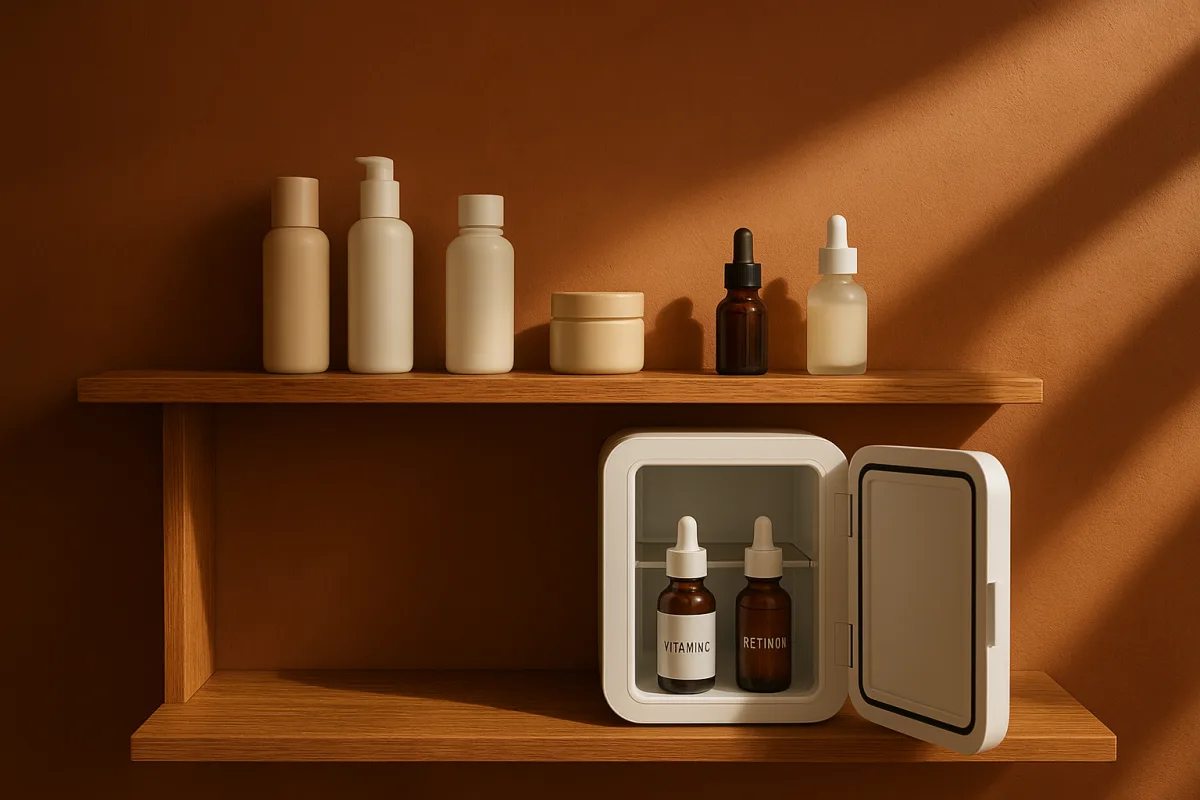
A skincare refrigerator is optional, not a universal upgrade. Refrigeration can help vitamin C serums, and guidance cited by Skincare Database and SABON says it may extend their shelf life by two to three times. [13][17]
The fridge can also make eye creams, hydrating masks, and facial mists feel cooling or more soothing on application. That is a sensory benefit, not a reason to expect a larger cosmetic result from the formula itself. [13][17]
Skip refrigeration for most creams, lotions, facial oils, and body scrubs. Cold storage can make these formulas solidify, separate, or change texture, leaving you with a product that is unpleasant or difficult to apply. [13][17]
If you refrigerate vitamin C, keep the serum in its closed, opaque container and avoid moving it repeatedly between the fridge and a warm bathroom. A stable storage routine is better than cycling the product through sharp temperature changes. [1][13]
We would reserve refrigerator space for one vitamin C serum that you use consistently, not for every product you own. A cool, dark drawer remains the default for most skincare.
Date each product when you open it
Write the opening month and year on the bottle, tube, or outer box with a marker. The printed expiration date may refer to an unopened product, while the time after opening is usually shorter because air and microbes enter during normal use. [6][7]
Cleansers and toners commonly last six to 12 months after opening. Moisturizers and creams generally fall in the same six- to 12-month range, assuming they have been stored well and still look, smell, and feel normal. [6]
Serums often have a shorter three- to six-month window, especially vitamin C serums. Sunscreens are generally listed at six to 12 months after opening. [6]
These are category-level ranges, not a guarantee that every product remains unchanged until the last day. A serum stored in a hot bathroom or a jar used with wet fingers may fail earlier. [6][13]
Buy the smallest size you can realistically finish if you rotate several serums or use vitamin C only a few mornings a week. Half-used products do not save money if they sit open long enough to discolor or separate.
Check the product before it reaches your face
Look at the formula before each use, especially if it has been sitting for weeks. Brown or darkened vitamin C, a new rancid or sour smell, visible separation, or an unexpected texture change are reasons to stop using it. [8][13]
A color shift is particularly relevant for vitamin C, because oxidation can show up as yellowing, orange, or brown discoloration. Do not try to fix it by chilling the bottle after the change has appeared. [4][8]
New irritation on application can also signal that something has changed in the formula. Stop using the product rather than pushing through it, and see a dermatologist if you have persistent or significant skin symptoms. [8]
Do not use a clean-looking product indefinitely because it was expensive. Storage can slow degradation, but it cannot make an opened formula last forever.
Tighten storage during hot or humid weather
A heat wave changes the storage problem. If your bedroom regularly rises above 77°F, move sensitive products to the coolest stable indoor space, keeping vitamin C and retinol away from windows and hot exterior walls. [1][4]
Avoid leaving skincare in a car, gym bag, or sunlit parcel locker. Those places can become far hotter than a room, and the product may spend hours there before you notice.
In a humid climate, keep the cabinet or box closed, avoid bathroom storage, and check temperature and humidity periodically with a basic monitor. Vapor-barrier enclosures can add protection where moisture is a recurring issue. [10]
Do not respond by refrigerating every bottle and jar. Stable, dark, dry storage protects most formulas better than constant moving between a warm room and a cold appliance. [1][13]
Frequently Asked Questions
What is the best temperature to store skincare products?
Most skincare products should be stored at a stable room temperature between 59°F and 77°F. Consistency is important, as repeated warming and cooling can damage formulas more than a steady temperature that is slightly warmer than ideal.
How should I store vitamin C and retinol products?
Vitamin C and retinol are sensitive to light, heat, and air. They should be kept in opaque, airtight containers, stored away from direct sunlight, and tightly closed after use. Refrigeration can be considered for vitamin C serums to extend their shelf life.
Why shouldn't I keep skincare in the bathroom?
Bathrooms often experience heat above 86°F and high humidity from showers, which speeds up formula degradation two to three times faster than at normal room temperature. Steam and moisture also encourage microbial growth and destabilize skincare products, especially when jars are repeatedly opened with damp fingers.
How can I tell if a skincare product has expired?
Date your products when you open them and replace any that change color, smell, or texture, even if the suggested shelf life has not passed. Changes in appearance or scent indicate that the formula may have degraded or become contaminated.
Is refrigeration necessary for some skincare products?
Refrigeration is beneficial for certain products like vitamin C serums, which can last two to three times longer when kept cold. It can also enhance the soothing effects of some eye creams and masks. However, refrigeration is unnecessary or may harm most creams, lotions, oils, and body scrubs by altering their texture.
How we researched this
This article was assembled from 17 cited references.
Nothing here is based on hands-on testing. Where a figure or finding appears, it belongs to the source cited beside it, and the writing says so rather than implying otherwise. Every source is listed below so you can check it.
Sources
- Skincare Expiration Dates, Storage & Skincare Fridges | INKEY
- Temperature vs. Humidity: Skincare Stability Guide | Journal
- How to Store Skincare and Makeup | SkinCarisma
- Vitamin C Skincare: L-Ascorbic Acid, Derivatives, and Stability Explained
- Niacinamide in Skincare: Stability, pH & Formulation Guide
- Skincare Shelf Life Chart: How Long Toners, Serums, Creams, and Sunscreens Last | BeautyChecker
- Do Skincare Products Expire? Shelf Life & Storage, The Element
- What Is the Shelf Life of Skincare Products - Ph Rituals Skincare
- How Long Does Skincare Last? A 2026 Shelf Life Guide
- How To Store Skincare Products In Humid Climates Without Losing Potency Or Growing Bacteria
- How To Store Skincare Products In Humid Climates Without Bacterial Growth Or Oxidation | ToolGuideDaily
- Skincare Ingredient Packaging: Balancing Protection, Stability & Sustainability | NIKOO Chemical
- How to Store Skincare Products, Complete Guide | Skincare Database
- How should I store skincare products properly? - Nordic Formula - Norwegian Skin Technology
- Countless TikTok Posts Are Creating Panic Around Benzene in Beauty Products-We Investigated the Science Behind the Story
- Do I need to store products in the refrigerator?, Celesty FAQ
- What Skincare Products Should & Should Not be Refrigerated | SABON
Related Articles
How to Introduce New Skincare Products Safely
Learn how to introduce new skincare products safely with patch testing, gradual use, and tips to avoid irritation and track reactions.
How to Layer Products for Acne-Prone Skin Correctly
Learn how to layer products for acne-prone skin with the right order, timing, and active ingredient use to avoid irritation and maximize results.
How to Fix Pilling in Skincare: Causes and Solutions
Learn how to fix pilling in skincare with tips on layering, product amounts, and application techniques to prevent product rolling and flaking.
How to Identify Cruelty-Free Skincare Products
Learn how to identify cruelty-free skincare products using certifications, logos, and tips to avoid misleading claims.