
Skin Type Home Test: How to Identify Your Skin Type
Learn how to perform a skin type home test using simple methods like the bare-faced test and blotting paper to identify your skin type accurately.
Start by dropping the idea that one label explains everything
“Skin type” is useful shorthand for how your skin tends to handle oil and moisture. The familiar labels are oily, dry, normal and combination. They are not medically standardised categories, and a home assessment cannot definitively sort everyone into one box. [2][4]
That matters because readers often take one bad skin week as evidence they have suddenly acquired “dry skin” or “oily skin.” A harsh cleanser, new retinoid, strong exfoliant, indoor heating or humid weather can all alter the surface signs you are trying to assess. [5][9][11]
Think of the result as a starting point for choosing texture and routine placement. It can tell you whether your cheeks and forehead behave differently. It cannot diagnose acne, eczema, rosacea, contact dermatitis or any other skin condition.
Before testing, write down what your skin normally does by the end of a typical day. Does makeup separate around the nose? Do cheeks feel rough after washing? Does your forehead shine while your jaw stays comfortable? Zones are more useful than a single label.
First problem: your current routine is distorting the answer
Do not assess skin type immediately after using a scrub, peel, clay mask or several new actives. Over-exfoliation and piling on multiple active ingredients can leave skin irritated and tight, which can look like inherent dryness when it is actually a disrupted barrier. [9][12][13]
The same applies to aggressive cleansing. A foaming cleanser that leaves your face squeaky may remove surface lipids so effectively that every skin type feels tight. That does not establish dry skin, it establishes that the cleansing step may be too harsh for that day. [11]
For the cleanest home test, choose a mild cleanser you already tolerate. Wash with lukewarm water, pat dry with a clean towel, and apply nothing afterwards: no toner, serum, moisturiser, facial oil, sunscreen or makeup. [2][22]
This is not an argument against sunscreen. Daily sunscreen belongs in a normal daytime routine, but it would interfere with an oil assessment. Do the test indoors or later in the day, then apply sunscreen before going outside. Skipping it regularly can alter visible skin damage over time. [10]
Do the bare-faced test without trying to make it scientific
After cleansing, leave skin alone for 30 minutes to two hours. The precise interval is not settled: Healthline gives a range, while CeraVe’s approach uses a shorter wait. The practical answer is consistency, using the same waiting time each time you compare results. [2][22]
At the end of the wait, stand in ordinary daylight near a window. Look at your forehead, nose, chin, cheeks and jaw separately. Then note how each area feels, without rubbing or repeatedly touching it.
If most areas look shiny or feel slick, especially before any products are applied, oily skin is the likely working label. If skin feels comfortable and looks neither notably shiny nor flaky, “normal” or balanced is the most accurate description for this particular test. [2][3]
If your skin feels tight, looks dull, has visible flaking, or feels rough, dry skin is the likely starting point. Tightness is subjective rather than a universally measurable threshold, although research on self-reported skin type links tightness with lower hydration. [4]
If your forehead, nose and chin are shiny while cheeks are comfortable, dry or rough, call it combination skin. This is common precisely because facial areas do not all produce oil in the same way. Trying to force combination skin into either oily or dry usually leads to mismatched products. [3][5]
Take notes rather than relying on memory. A useful entry is: “Two hours after cleanse: forehead shiny, nose lightly oily, chin neutral, cheeks comfortable but slightly tight.” That is enough information to make a better product choice than “my skin is confusing.”
Next problem: you cannot tell shine from a rich moisturiser
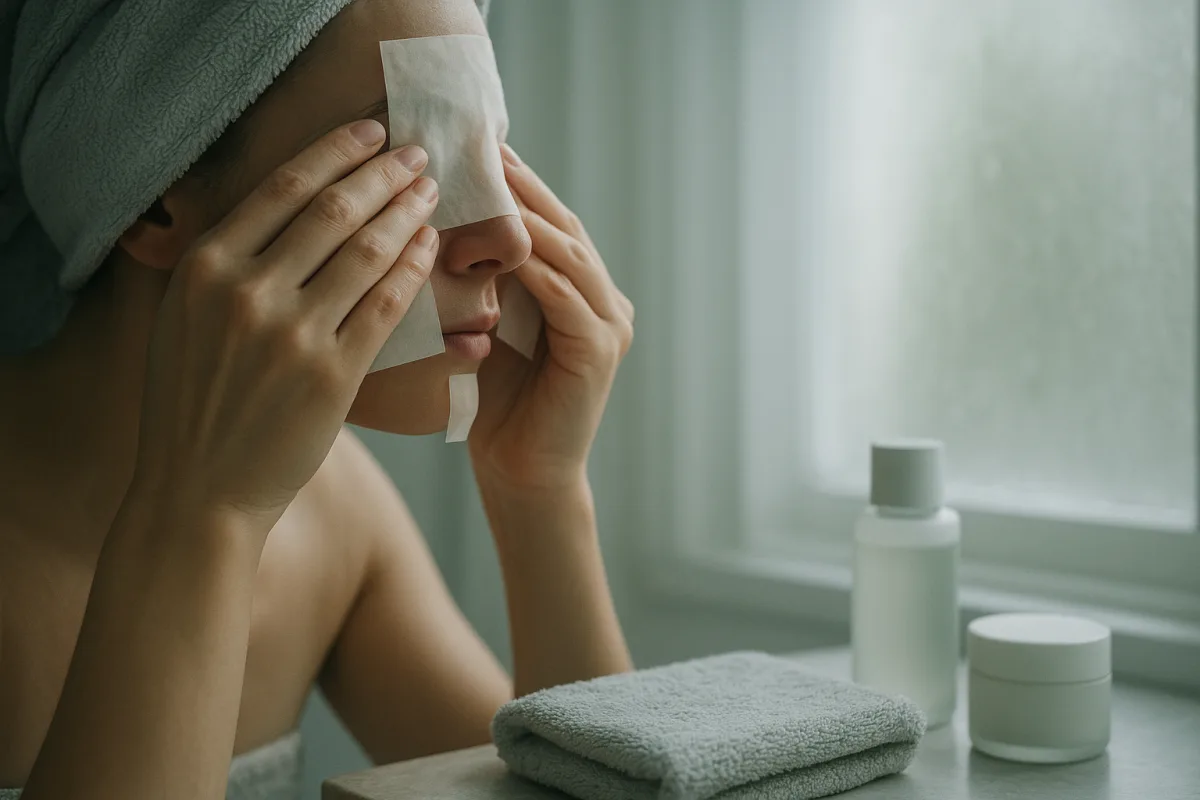
Use blotting paper on another day to check visible oil. NicerSkin recommends doing this two to three hours after washing, ideally around midday, then pressing paper onto the forehead, nose, chin and each cheek. Do not drag it across the skin. [3]
Hold each sheet against light after use. Oil from every area points toward oily skin, while oil mainly from the forehead, nose and chin supports a combination pattern. Very little oil suggests normal skin, and no noticeable oil supports dry skin. [3]
The test measures surface oil, not hydration, and that distinction matters. A face can be oily and still feel dehydrated, particularly in summer, when heat can increase sebum production while sweat and sun exposure contribute to water loss. [6]
Do not repeat the blotting test after a long workout, in extreme heat, or immediately after wearing a heavy base product. Those conditions answer a different question: how your skin behaves under sweat, makeup and weather, rather than its baseline tendency.
If the two tests disagree, believe the pattern, not the label
A shiny forehead with tight cheeks is not a failed test. It is useful evidence that your routine may need to be zoned. Outerderm recommends oil-control products on the T-zone and a richer moisturiser where skin is drier, rather than applying one aggressive treatment everywhere. [5]
For instance, you might use a lightweight moisturiser across the face but add an extra cream layer to cheeks at night. If the T-zone gets oily, keep richer products off that area rather than trying to strip it with a harsh cleanser.
Do not infer that oiliness means you need more acids. Exfoliating acids can improve surface texture in appropriately formulated products, but they can also cause irritation when overused. This home assessment does not tell you that you need a particular active, concentration or treatment plan. [9][12]
Nor does dryness automatically mean your skin needs expensive oils. The more useful question is whether a bland moisturiser leaves your skin comfortable. Combination skin often benefits from applying different amounts of the same moisturiser to different zones before buying multiple specialised products.
Sensitive is a separate note on your results sheet
Sensitive skin is generally better understood as a tendency to sting, burn, itch, flush or become irritated by products and environmental exposures. It can coexist with dry, oily, normal or combination skin. It is not the opposite of oily skin. [21][27]
Also distinguish long-running sensitivity from temporary sensitisation. New irritation after introducing several products, over-cleansing or exfoliating is a reason to simplify your routine, not a reason to declare that your lifelong skin type has changed. [21][28]
A practical reset is a gentle cleanser, simple moisturiser and sunscreen, with no new exfoliants or multiple actives introduced at once. Sources discussing sensitive routines point to soothing, barrier-supportive ingredients such as ceramides, colloidal oatmeal and niacinamide. [21]
Ingredient lists still matter. Niacinamide is not automatically gentle at every concentration or in every formula, and “soothing” is a marketing word, not a diagnosis. Patch testing can help identify a product reaction, but persistent symptoms need medical assessment.
If you have ongoing burning, swelling, cracking, widespread redness, oozing, painful lesions or a rash, book a dermatologist. A quiz or app cannot distinguish skin type from a condition that deserves diagnosis and tailored medical care.
Repeat the assessment when the weather changes
A test done during a cold, dry winter may overstate dryness. Winter conditions can increase transepidermal water loss, which can bring flaking, tightness and sensitivity even to skin that feels balanced during warmer months. [6]
Summer can produce the opposite result. Higher temperatures may increase sebum, while regional temperature and humidity also influence skin characteristics. Research on seasonal variation supports reassessing rather than treating one result as a fixed identity. [5][6][7]
Repeat the bare-faced and blotting-paper checks at the start of winter and summer, or when you move climate. Compare notes only when your cleanser and routine have been stable for several days, otherwise you are mostly measuring product effects.
Give routine changes time. A source on skincare trend mistakes notes that visible changes often take six to 12 weeks, not days. That is a broad expectation, not a promise, and irritation is a reason to stop experimenting rather than wait it out. [10]
Where apps and devices fit, and where they do not
Digital tools can organise observations, but they cannot establish a medical diagnosis or replace a consistent bare-faced assessment. There is no universally accepted low-cost home device in the brief that precisely determines skin type, and consumer results can vary with lighting, photos and algorithms.
SkinInsight AI Skin Analysis App is free and is positioned for skin-type analysis and product guidance. Yuka Skin Care Scanner App is also free, with a reported 4.8-star rating and more than 100,000 users, and is most useful for scanning and reviewing product information rather than measuring your skin. [14][16]
OnSkin Beauty Product Scanner App is free, with a reported 4.7-star rating and roughly 33,000 users. It suits readers who want ingredient and product-scanning support, but an ingredient scan cannot tell whether your cheeks are dry or your forehead is oily today. [17][18]
Boots offers a free AI-powered skin-analysis service that combines a quiz with photo analysis and produces routine suggestions. It may suit someone who wants a structured prompt for observations, but treat the output as shopping guidance, not a verdict. [15][26]
At the pricier end, the FOREO LUNA play smart 2 Skin Analyzer is listed at $199 to $279 and is marketed as measuring oil, elasticity, pores and pigmentation through app connectivity. It suits readers interested in device-led tracking, not anyone seeking clinical precision. [19][20]
Professional-grade research tools can measure sebum and stratum-corneum hydration more objectively. A 2026 Journal of Cosmetic Dermatology validation study examined the SkinConnect Nomadic Multi-Parametric Device for hydration assessment, but that does not make consumer app readings interchangeable with clinical measurement. [23]
The least glamorous method remains the most practical: gentle cleanse, wait, observe each facial zone, blot on a separate day, and revisit your notes when climate or routine changes. It is modest information, but it is enough to stop buying for a skin type you may not have.
Frequently Asked Questions
How do I perform a bare-faced test to identify my skin type at home?
Start by cleansing your face gently with a mild cleanser you tolerate well, using lukewarm water. After washing, do not apply any skincare products and wait for 30 minutes to two hours. Then, observe your skin in natural daylight, noting how different areas (forehead, nose, chin, cheeks, jaw) look and feel without touching them repeatedly. This test gives a snapshot of your skin’s oiliness or dryness but is not a permanent diagnosis.
What is the best way to use blotting paper to check my skin type?
Use blotting paper after your face has been free of products for two to three hours, ideally around midday. Press separate sheets gently onto your forehead, nose, chin, and cheeks. Assess the amount of oil absorbed: oil on all areas suggests oily skin, oil mainly on the T-zone indicates combination skin, little or no oil points to dry skin, and minimal oil suggests normal skin.
How often should I retest my skin type at home?
It is advisable to repeat skin type tests in different seasons because environmental factors like temperature and humidity can alter your skin’s oil and moisture levels. Seasonal changes can cause your skin to behave differently, so retesting helps capture these variations for a more accurate understanding of your skin’s needs.
Can skin type change with seasons and how to test for it?
Yes, skin type can change with seasons. Cold, dry weather tends to increase dryness and sensitivity, while summer heat often increases oil production. To test for seasonal changes, perform the bare-faced and blotting paper tests during different times of the year and compare results by facial zone to track how your skin’s behavior shifts with the climate.
How do I differentiate between oily skin and moisturized skin during testing?
Oily skin typically appears shiny and feels slick, especially in the T-zone, and leaves noticeable oil on blotting paper. In contrast, well-moisturized skin feels comfortable and balanced without excessive shine or oiliness. Avoid confusing tightness from dryness or irritation with lack of oiliness, and remember that the bare-faced test should be done without applying moisturizers to get an accurate oil assessment.
How we researched this
This article was assembled from 28 cited references.
Nothing here is based on hands-on testing. Where a figure or finding appears, it belongs to the source cited beside it, and the writing says so rather than implying otherwise. Every source is listed below so you can check it.
Sources
- Skin Goals: What is My Skin Type? | Skinworks School of Advanced Skincare
- The No BS Guide to Discovering Your Real Skin Type
- How to Determine Your Skin Type: The Complete Guide | NicerSkin
- An Overview of Methods to Characterize Skin Type: Focus on Visual Rating Scales and Self-Report Instruments
- Does Skin Type Change With Season?
- How Seasonal Changes Impact Your Skin (and What to Do About It) - Skin Care Institute
- (PDF) The Effects of Regional Climate and Aging on Seasonal Variations in Chinese Women's Skin Characteristics
- Skin Type Test — Find Your Skin Type in 10 Minutes | Ceruna
- 7 Common Skincare Mistakes (and How to Fix Them) | Sola AI
- Skincare Trends & Predictions for 2026: Ingredients, Routines, AI Skincare & K-Beauty Evolution | predict.skin
- 12 Everyday Skincare Mistakes Behind a Damaged Skin Barrier and Ongoing Irritation
- Common Mistakes With Skincare for a Natural Look (and What to Do Instead) - The Estetica
- The Most Common Skincare Mistakes in 2026 – Bioniva Skincare
- How to Find Your Skin Type — Free AI Test (2026 Guide) | SkinInsight AI
- Boots Skin Analysis Tool creates a bespoke skincare routine in under 2 minutes - I'm sold
- Discover the Yuka App: Your Guide to Clean Beauty Products
- 246+ Best Skin Care Scanner Apps for iPhone (2026) | Free & Paid
- OnSkin App | AIBY
- FOREO LUNA Play Smart 2 Skin Analysis & Facial Cleansing Brush for All Skin Types - Face Massager | Enhances Absorption of Skin Care | Waterproof | Shopee Philippines
- The Complete Guide to Skincare Tools in 2026 Every Device You Need for Glowing Skin – carewellix.com
- So, You Think You Have Sensitive Skin? Here's What Experts Are Desperate for You to Know
- What Skin Type Do I Have? | Determine Your Skin Type | CeraVe
- Validation of the SkinConnect Nomadic Multi‐Parametric Device for Assessing Stratum Corneum Hydration - Flament - 2026 - Journal of Cosmetic Dermatology - Wiley Online Library
- Skin Breaks Out Every Season Change — What’s Actually Different? | 스킨구하리
- Skinsight AI: Korean Skincare
- Boots works with dermatologists to offer free skincare service
- What Is My Skin Type and Why Does It Matter?
- There's a big difference between sensitive and sensitised skin-here are four derms on the key distinctions
Related Articles

How to Identify Your Skin Type: A Practical Beginner's Guide
Learn how to identify your skin type accurately with at-home tests, avoid common mistakes, and understand how it changes over time.
How to Interpret Skin Type Test Results for Skincare
Learn how to interpret skin type test results to understand your skin's needs and choose the right skincare routine.
Transition Skincare for Winter: How to Adjust Your Routine
Learn how to transition skincare for winter with expert tips on adjusting routines, choosing ingredients, and protecting your skin in cold weather.
How to Choose a Sunscreen: SPF, Broad Spectrum & Formulas
Learn how to choose a sunscreen with the right SPF, broad spectrum protection, and formula for your skin type and daily needs.