
How to Choose a Gentle Cleanser for Sensitive Skin
Learn how to choose a gentle cleanser with skin-friendly pH and safe ingredients to avoid irritation and support sensitive skin health.
Start with the problem you are trying to avoid: a cleanser that leaves skin worse
Sensitive skin is not a licence for vague “calming” packaging. The practical issue is whether cleansing leaves you with burning, stinging, tightness, visible flushing or dry, rough-feeling skin shortly afterward.
A cleanser is a rinse-off product, so its effects are usually modest. It can support a more comfortable routine by removing oil and debris without excessive disruption, but it cannot diagnose or resolve persistent rashes, facial swelling or recurrent burning.
If you have ongoing redness, cracking, itch, scaling, hives or painful breakouts, do not attempt to ingredient-list your way to a diagnosis. Those symptoms can overlap with medical skin conditions and deserve assessment from a dermatologist.
The first useful filter is simple: skip products that make your face feel “squeaky clean.” That clean, stripped feeling can reflect removal of too much surface oil and a compromised barrier rather than superior cleansing. [3][11]
Before buying, decide how much cleansing you actually need
The common sensitive-skin mistake is assuming more cleansing means fewer problems. Over-cleansing, particularly more than twice daily, is among the routine habits linked with barrier irritation in guidance collected by Beauty World News, The Estetica and Adonis Skincare. [11][12][13]
For most sensitive skin, begin with one cleanse in the evening. That is when you are most likely removing sunscreen, makeup, pollution and accumulated oil. Morning cleansing can be optional, especially if your skin is dry or reactive. [1]
If you wake up oily, exercise early or use a heavy overnight treatment, a brief morning cleanse may be reasonable. Otherwise, lukewarm water alone may be enough, followed by moisturiser and daytime sun protection as appropriate.
The suggested timing is 30 seconds to one minute, using fingertips and light circular motions. That is consensus-based practical guidance, not a clinical trial result showing that 31 seconds is better than 29. [1]
There is no good reason to scrub harder because your skin feels textured. Abrasive cloths, cleansing brushes and vigorous rubbing add friction, while frequent exfoliation can compound irritation from an already active-heavy routine. [11][12]
The ingredient list: what to screen out first
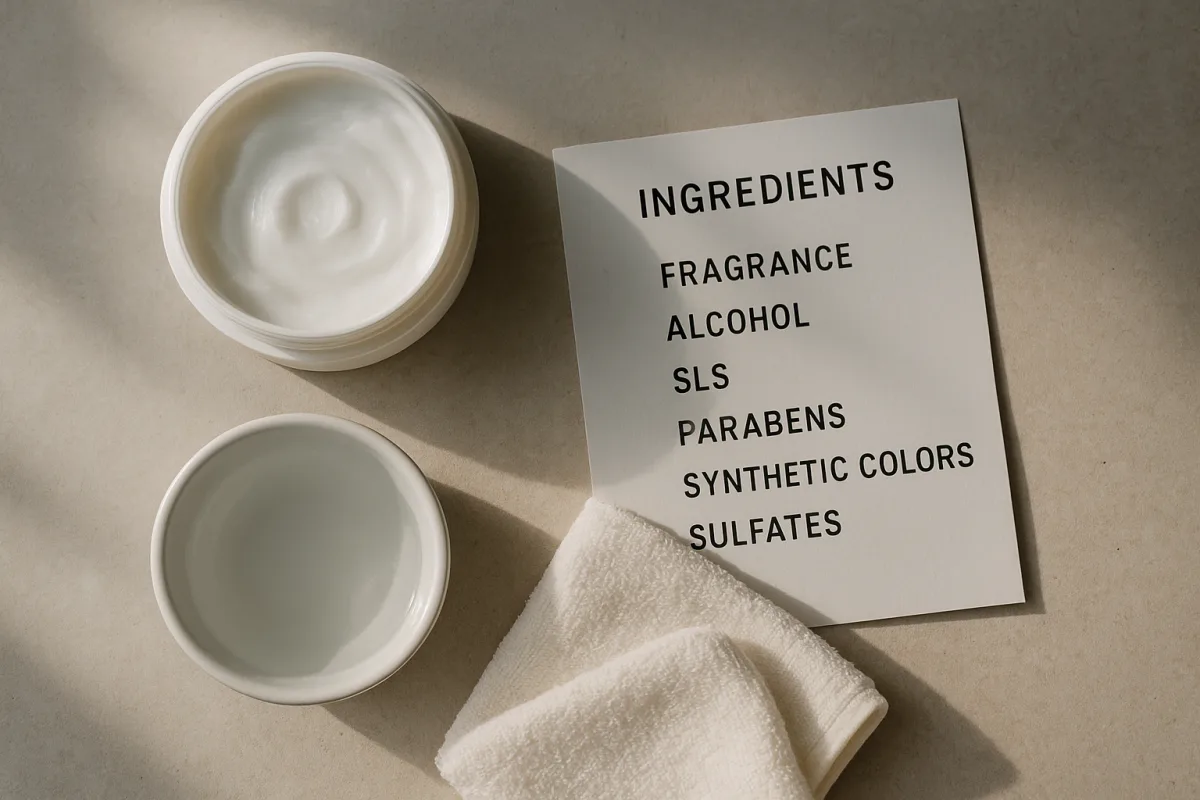
Surfactants are the ingredients that allow cleanser to lift oil and grime away with water. They are necessary, not inherently bad, but a sensitive-skin routine may be better served by avoiding known harsh choices when they have caused problems before.
Dermathub and SkinDetekt specifically flag sodium lauryl sulfate, usually listed as SLS, and sodium laureth sulfate, SLES, as surfactants to approach cautiously in sensitive-skin cleansers. [1][2]
Next, look for denatured alcohol, sometimes written as Alcohol Denat. or SD Alcohol. It is not the same as every alcohol on an ingredient list, but these drying alcohols are among the ingredients Dermathub identifies as potential irritants. [1]
Fragrance is another high-value place to simplify. Avoid added parfum or fragrance if possible, and do not assume an unscented botanical formula is fragrance-free. Essential oils can supply scent just as effectively as conventional fragrance mixtures.
Citrus, mint and cinnamon essential oils are specifically identified as potential irritants for sensitive skin. Menthol, eucalyptus and camphor can also create a cooling or tingling sensation that is not necessarily a sign of soothing. [1][2]
That matters because “tingly” is frequently marketed as fresh or purifying. For reactive skin, it is more useful to interpret tingling as feedback. Stop using a product if it repeatedly stings, and do not try to acclimatise through escalating discomfort.
Be especially wary of the natural-gentle shortcut
Witch hazel is a good example of why ingredient folklore is not a reliable purchasing tool. It is often positioned as a natural toner-like ingredient, but Dermathub flags witch hazel, particularly alcohol-containing versions, as a possible irritant. [1]
The formulation matters. The research brief does not establish a universal concentration at which witch hazel, fragrance or essential oils will irritate everyone. Alcohol content, the wider formula and individual tolerance all change the picture.
Nor does “preservative-free” automatically mean better. The brief flags formaldehyde-releasing preservatives such as DMDM hydantoin and quaternium-15, along with parabens, as ingredients some sensitive-skinned shoppers may wish to avoid. [1][2]
That is a caution, not evidence that every person reacts to every paraben-containing cleanser. Preservatives have a safety role in water-based products. The sensible approach is to choose a short, fragrance-free formula and pay attention to your own repeat reactions.
Do not accidentally buy an exfoliant when you need a cleanser
A face wash labelled “brightening,” “resurfacing” or “pore refining” may be built around acids rather than gentleness. For a sensitive-skin baseline cleanser, keep high-strength actives out of the equation.
The brief advises avoiding AHAs at concentrations of 10% or more, salicylic acid above 2%, and prescription-strength retinoids in a gentle cleanser routine. [1][2] These are not ingredients you need for ordinary daily cleansing.
Acids can have cosmetic uses, including smoothing the appearance of uneven texture, but cleanser contact time is short. Do not expect a rinse-off acid wash to produce dramatic changes, and do not layer it with several other potent leave-on actives.
If you already use retinoids, acids or acne treatments prescribed or recommended by a clinician, choosing a deliberately plain cleanser can make the rest of the routine easier to tolerate. For treatment questions, ask the prescribing dermatologist.
Check pH, but do not turn it into a false promise
A gentle cleanser ideally sits around pH 4.5 to 5.5, close to the skin’s naturally acidic surface environment. NicerSkin cites a British Journal of Dermatology study in support of this range and notes that alkaline cleansing can increase water loss. [3]
The practical benefit is barrier support, not a transformation. A pH-balanced cleanser may be a better bet for people who become dry or tight after washing, but no evidence in the brief proves meaningful long-term differences within every point of that range.
Not every brand publishes pH. If it does, use the number as one selection factor alongside fragrance, surfactant choices and your reaction to the formula. If it does not, do not assume a “balanced” marketing claim is independently verified.
Choose the texture that fits the moment, not a skin-type stereotype
Cream and lotion cleansers are often a sensible first category for skin that feels dry, tight or easily irritated. They can feel less stripping than stronger foaming washes, particularly during colder weather, when water loss can be more noticeable. [9]
Skin Care Institute’s seasonal guidance suggests creamier, ceramide-oriented cleansers in winter and autumn, when dryness is more likely to be the immediate concern. Ceramides in a rinse-off product are not a medical repair treatment, but they fit a barrier-focused formula. [9]
In warmer months, you may prefer a lighter non-comedogenic foam or gel if oiliness increases. Seasonal guidance also points toward hydrating ingredients such as glycerin, hyaluronic acid and ceramides during summer rather than compensating with aggressive degreasing. [9][10]
These are adjustments, not rules. The brief notes limited controlled evidence measuring how seasons change cleanser efficacy. If a cream cleanser leaves sunscreen behind, change the cleansing method or product rather than accepting inadequate removal because it is “gentle.”
Product examples: compare price, size and purpose
Vanicream Gentle Facial Cleanser is the low-cost option in this group: $6.99 to $12.99 for 8 oz, or 237 ml. It suits someone looking for a basic sensitive-skin cleanser without paying for a premium texture or branding story. [14]
La Roche-Posay Toleriane Hydrating Gentle Cleanser costs about $20 for 400 ml. It suits dry or sensitive skin that prefers a hydrating cleanser format, and the larger size may be useful for regular evening cleansing. [[4]](https://www.lookfantastic.cz/la-roche-posay-toleriane-hydrating-gentle-cleanser-400ml/11395381.html?utm_source=openai "La Roche-Posay Toleriane Hydrating Gentle Cleanser 400ml
| Doprava zdarma k dispozici | Lookfantastic")[5]
Cetaphil Gentle Skin Cleanser is listed at about £17 for 473 ml. It suits shoppers who want a larger face-and-body cleanser and prefer a simple, non-specialist format over a smaller dedicated facial product. [15]
Skin+Me Cream Cleanser is about £9, although the available brief does not provide a size. It suits someone specifically seeking a cream-cleanser texture at a lower price, but compare the bottle size before deciding it is the cheaper per-ml option. [6]
Kate Somerville Goat Milk Moisturizing Cleanser is about £39 for 120 ml, or 4 fl oz. It suits a buyer who prefers a more expensive moisturising cleanser format, but it is the costliest option here by volume. [7][8]
Prices are retailer listings rather than universal prices, and availability varies by country. A £17 473 ml cleanser can be better value than a £9 cleanser only if you compare unit size, frequency of use and whether the formula agrees with your skin.
None of these names guarantees compatibility. Sensitive skin is individual, and this article has not physically tested these products. The product positioning and price details above come from retailer and beauty-publication sources, not hands-on assessment. [[4]](https://www.lookfantastic.cz/la-roche-posay-toleriane-hydrating-gentle-cleanser-400ml/11395381.html?utm_source=openai "La Roche-Posay Toleriane Hydrating Gentle Cleanser 400ml
| Doprava zdarma k dispozici | Lookfantastic")[5][6][7][8][14][15]
Use the product in a way that gives it a fair chance
Use lukewarm, not hot, water. Hot water may feel comforting but can aggravate dryness and irritation, while lukewarm water is the technique recommended in sensitive-skin cleansing guidance from Dermathub. [1]
Apply the cleanser with fingertips rather than a rough washcloth. Massage lightly for up to a minute, rinse thoroughly and pat, rather than rub, with a clean towel. Follow with a moisturiser while skin is still slightly damp.
If the cleanser is new, change one product at a time. Introducing a cleanser alongside a new acid, retinoid, serum and sunscreen makes it nearly impossible to identify what caused a reaction.
Finally, do not mistake a cleanser for the whole barrier routine. Skipping moisturiser and sun protection is listed among common habits associated with ongoing irritation, and a gentle wash cannot compensate for an otherwise overactive routine. [11][13]
Ingredient labels are changing, but the basics remain useful
For readers shopping in the European Union, fragrance disclosure rules are due to expand from July 31, 2026, with roughly 80 fragrance substances requiring disclosure. That may make labels easier to interrogate, but fragrance-free remains the simplest route for many reactive skins.
EU restrictions on silicones D4, D5 and D6 in rinse-off products also take effect immediately under the regulatory changes outlined in the brief. This is primarily a formulation and environmental regulatory issue, not proof that silicone-free cleansers are inherently gentler.
In the United States, the EPA Safer Choice Standard assesses ingredient safety and environmental criteria. A certification can be a useful additional signal, but it does not replace reading the full ingredient list or noticing how your skin responds.
The best gentle cleanser is usually unglamorous: appropriate pH where disclosed, no unnecessary scent, no aggressive exfoliating agenda and a routine that does not ask your skin to endure repeated stripping. Results should feel gradual and modest, mostly less tightness and fewer cleansing-related flare-ups.
Frequently Asked Questions
How do I choose a gentle cleanser for sensitive skin?
Select a fragrance-free cleanser with a skin-friendly pH between 4.5 and 5.5 to support your skin’s natural acid mantle. Avoid assuming “natural” means non-irritating; instead, focus on ingredient safety and how your skin reacts. The cleanser should remove impurities without causing burning, stinging, or tightness afterward.
What ingredients should I avoid in a gentle cleanser?
Avoid harsh surfactants like sodium lauryl sulfate (SLS) and sodium laureth sulfate (SLES), denatured alcohols, synthetic fragrances, essential oils (such as citrus, mint, cinnamon), menthol, camphor, witch hazel (especially alcohol-containing), and high concentrations of exfoliating acids. Also steer clear of formaldehyde-releasing preservatives and parabens if they have caused irritation before.
How often should I cleanse sensitive skin?
For most people with sensitive skin, cleansing once daily in the evening is recommended to remove sunscreen, makeup, and daily grime. Morning cleansing is optional and may be skipped unless your skin is oily, you exercise early, or use heavy overnight treatments. Use lukewarm water and cleanse gently for 30 seconds to one minute.
Why is pH important in a gentle cleanser?
A cleanser with a pH of about 4.5 to 5.5 matches the skin’s natural acid mantle, helping maintain barrier integrity and prevent irritation. Using alkaline cleansers can raise skin pH, weaken the barrier, and increase water loss, which may worsen sensitivity and dryness.
What does a gentle cleanser feel like on the skin?
A gentle cleanser should remove impurities without leaving your skin feeling squeaky clean, hot, or persistently tight. These sensations indicate excessive stripping of natural oils and barrier disruption rather than effective cleansing. After rinsing, skin should feel comfortable and not irritated.
How we researched this
This article was assembled from 15 cited references.
Nothing here is based on hands-on testing. Where a figure or finding appears, it belongs to the source cited beside it, and the writing says so rather than implying otherwise. Every source is listed below so you can check it.
Sources
Building a Skincare Routine for Extremely Sensitive Skin: The Complete Guide | SkinDetekt
How to Choose a Facial Cleanser: The Complete Guide for Every Skin Type | NicerSkin
[La Roche-Posay Toleriane Hydrating Gentle Cleanser 400ml
| Doprava zdarma k dispozici | Lookfantastic](https://www.lookfantastic.cz/la-roche-posay-toleriane-hydrating-gentle-cleanser-400ml/11395381.html?utm_source=openai)
7 Best Face Washes for Sensitive Skin That Are Gentle Yet Effective | Allure
Budget to Blowout: These are the three gentle cleansers I rely on, as someone with sensitive skin
The Best Cream Cleansers for Morning Use: 11 Gentle, Hydrating Picks | Who What Wear
Kate Somerville Goat Milk Moisturizing Cleanser (4 fl. oz.) | Dermstore
How Seasonal Changes Impact Your Skin (and What to Do About It) - Skin Care Institute
I'm Updating My Skincare Routine For Spring-and I'm Starting With This Luxury Serum
12 Everyday Skincare Mistakes Behind a Damaged Skin Barrier and Ongoing Irritation
Common Mistakes With Skincare for Sensitive Skin (and How to Fix Them) - The Estetica
Vanicream Gentle Facial Cleanser Pump Dispenser For Sensitive Skin 8 oz (237 ml) | eBay UK
CETAPHIL, Gentle Skin Cleanser For Face & Body 473ml | Watsons Malaysia
Related Articles
How to Choose a Face Scrub for Sensitive Skin Safely
Learn how to choose a face scrub for sensitive skin with gentle ingredients, proper exfoliation frequency, and what to avoid to prevent irritation.

How to Choose a Moisturizer for Combination Skin
Learn how to choose the best moisturizer for combination skin with tips on ingredients, textures, and applying to oily and dry zones effectively.
How to Choose a Toner for Oily Skin
Learn how to choose a toner for oily skin with tips on ingredients, pH, and usage to control shine and avoid irritation.
How to Choose Face Wash for Combination Skin: Key Tips
Learn how to choose a face wash for combination skin with tips on ingredients, pH, and routines to balance oily and dry areas effectively.