How to Determine If a Product Is Cruelty-Free
Learn how to determine if a product is cruelty-free by verifying certifications, understanding supply chains, and spotting authentic logos.
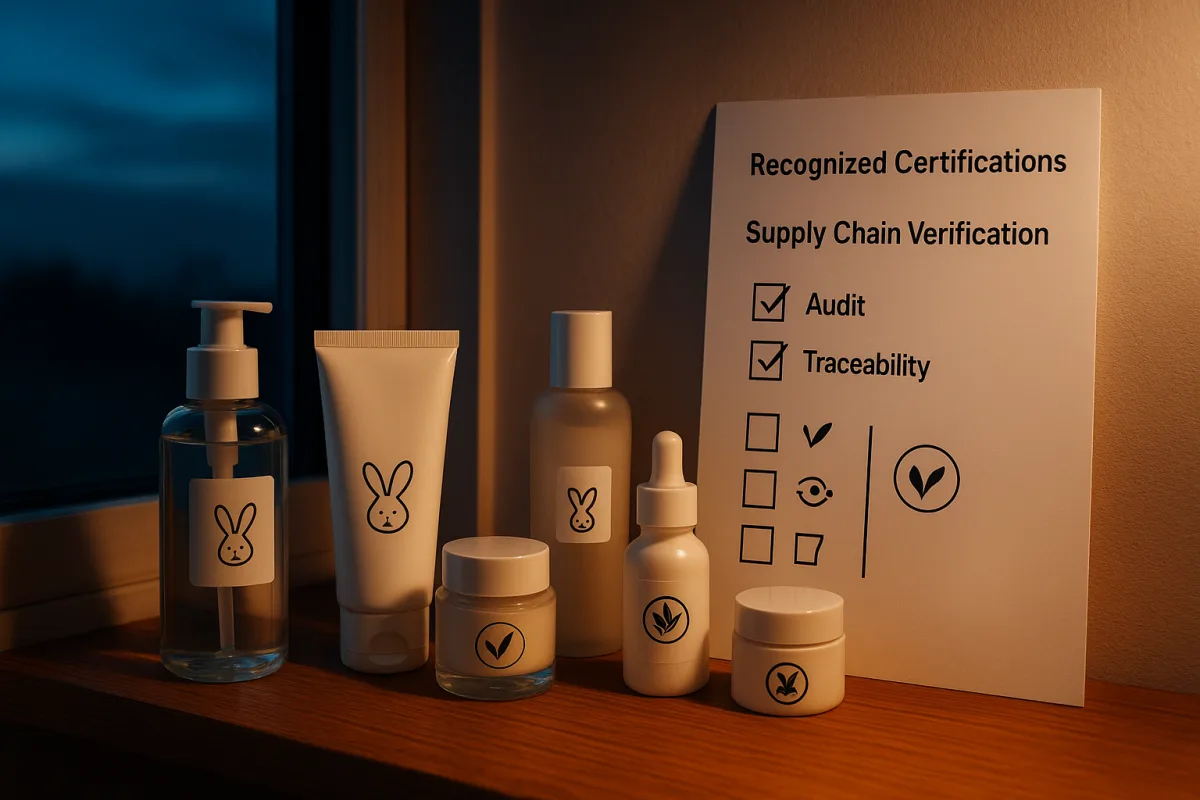
The important question is who controls the testing decision
“Cruelty-free” sounds like a simple product attribute, rather like fragrance-free or oil-free. It is not. In skincare, it is really a claim about a chain of commercial decisions made before a serum reaches your bathroom shelf.
The product brand is only one participant. A formula may involve ingredient manufacturers, raw-material brokers, laboratories, contract manufacturers, distributors, and regulators in the countries where the company chooses to sell.
That is why a brand saying, “We do not test on animals,” can be accurate yet incomplete. The company may not perform testing itself, but an ingredient supplier, an outside laboratory, or a regulatory process may still be involved. [4][8]
The United States Food and Drug Administration does not require cosmetic companies to conduct animal testing. It leaves manufacturers responsible for substantiating product safety, and notes that companies may use animal or non-animal testing methods. [1]
That regulatory position does not create a legal US definition for “cruelty-free.” The phrase can therefore appear on packaging without one universal, government-enforced meaning behind it, which is precisely why certification standards matter. [3][8]
The useful consumer question is not, “Does this jar say cruelty-free?” It is, “What evidence shows that every company able to commission testing for this product has agreed not to do so?”
Certification is a supply-chain control system
The strongest cruelty-free certifications are not simply permissions to print a logo. They are attempts to control the testing practices of an entire supply chain, including businesses a shopper will never see named on a label.
Leaping Bunny, administered through the Coalition for Consumer Information on Cosmetics and Cruelty Free International, is generally treated as the more rigorous of the widely recognised systems. Its model relies on supplier monitoring, declarations, independent audits, and annual renewal. [5][8]
That matters because skincare formulas are assembled from purchased inputs. A brand may buy niacinamide, glycerin, plant extracts, emulsifiers, preservatives, fragrance materials, or packaging from separate suppliers, each with its own records and testing policies.
Under a supply-chain approach, the brand needs declarations from those suppliers covering the relevant materials. The point is to establish that neither a finished formula nor its ingredients have been newly tested on animals for the brand. [5][12]
Documentation can include supplier statements, certificates of analysis, and safety data sheets. These documents are not glamorous, but they are where an ethical claim becomes something closer to an auditable process than a marketing preference. [12]
An audit adds another layer. Rather than merely accepting a brand’s statement, an outside reviewer can inspect whether the company has records, supplier controls, and policies consistent with its certification commitment. Leaping Bunny includes independent audits in its system. [5][8]
Annual renewal matters for the same reason. A cruelty-free position is not permanently secured by one clean year, because suppliers change, formulas are reformulated, companies acquire other companies, and brands enter new markets.
None of this means a certification system can offer metaphysical certainty. It means the claim has a defined rulebook, routine evidence requirements, and consequences if the company cannot continue to meet the standard.
Why PETA and Leaping Bunny are not interchangeable
PETA’s Beauty Without Bunnies programme is also a recognisable signal, and it is substantially more useful than an unverified statement printed by the brand itself. It relies on company assurances and follow-up, but is generally considered less stringent than Leaping Bunny’s audit-centred supply-chain model. [8][16]
That distinction is not an invitation to dismiss a PETA-listed brand. It is a reason to understand what the logo does and does not tell you. Different certifiers set different rules, collect different evidence, and enforce policies with different levels of scrutiny. [8]
If your priority is the most documented assurance available at the checkout, look for Leaping Bunny first. If a brand is listed by PETA but not Leaping Bunny, regard it as a positive data point, then read the brand’s animal-testing policy. [5][16]
A credible policy should cover the finished product, individual ingredients, suppliers, third-party laboratories, and the company’s approach to markets where testing may be required. It should be specific enough that a reader can identify what is included.
A weak policy often uses carefully narrow language. “We do not test our finished products on animals” says nothing about ingredients. “We are against animal testing” is a value statement, not an explanation of contractual controls.
Be equally wary of logos that resemble official marks but belong to the brand itself. A rabbit icon can be decorative branding, a self-created ethical badge, or a recognised certification mark. The image alone is not evidence. [18][19]
Market access can change the answer
The hardest part of cruelty-free verification is often not the cleanser’s formula. It is the brand’s sales strategy. Some certification standards treat a company’s willingness to sell where animal testing is required as incompatible with cruelty-free status. [3][5]
The European Union has bans on animal testing for cosmetic finished products, cosmetic ingredients, and the marketing of cosmetics tested on animals, with the bans introduced in 2004, 2009, and 2013 respectively. [3]
That sounds straightforward, but a European sale does not prove a whole multinational brand is cruelty-free. A company can comply with EU rules while operating under different requirements, policies, or regulatory pathways elsewhere.
China is particularly important because its regulatory framework has changed, rather than simply disappearing as a concern. As of July 2026, many general cosmetics may qualify for exemptions from mandatory animal testing when specified conditions are met. [3]
However, special-use cosmetics and new ingredients can still face testing requirements, and the rules continue to evolve. A blanket statement that every product sold in mainland China is tested, or that none is, is too crude. [3]
For a shopper, the practical point is modest but important: check the certifier’s current listing and the company’s present policy. Do not infer cruelty-free status solely from country of sale, and do not rely on an old blog post.
India is another example of why certainty should not be manufactured from thin public information. Available reporting on cosmetic animal-testing rules remains unclear, so it is sensible to rely on current certification evidence rather than sweeping country-based assumptions. [3]
How to verify a product without becoming a compliance officer
Start with the exact brand, not the retailer’s category filter. Retailers may group products under “clean,” “conscious,” “vegan,” or “responsibly made,” but those labels are not substitutes for a cruelty-free certification standard. [19]
Then search a recognised, current database. Bunny Search is designed to help shoppers find cruelty-free brands, while Cruelty Cutter provides verification guidance and brand-status information. Their listings are useful cross-checks, not infallible global registries. [6][7]
If the brand appears, check which certification or policy supports the listing. A current Leaping Bunny listing answers a different question from a company’s own claim, and a PETA listing represents a different level of verification again. [5][16]
If it does not appear, do not automatically assume wrongdoing. Databases can be incomplete, a small brand may not have sought certification, or a listing may not yet reflect a change in ownership or policy. [6][7]
In that case, read the company’s policy page and look for complete wording. You want explicit coverage of ingredients, suppliers, contract manufacturers, third-party testing, and regulatory requirements, rather than a single sentence about the finished product.
If the wording is vague, email the company with a narrow question: “Do your ingredient suppliers, contract manufacturers, or third parties conduct or commission animal testing for your products or ingredients?” A detailed answer is more informative than a reassurance.
A refusal to name suppliers is not automatically suspicious, since commercial confidentiality is real. But a company can still explain its control system, certification, audit process, and market policy without publishing every supplier contract.
Do not confuse cruelty-free with vegan, clean, or inexpensive
The Vegan Society logo addresses a different, though overlapping, concern. It indicates that a product contains no animal-derived ingredients and is not animal-tested, but vegan status is principally about animal ingredients rather than a complete substitute for cruelty-free supply-chain scrutiny. [8]
“Natural,” “clean,” and “eco-friendly” do not answer the animal-testing question at all. They may describe an ingredient story, an aesthetic, or a brand’s positioning, but they do not establish who tested what, or under whose authority. [19]
Packaging creates similar confusion. A green bottle, botanical illustration, or claim that a component is recyclable may communicate environmental intent, but recyclability depends on local collection and processing infrastructure, not colour palette. [19]
Cruelty-free also does not establish fair labour conditions, responsible agricultural sourcing, or a lower carbon footprint. Those are separate supply-chain questions, and a company can perform well on one while offering little evidence on another. [13]
Price is not a reliable shortcut either. The available comparisons are patchy and usually compare unlike product types. One cited example places a La Roche-Posay moisturiser at roughly $7.39 per ounce and a Kinship serum at roughly $28.24 per ounce. [14][15]
That is not proof that cruelty-free skincare costs four times as much, because moisturiser and serum are not equivalent categories. A serum often costs more per ounce because it is a more concentrated, differently positioned product, regardless of certification.
There may be a price premium for third-party verification, supplier controls, and consumer willingness to pay for ethical claims. But current price evidence is too limited to turn that possibility into a reliable shopping rule. [2][14]
The blunt version is this: certification costs money, but so do prestige packaging, advertising, retailer margins, and high-priced actives. A higher price does not prove a more ethical product, and a lower price does not disprove one.
Why the distinction is worth making
Consumer interest is not trivial. In UK and US research from 2021, 50% of Gen Z consumers said they would refuse to buy from brands that were not cruelty-free. [9]
Yet reported adoption remains limited. About 15% of global cosmetic brands met recognised cruelty-free standards in 2026, while one 2025 analysis estimated that 84.6% of top global beauty brands still funded animal testing. [3][10]
Those figures should be read cautiously because definitions and methods vary, and no complete global database reconciles every certification system. Still, they explain why a familiar beauty name and a credible cruelty-free status do not automatically travel together.
The most practical ethical choice is therefore a boring one: favour a recognised certification, confirm it in a current database, read beyond the front-label claim, and accept that “cruelty-free” answers one precise question rather than every ethical one.
Frequently Asked Questions
How can I verify if a skincare product is truly cruelty-free?
To verify cruelty-free status, look for a recognised certification such as Leaping Bunny and then confirm the brand’s current listing in official databases rather than relying solely on packaging claims. True cruelty-free status means no animal testing by the brand or any suppliers, contractors, or market access arrangements. Independent audits and supply-chain transparency are key elements in verification.
What certifications prove a product is cruelty-free?
Leaping Bunny is generally considered the most rigorous cruelty-free certification, requiring supplier monitoring, declarations, independent audits, and annual renewal. PETA’s Beauty Without Bunnies is another certification but relies more on company self-reporting and is less stringent. Some other certifications, like COSMOS Organic, include animal testing bans but focus on organic standards and are primarily European.
Why is "not tested on animals" not always reliable?
The phrase “not tested on animals” can be misleading if it only applies to the finished product while ingredients, suppliers, or third parties may still conduct animal testing. Without supply-chain controls and certification, such claims do not guarantee that no animal testing occurred anywhere in the product’s development or production.
What is the difference between Leaping Bunny and PETA cruelty-free logos?
Leaping Bunny requires comprehensive supply-chain monitoring, independent audits, and annual renewal, making it a more rigorous and auditable standard. PETA’s Beauty Without Bunnies certification depends more on company self-reporting with follow-ups, so it is generally considered less strict than Leaping Bunny.
How does market availability affect cruelty-free status?
A brand’s presence in markets that legally require animal testing, such as certain product categories in China or India, can affect its cruelty-free certification status. Even if the brand itself does not conduct animal testing, selling in these markets may disqualify it from recognised cruelty-free certifications due to regulatory requirements.
How we researched this
This article was assembled from 19 cited references.
Nothing here is based on hands-on testing. Where a figure or finding appears, it belongs to the source cited beside it, and the writing says so rather than implying otherwise. Every source is listed below so you can check it.
Sources
- Animal Testing & Cosmetics | FDA
- Ethical Appetite: Consumer Preferences and Price Premiums for Animal Welfare-Friendly Food Products
- What Is Cruelty-Free Skincare? Labels vs. Reality - ScienceInsights
- Cruelty-Free Labeling - MSPCA-Angell
- A consumer guide to cruelty-free products | Humane World for Animals
- Verification – Cruelty Cutter
- Bunny Search - Let's Find Cruelty Free Brands
- What Cruelty-Free Labels Truly Mean — JHU Toxicology Policy Lab
- Beauty: Gen Z about buying from non cruelty-free brands 2021| Statista
- 84.6% of Top Brands are Animal Testing in 2025 – Statistics
- Updated list of brands that are not cruelty-free in 2026
- Cruelty Free Cosmetics Manufacturer Guide | ARIS
- Ethically Sourced Skincare Ingredients: 2026 Guide
- 12 Best Cruelty-Free Skincare Brands for Every Bud | Solevere
- Natural Cruelty-Free Skincare For Sensitive Skin – Kinship
- Pledge to Be Cruelty-Free | PETA
- Are Grove’s products cruelty-free? – Grove Collaborative
- Cruelty-Free Labels: Can You Trust Them? | About Animal Testing
- How to spot greenwashing skincare brands in 2026 – Fierce Nature
Related Articles
How to Identify Cruelty-Free Skincare Products
Learn how to identify cruelty-free skincare products using certifications, logos, and tips to avoid misleading claims.
How to Fix Pilling in Skincare: Causes and Solutions
Learn how to fix pilling in skincare with tips on layering, product amounts, and application techniques to prevent product rolling and flaking.
How to Introduce New Skincare Products Safely
Learn how to introduce new skincare products safely with patch testing, gradual use, and tips to avoid irritation and track reactions.
How to Layer Products for Acne-Prone Skin Correctly
Learn how to layer products for acne-prone skin with the right order, timing, and active ingredient use to avoid irritation and maximize results.